 EN
EN

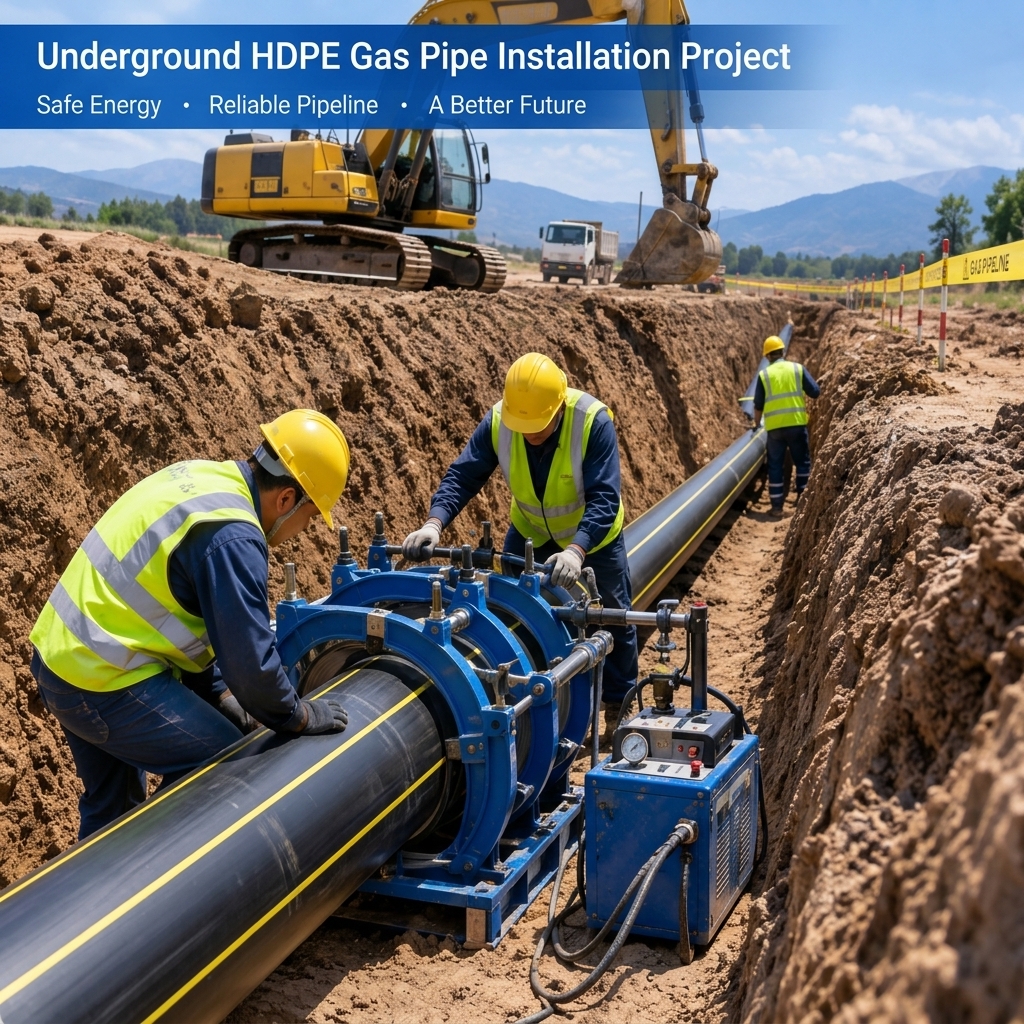
Underneath almost any street built in recent decades, the buried gas mains are likely made of high-density polyethylene (HDPE). Since polyethylene pipes were first used for gas transmission in the 1960s, HDPE gas pipes have become the standard choice for underground natural gas distribution. Today, in North America, Europe, and much of Asia, the highest-performance polyethylene grade—PE100—underlies the vast majority of new gas mains and branch lines. This reputation was earned in the real underground environment, not just in brochures. A buried gas pipeline must operate safely for 50 years or more in moist and chemically corrosive soil, and polyethylene is better suited to this environment than any conventional pipe material. Steel and ductile iron corrode in most soils and require anti-corrosion coatings, cathodic protection, and regular inspections to maintain their service life. In contrast, HDPE gas pipes do not have these weaknesses. They are completely unaffected by corrosion that slowly destroys metal pipes, so utilities that comply with ISO 4437 and ASTM D2513 standards now designate PE pipes as the preferred material for the vast majority of new gas distribution projects.
People's confidence in polyethylene goes far beyond its corrosion resistance. Its joints are fusion-welded, not mechanically assembled. Butt fusion welds pipe sections into a continuous, monolithic material, while electrofusion achieves the same effect on fittings. Therefore, properly manufactured high-density polyethylene (HDPE) gas pipe joints are as strong as the pipe wall itself and contain no gaskets, threads, or mechanical seals that can loosen, age, or leak over time. This is why gas engineers claim that a properly installed PE100 network can practically achieve zero leaks. The material is also worker-friendly: HDPE pipes can bend to fit trench contours and large-radius curves without the need for additional fittings, and possess sufficient flexibility to absorb ground displacement caused by soil settlement, frost heave, and earthquakes—factors that can cause rigid metal pipes to crack or break. Combined with trenchless construction techniques such as horizontal directional drilling, polyethylene has become the lowest-risk, lowest-cost way to deliver gas to communities. These four characteristics explain its dominance: corrosion resistance, leak-free fusion joints, flexibility, and resistance to ground displacement. In the following chapters, we will explore these characteristics one by one from a practical application perspective: what they mean in trenches, underground environments, and during the next 50 years of service.
Why are high-density polyethylene (HDPE) pipes widely used in underground natural gas transmission and distribution systems ?
Before installation, gas engineers must make two decisions that directly impact the lifespan of the pipeline network: material grade and wall thickness. PE (polyethylene) pipes are classified based on their "Minimum Required Strength" (MRS), which is the ability to withstand circumferential stress for 50 years at 20°C (according to ISO 9080). PE80 has an MRS of 8.0 MPa, while PE100 has 10.0 MPa; therefore, with the same wall thickness, PE100 SDR11 gas pipes have higher rated performance and stronger resistance to slow crack propagation—the most critical failure mode for buried gas pipelines. For this reason, PE100 SDR11 gas pipes have become the default configuration for newly built medium-pressure gas main pipelines, while PE80 continues to be used in older low-pressure networks. Material selection and SDR (standard dimension ratio) must also comply with current gas regulations: Europe uses ISO 4437/EN 1555, and North America uses ASTM D2513.
For underground gas transmission and distribution systems, the second decision is wall thickness. SDR (Surface Diameter Ratio) is defined as the ratio of outer diameter to wall thickness, and its pressure rating is calculated using the formula: MOP = 2 × MRS / (C × (SDR − 1)), where MOP is the maximum operating pressure and C is the total utilization factor. The gas industry typically uses C = 2, therefore the rated pressure of a PE100 SDR11 gas pipeline is approximately 10 bar; while SDR17 or SDR17.6 pipelines (thinner walls, lower cost) are suitable for low-pressure transmission and distribution. In addition, two correction factors often overlooked in general articles must be considered. The first is the design factor, which controls the circumferential stress at approximately half of the 50-year strength (C = 2, and the US 49 CFR 192 regulation specifies an upper limit of 0.4) to prevent slow crack propagation during decades of operation. Secondly, there is the temperature derating, since all ratings are based on 20°C: when the temperature is above 20°C, the MOP must be multiplied by the derating factor defined in ISO 4437-5 (up to 40°C); if the derating value is lower than the required working pressure, a pipe with a smaller SDR value must be selected (i.e., the wall thickness must be increased). For medium-pressure main pipelines, the final specification should be PE100 SDR11 gas pipeline, and its SDR, design factor, and temperature derating have all been verified according to current specifications.
Quality control during HDPE natural gas pipeline installation ?
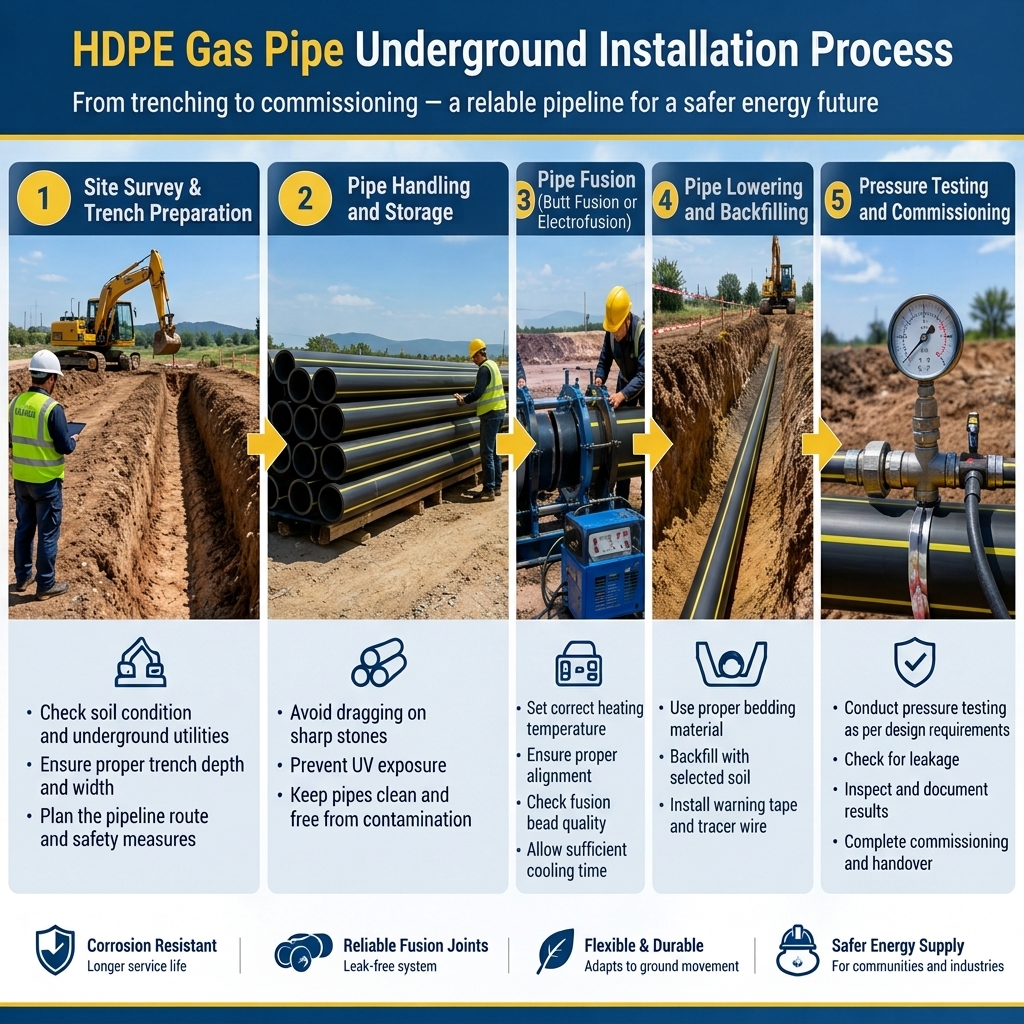
How to ensure the safety of HDPE gas pipeline installation? Quality control focuses on four key aspects, which are often the source of leaks: fusion joints, grooved bedding, pressure testing, and the selection of SDR (Standard Draw Reduction). These problems can be completely avoided through proper operation.
Common installation errors are rampant worldwide. Incorrect welding parameters: Incorrect temperature or heating time can cause joints to appear intact but fail due to long-term ground movement; therefore, welding must be performed strictly according to certified parameter tables. Poor trench bedding: During backfilling, sharp stones and voids can damage the pipe wall; therefore, fine-grained and compacted materials should be used for bedding and backfilling around the pipeline. Insufficient pressure testing: Every pipeline must undergo testing to meet specifications; procedures should never be shortened or steps skipped. Incorrect SDR selection: Before laying the pipeline, the SDR11 or SDR17.6 specification should be selected based on the actual working pressure. By controlling these four key points, the safe and reliable installation of HDPE natural gas pipelines can be ensured.
HDPE gas pipeline installation: A comparison of trenching and trenchless construction ?
The appropriate HDPE gas pipeline installation method should be selected based on site conditions. Open trenching is suitable for conventional underground engineering; horizontal directional drilling (HDD) technology can cross roads and rivers without damaging the surface. HDPE material is naturally suited to trenchless construction requirements: the pipe sections after heat fusion connection remain flexible, allowing them to bend through boreholes and ultimately form a leak-free monolithic pipeline.
|
Method |
Application |
|
Open trench |
Standard underground works |
|
Horizontal directional drilling |
Road crossings, river crossings |
|
Pipe bursting |
Pipe replacement |
Pipe bursting involves breaking up the old main pipe and pulling the new HDPE pipe into the same channel, thus limiting the excavation area to the work pit. New pipeline networks are mostly constructed using trenching, HDD (High-Density Die-Drying) technology is used when crossing obstacles, while pipe replacement often employs bursting. All three methods rely on the inherent advantages of HDPE material—namely, the flexibility and traction of the pipe section, and the strength of the heat-fusion joint being comparable to the pipe wall—which is why HDPE gas pipelines maintain their structural integrity regardless of whether trenching or trenchless installation is used.
Frequently Asked Questions about HDPE Gas Pipes: The Most Frequently Asked Questions by Engineers and Buyers
Q1. What type of HDPE pipe is used for underground natural gas pipelines?
Underground gas main pipelines and user branch pipes use PE80 or PE100 polyethylene pipes (usually yellow or black with yellow stripes) and conform to ISO 4437/EN 1555 standards (ASTM D2513 standard is used in North America). PE100 pipes have a minimum required strength (MRS) of 10 MPa and are the standard choice for newly built medium-pressure pipeline networks: with the same wall thickness, they have higher rated pressure and better resistance to slow crack propagation.
Q2. What SDR (Standard Draw Ratio) is recommended for HDPE gas pipelines?
This depends on the operating pressure. If the gas design factor C = 2, the rated pressure of a PE100 SDR11 gas pipeline is approximately 10 bar; SDR11 is suitable for medium-pressure main pipelines and trenchless construction. For low-pressure networks, thinner-walled and lower-cost SDR17.6 pipelines can be used; if the pipe wall temperature exceeds 20°C, pressure reduction must be performed according to ISO 4437-5 standard.
Q4. Can HDPE gas pipelines be installed using trenchless methods?
Yes. Horizontal directional drilling (HDD) technology is commonly used to install HDPE gas pipelines under roads, rivers, and railways: pipe sections are joined together by thermofusion butt welding and then pulled into the borehole. The pipe's flexibility allows it to conform to the borehole path; the absence of mechanical joints means no leaks occur during traction—something rigid steel pipes cannot do.
Q5. What is the difference between butt fusion and electrofusion?
Both methods can create integral welded joints with strength comparable to the pipe wall, without the need for gaskets or threads. Butt fusion uses a heating plate to heat the pipe ends and press them together—suitable for straight pipe sections and main pipelines, it is fast and economical, but requires a butt fusion machine and trained operators. Electrofusion uses an electric heating wire embedded in the fitting to melt the pipe in situ—suitable for branch connections, maintenance, and work in confined spaces.