 EN
EN

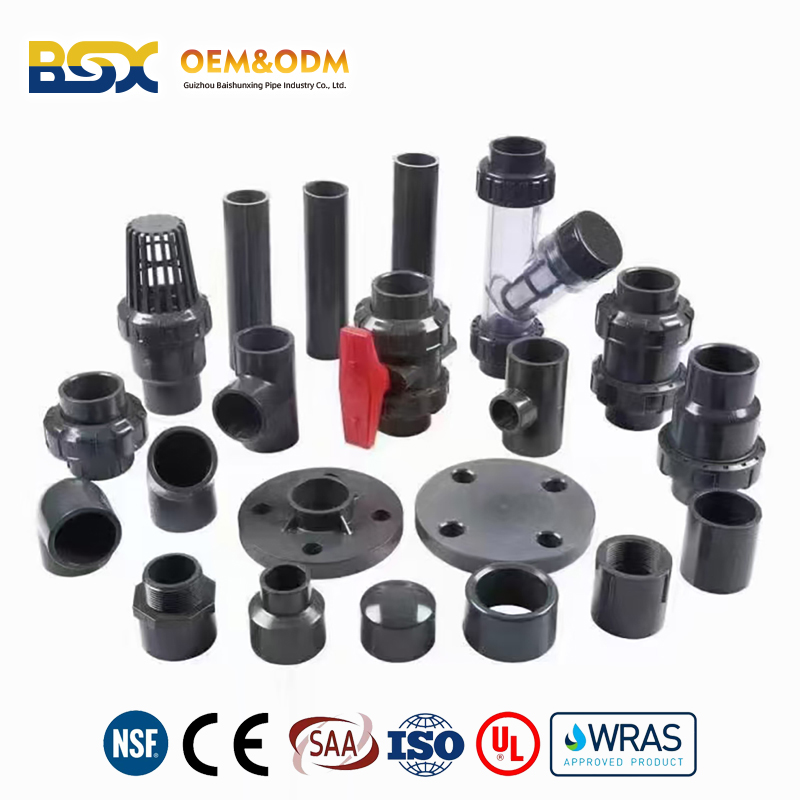
Core PVC Fittings Types and Their Project-Specific Applications
Standard fitting categories: elbows, tees, couplings, reducers, and adapters
PVC fittings are essential components in modern piping systems, providing reliable connections, directional control, and size transitions across residential, commercial, and industrial applications. Selecting the correct fitting type is critical for maintaining hydraulic performance, installation efficiency, and long-term system reliability.
The most common PVC fitting categories include elbows, tees, couplings, reducers, and adapters, each designed for a specific connection requirement.
Elbows are used to change the direction of a piping system, typically available in 45° and 90° configurations. Their smooth internal surfaces help maintain efficient flow while minimizing turbulence and pressure loss.
Tees create branch connections within piping networks. Standard tees are commonly used in pressure piping systems, while sanitary tees are designed specifically for drainage, waste, and vent (DWV) applications. Their curved branch design helps improve flow direction and reduce turbulence in gravity drainage systems.
Couplings connect two pipes of the same nominal size and are widely used for extending pipelines or repairing existing systems. PVC couplings are typically joined through solvent cement connections or threaded designs depending on application requirements.
Reducers allow transitions between different pipe diameters. Proper reducer selection helps maintain flow efficiency while avoiding unnecessary pressure losses caused by abrupt size changes.
Adapters enable connections between PVC piping and other components, including threaded fittings, valves, or approved transition assemblies. They are commonly used in system modifications, equipment connections, and retrofit projects.
For contractors, distributors, and bulk buyers, selecting the correct PVC fittings supplier ensures consistent dimensions, reliable material performance, and reduced installation risks across large-scale projects.
DWV vs. Pressure-Rated PVC Systems: Selecting the Right Fittings for Each Application
PVC piping systems are generally divided into two major categories: drainage, waste, and vent (DWV) systems and pressure-rated systems. Each requires fittings designed according to different performance requirements.
DWV PVC fittings
DWV systems operate primarily through gravity flow and are commonly used in residential and commercial drainage applications, including:
- Bathroom drainage
- Kitchen waste lines
- Vent stacks
- Building drainage systems
DWV fittings are typically manufactured according to standards such as ASTM D2665, which defines requirements for PVC plastic drain, waste, and vent pipe and fittings.
These fittings are designed with smooth internal passages and appropriate geometry to support efficient gravity drainage and reduce flow restrictions.
Pressure-rated PVC fittings
Pressure-rated PVC fittings are designed for systems where internal pressure is continuously applied, including:
- Industrial process piping
- Irrigation systems
- Water distribution
- Chemical handling applications
Common pressure-rated fitting standards include:
- ASTM D2466 for Schedule 40 PVC fittings
- ASTM D2467 for Schedule 80 PVC fittings
Compared with DWV fittings, pressure-rated fittings feature stronger mechanical performance and are tested for hydrostatic pressure resistance.
When selecting PVC fittings for a project, engineers and procurement teams should verify:
- Pressure rating
- Temperature limitations
- Material compatibility
- Applicable ASTM standards
- Local plumbing code requirements
Using fittings outside their intended service conditions may result in leaks, premature failure, or compliance issues.
PVC Fittings Sizing and Schedule Compatibility for Code-Compliant Bulk Orders
Avoiding IPS and CTS mismatches in large-volume procurement
Accurate sizing is one of the most important factors in bulk PVC fittings procurement. Dimensional inconsistencies can lead to installation problems, rejected shipments, and costly project delays.
Most North American PVC pressure piping systems use IPS (Iron Pipe Size) dimensions. Under the IPS system, nominal pipe size corresponds to a standardized outside diameter (OD).
For example:
- 1-inch IPS PVC pipe has an outside diameter of approximately 1.315 inches.
However, CTS (Copper Tube Size) follows different dimensional standards and is commonly associated with CPVC tubing rather than standard PVC pressure piping.
For example:
- 1-inch CTS tubing has an outside diameter of approximately 1.125 inches.
Because the dimensional difference affects socket engagement and solvent welding performance, mixing IPS and CTS components can cause improper connections and potential leakage.
For wholesale PVC fittings orders, procurement documents should clearly specify:
- Pipe sizing system (IPS, CTS, or other)
- Nominal diameter
- Schedule designation
- Applicable ASTM standards
Before shipment, professional PVC fittings manufacturers should provide dimensional drawings, product specifications, and quality documentation to ensure compatibility with project requirements.
Schedule 40 vs. Schedule 80 PVC Fittings: Selecting Based on Pressure Requirements
Schedule selection directly affects the mechanical strength, pressure capability, and application suitability of PVC fittings.
Both Schedule 40 and Schedule 80 PVC fittings generally share the same outside diameter dimensions, allowing compatibility with corresponding pipe sizes. However, their wall thickness and pressure ratings differ.
Schedule 40 PVC fittings
Schedule 40 fittings are commonly selected for:
- Residential plumbing applications
- Irrigation systems
- General low-to-medium pressure applications
They provide a balance between cost efficiency and reliable performance.
Schedule 80 PVC fittings
Schedule 80 fittings feature thicker walls and higher pressure capabilities, making them suitable for:
- Industrial piping systems
- Chemical processing applications
- Higher-pressure water systems
- Applications requiring enhanced mechanical strength
Typical pressure ratings vary depending on:
- Fitting diameter
- Operating temperature
- Manufacturer design
- Applicable standards
The following values are commonly referenced for PVC pressure products at 73°F:
| Nominal Size | Schedule 40 | Schedule 80 |
|---|---|---|
| 1 inch | Up to approximately 450 psi | Up to approximately 630 psi |
| 2 inch | Up to approximately 280 psi | Up to approximately 400 psi |
| 4 inch | Up to approximately 220 psi | Up to approximately 320 psi |
Actual fitting pressure ratings should always be confirmed through manufacturer-certified technical data sheets.
For bulk PVC fittings procurement, choosing between Schedule 40 and Schedule 80 should be based on:
- System design pressure
- Chemical exposure
- Temperature conditions
- Installation environment
- Applicable regulations
Optimizing Bulk Procurement of PVC Fittings: Cost, Lead Time, and Quality Control
Total cost of ownership: Beyond unit price considerations
For large-scale PVC fittings purchases, the lowest unit price does not always represent the best overall value. Total cost of ownership includes:
- Product pricing
- Transportation expenses
- Inventory management
- Quality control costs
- Potential replacement expenses
Freight efficiency plays an important role in international PVC fittings sourcing. Container utilization, pallet optimization, and shipment planning can significantly affect the final landed cost.
Inventory management is equally important. Excess stock may increase storage costs and expose products to unnecessary environmental risks, while insufficient inventory can result in production delays and urgent replacement orders.
A reliable PVC fittings supplier should provide:
- Stable production capacity
- Consistent delivery schedules
- Professional export experience
- Quality documentation
- Responsive technical support
Quality control is another critical factor in bulk procurement. Even a small defect rate can create significant project costs when thousands of fittings are involved.
For example, a 2% defect rate in a 50,000-piece order could result in 1,000 non-conforming fittings requiring replacement, inspection, and additional labor.
Professional suppliers should implement inspection procedures based on recognized sampling standards such as:
- ANSI/ASQ Z1.4
- ISO 2859-1
Combining competitive pricing, efficient logistics, and strict quality management helps optimize long-term procurement value.
Ensuring Code Compliance and Supplier Reliability for Large-Scale PVC Fittings Orders
For commercial construction, industrial projects, and infrastructure applications, code compliance is a fundamental requirement.
PVC fittings should be manufactured using materials and processes that meet applicable industry standards, including:
- ASTM D1784 – PVC compound classification
- ASTM D2466 – Schedule 40 PVC fittings
- ASTM D2467 – Schedule 80 PVC fittings
- ASTM D2665 – PVC DWV fittings
- NSF/ANSI 61 or NSF/ANSI 372 – potable water applications where applicable
Depending on project requirements and location, products may also require certification or listing from organizations such as:
- IAPMO
- UL
- CSA
Reliable PVC fittings manufacturers should provide:
- Product certifications
- Material traceability
- Batch identification
- Inspection reports
- Technical documentation
A strong quality management system, such as ISO 9001 certification, demonstrates that manufacturing processes are controlled and consistently monitored.
For international buyers and distributors, choosing a verified PVC fittings supplier reduces risks related to product quality, customs compliance, project delays, and installation failures.
FAQ
What are the main types of PVC fittings?
The main types of PVC fittings include elbows, tees, couplings, reducers, and adapters. Each fitting type serves a specific purpose, including directional changes, branch connections, pipe extensions, size transitions, and equipment connections.
What is the difference between DWV and pressure-rated PVC fittings?
DWV PVC fittings are designed for gravity drainage systems and follow standards such as ASTM D2665. Pressure-rated PVC fittings are manufactured for systems containing internal pressure and commonly follow ASTM D2466 or ASTM D2467 requirements.
How can I avoid IPS and CTS mismatches when purchasing PVC fittings?
Always confirm the required sizing system before ordering. Most PVC pressure systems use IPS dimensions, while CTS sizing is commonly associated with CPVC tubing. Reviewing product specifications and dimensional drawings before shipment helps prevent compatibility issues.
What is the difference between Schedule 40 and Schedule 80 PVC fittings?
Schedule 40 PVC fittings are commonly used for general-purpose applications where moderate pressure performance is sufficient. Schedule 80 fittings have thicker walls and higher pressure ratings, making them suitable for more demanding industrial applications.
How can I ensure quality when buying PVC fittings in bulk?
Choose a manufacturer that provides quality certifications, inspection reports, material traceability, and consistent production control. Bulk buyers should also use recognized inspection procedures such as ANSI/ASQ Z1.4 or ISO 2859-1.
What certifications should PVC fittings have?
Depending on the application, PVC fittings may require compliance with ASTM standards such as ASTM D2466, ASTM D2467, ASTM D2665, and material classification requirements under ASTM D1784. Potable water applications may also require NSF/ANSI certifications.
Table of Contents
- Core PVC Fittings Types and Their Project-Specific Applications
- Standard fitting categories: elbows, tees, couplings, reducers, and adapters
- DWV vs. Pressure-Rated PVC Systems: Selecting the Right Fittings for Each Application
- DWV PVC fittings
- Pressure-rated PVC fittings
- PVC Fittings Sizing and Schedule Compatibility for Code-Compliant Bulk Orders
- Avoiding IPS and CTS mismatches in large-volume procurement
- Schedule 40 vs. Schedule 80 PVC Fittings: Selecting Based on Pressure Requirements
- Schedule 40 PVC fittings
- Schedule 80 PVC fittings
- Optimizing Bulk Procurement of PVC Fittings: Cost, Lead Time, and Quality Control
- Total cost of ownership: Beyond unit price considerations
- Ensuring Code Compliance and Supplier Reliability for Large-Scale PVC Fittings Orders
- FAQ
- What are the main types of PVC fittings?
- What is the difference between DWV and pressure-rated PVC fittings?
- How can I avoid IPS and CTS mismatches when purchasing PVC fittings?
- What is the difference between Schedule 40 and Schedule 80 PVC fittings?
- How can I ensure quality when buying PVC fittings in bulk?
- What certifications should PVC fittings have?