 EN
Introduction
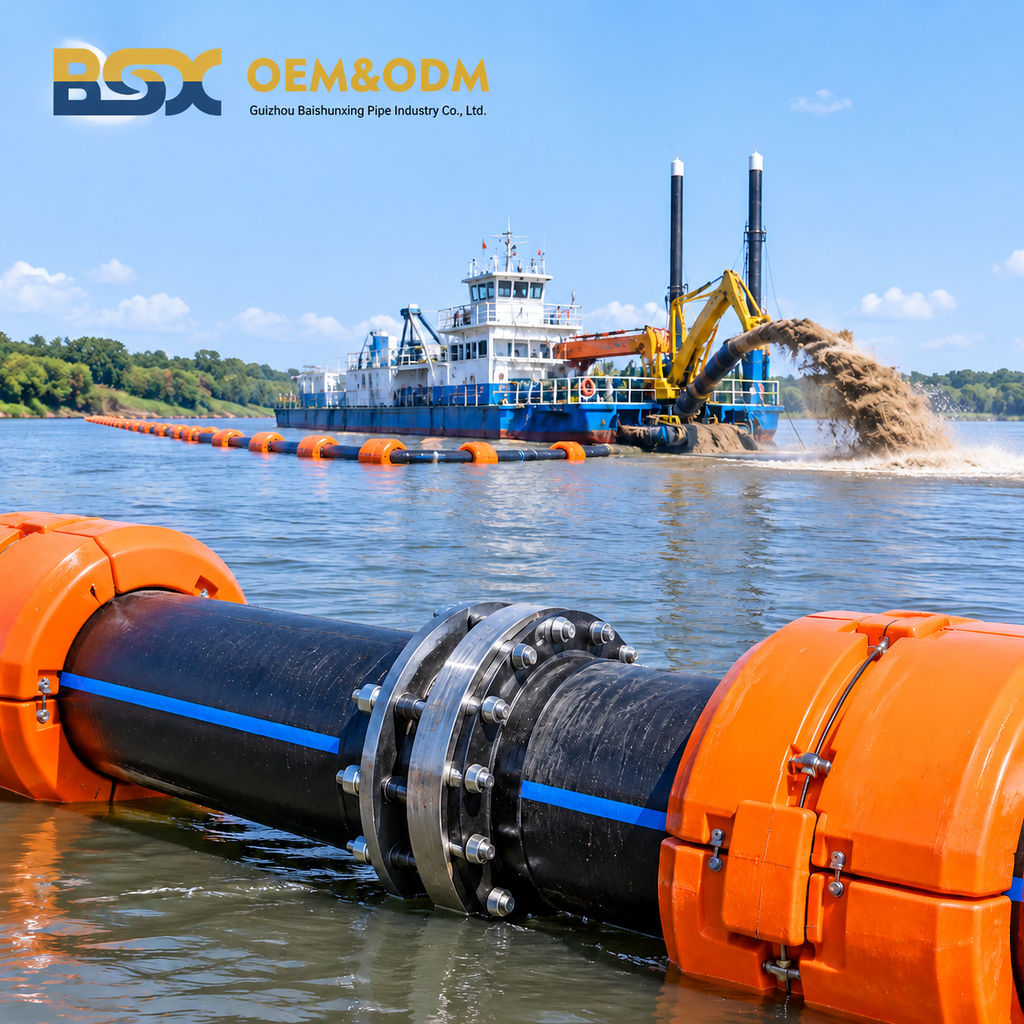
River desludging projects are essential for maintaining water flow, reducing sediment
accumulation, and improving navigation and water storage capacity. These projects involve
removing accumulated mud, silt, sand, and other sediments from riverbeds and transporting the dredged material to designated disposal or reclamation areas.
An efficient pipeline system is an important part of this process. HDPE pipes are widely
considered for river desludging because they are lightweight, corrosion-resistant, flexible, and suitable for transporting different types of slurry.
However, choosing the right HDPE pipe requires careful consideration of sediment
characteristics, pumping capacity, transportation distance, operating pressure, and installation conditions.
A poorly selected pipeline can experience excessive wear, pressure problems, sediment settling, or connection failures.
This guide explains how to select, configure, and install HDPE pipes for river desludging projects.
Why Use HDPE Pipes for River Desludging?
High-density polyethylene (HDPE) is a thermoplastic material commonly used in industrial fluid transportation and dredging applications.
Its mechanical properties make it suitable for many demanding environments where
conventional metal pipelines may experience corrosion, heavy handling requirements, or maintenance challenges.
The main advantages include:
Corrosion Resistance
River water may contain dissolved minerals, organic matter, and other substances that can affect conventional metal pipelines.
HDPE does not rust like steel, making it a practical option for transporting river water and sediment mixtures.
Abrasion Resistance
Desludging pipelines transport materials such as sand, silt, and fine gravel. These particles can gradually wear the internal pipe surface.
HDPE offers good abrasion resistance and toughness, although actual wear depends on particle size, concentration, flow velocity, and pipeline configuration.
Lightweight Construction
HDPE pipes are generally easier to transport and handle than comparable steel pipes.
Their relatively low weight can simplify installation, relocation, and assembly in river environments where access for heavy equipment may be limited.
Flexibility and Impact Resistance
River projects often involve changing water levels, currents, and uneven installation conditions.
HDPE's flexibility helps accommodate certain movements and installation requirements. However, adequate anchoring and support remain necessary.
How to Select the Right HDPE Pipe for River Desludging
Selecting the correct pipe involves evaluating the material being transported and the hydraulic requirements of the project.
Understand the Sediment Characteristics
The first step is identifying the material that will pass through the pipeline. River sediments may include:
● Fine silt and clay.
● Sand and fine gravel.
● Organic sediment.
● Mixed mud and water.
● Other abrasive particles.
Different sediment types create different transportation challenges.
For example, fine mud may produce a relatively viscous slurry, while sand-containing mixtures can create greater abrasion and particle-settling concerns.
Particle size distribution and solids concentration should be evaluated before choosing the pipe diameter and operating flow conditions.
Select the Appropriate Pipe Diameter
Pipe diameter directly affects transportation capacity, water velocity, and pumping requirements.
A larger diameter can reduce flow resistance at a given flow rate, but it may also increase the cost of the pipeline and require a different pumping configuration.
A smaller diameter can increase velocity, but excessive velocity may increase friction losses and abrasive wear.
The final diameter should be calculated using:
● Required slurry transportation volume.
● Pump discharge capacity.
● Sediment particle characteristics.
● Pipeline length.
● Acceptable pressure losses.
● Minimum transport velocity.
The Plastics Pipe Institute'sHandbook of Polyethylene Pipe – Hydraulic Design and Slurry Flow provides technical guidance on polyethylene pipe hydraulics, slurry transportation, particle size, and critical flow velocity.
This information is useful when evaluating the relationship between pipe diameter, slurry characteristics, and pumping performance.
Choose the Correct SDR and Pressure Rating
SDR represents the relationship between the pipe's outside diameter and wall thickness. A lower SDR generally indicates a thicker pipe wall for the same outside diameter.
For river desludging, pipe wall thickness should be selected according to operating pressure, pressure surges, sediment characteristics, and expected service conditions.
Common HDPE pipe configurations include SDR17, SDR13.6, SDR11, and SDR9.
However, the appropriate configuration should not be selected from SDR alone. Engineers must also consider material grade, pressure rating, temperature, and applicable product standards.
The pipeline should be designed for the maximum expected operating and transient pressure.
Consider Transportation Distance and Pumping Requirements
Long-distance river desludging requires careful hydraulic planning.
As pipeline length increases, friction losses can become significant. Changes in elevation, bends, valves, and fittings also influence the total pumping head.
For longer routes, engineers may need to evaluate booster pump stations to maintain the required slurry transportation conditions.
TheFederal Remediation Technologies Roundtable's Environmental Dredging Technology
Screening Matrix explains hydraulic transport of dredged sediment through pipelines, including floating and submerged configurations and the potential use of booster pumps.
This is particularly relevant when designing pipelines for large river restoration and sediment removal projects.
Floating vs Submerged HDPE Pipelines
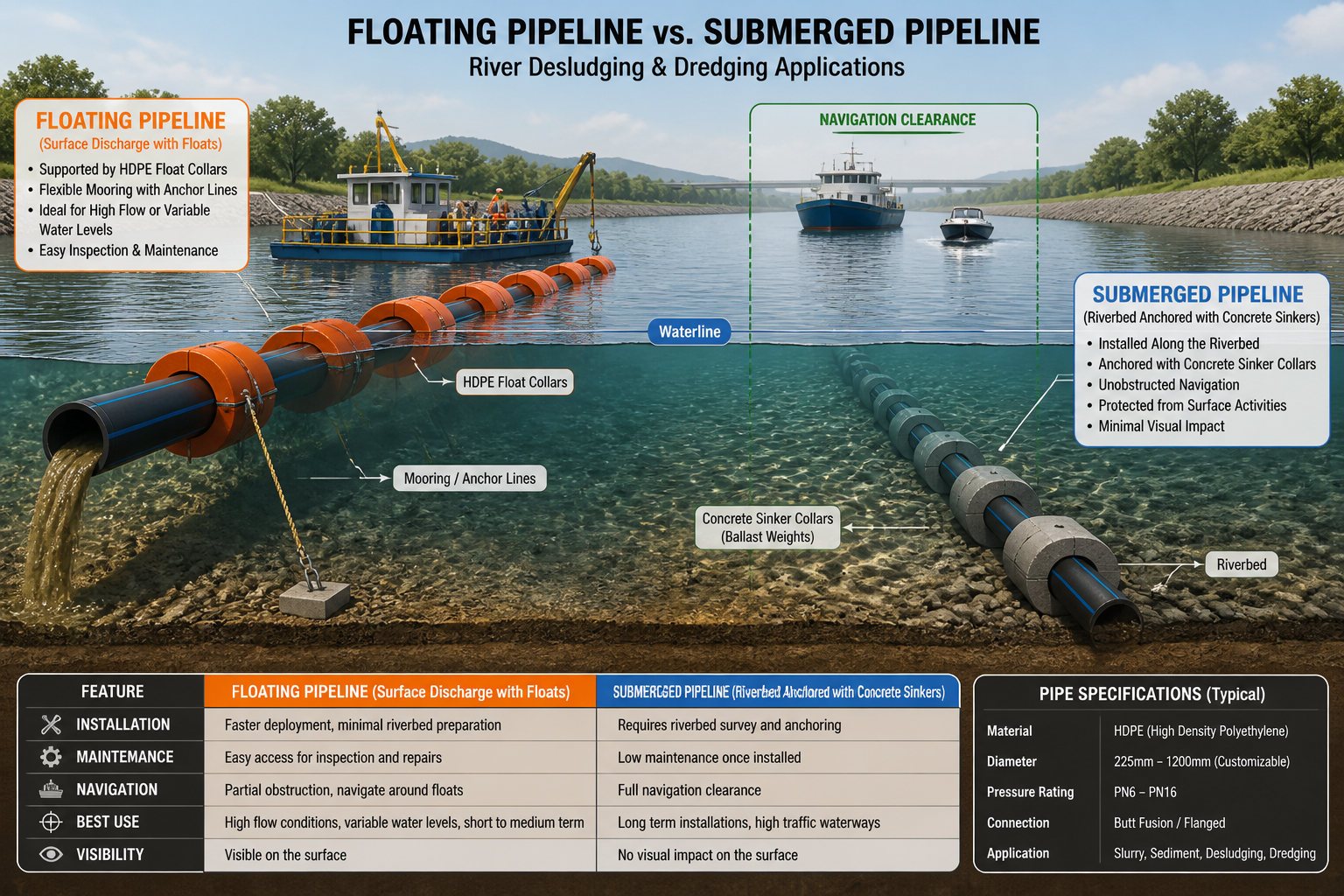
River desludging projects generally use floating or submerged pipeline configurations, depending on the site layout and operational requirements.
Floating HDPE Pipelines
Floating pipelines transport slurry across the water surface.
They are useful when dredged material must be discharged along a route that crosses a river or waterway.
Typical components include:
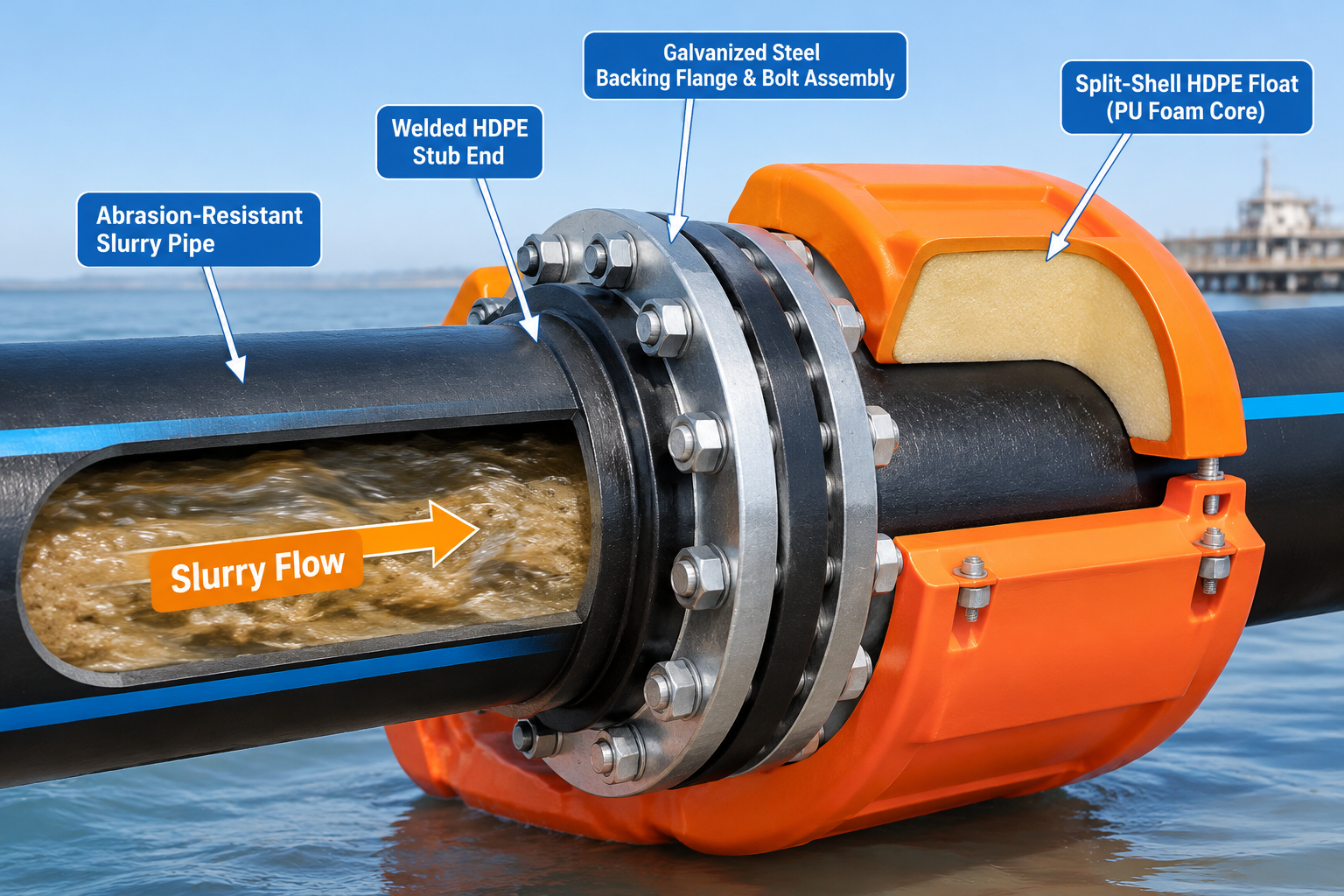
● HDPE dredging pipes.
● External pipe floats.
● Steel backing flanges.
● Bolted connections.
● Suitable anchoring and restraint systems.
The flotation capacity must support the complete operating load, including the pipe, slurry, and accessories.
Engineers should also account for river currents, wind, changing water levels, and vessel movement.
Submerged HDPE Pipelines
Submerged pipelines are installed below the water surface, sometimes resting on the riverbed or following a designated underwater route.
They can be useful when surface navigation must remain relatively unobstructed.
However, submerged pipelines require suitable buoyancy control, anchoring, and protection against external damage.
The design must consider riverbed conditions, water depth, current forces, and possible movement caused by changing flow conditions.
How to Set Up an HDPE River Desludging Pipeline
Proper installation is essential for reliable operation.
Inspect the Project Site
Before installation, assess the river's depth, width, current speed, water levels, access points, and sediment disposal location.
Identify potential obstacles such as existing utilities, navigation routes, bridges, and sensitive environmental areas.
Prepare the Pipeline Route
Plan the shortest practical route that satisfies operational and environmental requirements.
Avoid unnecessary bends and sharp directional changes because they can increase hydraulic losses and create areas of concentrated particle impact.
Where directional changes are necessary, use appropriately engineered fittings and wear-resistant components.
Connect HDPE Pipe Sections
Butt fusion creates a permanent connection between compatible pipe ends, while flanged connections allow sections to be assembled and dismantled more easily.
Floating pipeline sections often use flanges and steel backing rings to support modular assembly.
The selected joining method should match the project requirements and manufacturer's instructions.
Install Floats or Submerged Supports
For floating systems, install floats according to the calculated buoyancy requirements and approved spacing.
For submerged systems, use suitable weights, restraints, or anchoring arrangements where required.
The support configuration should prevent excessive movement without creating damaging loads on the pipe.
Inspect and Test Before Operation
Before starting dredging, inspect all pipe sections, connections, flanges, and support equipment. Conduct the required pressure or leak testing using an approved procedure.
Start the pumping system gradually and monitor discharge pressure, flow conditions, and signs of leakage.
Regular inspection during operation helps identify developing problems before they cause significant downtime.
Common Mistakes in River Desludging Pipeline Projects
Several mistakes can reduce pipeline efficiency and increase maintenance costs.
Choosing an undersized pipe: Excessive flow resistance can increase pumping requirements.
Ignoring sediment characteristics: Different particle sizes and concentrations require different transportation conditions.
Selecting an unsuitable SDR: Insufficient wall thickness or pressure capacity can create operational risks.
Ignoring pipeline anchoring: Floating and submerged lines may move under current and wave forces.
Using unsuitable connections: Poorly assembled joints can cause leakage and unexpected shutdowns.
Neglecting maintenance: Abrasion, damaged floats, loose bolts, and sediment buildup shoul be checked regularly.
Careful planning and routine inspection can improve the reliability of the complete dredging system.
Choosing an HDPE Pipe Supplier for River Desludging
A reliable supplier should provide suitable pipe materials, dimensional options, pressure rating and connection configurations.
BSX Pipe offers HDPE dredging pipes manufactured using PE100, PE4710, and PE100RC materials.
Its product information includes DN50mm to DN1000mm diameter options, different SDR configurations, and flange connection arrangements.
Buyers can explore theBSX HDPE Dredging Pipe range for product specifications and application information.
For projects requiring floating or underwater pipeline configurations, theBSX HDPE Floating Dredging Pipeline provides additional product details.
When requesting a quotation, provide the required pipe diameter, SDR, slurry characteristics, pumping capacity, transportation distance, and installation method.
These details help the supplier assess the application and identify suitable pipeline configurations.
Conclusion
HDPE pipes offer practical advantages for river desludging projects because of their corrosion resistance, flexibility, lightweight construction, and abrasion resistance.
However, successful performance depends on selecting the correct diameter, SDR, pressure rating, and connection system.
Engineers should also evaluate sediment characteristics, slurry velocity, pumping requirements, pipeline route, and whether floating or submerged installation is more suitable.
A properly designed HDPE pipeline system, supported by appropriate installation procedures and regular inspection, can help improve the efficiency and reliability of river sediment removal operations.
FAQ
Why are HDPE pipes used for river desludging projects?
HDPE pipes are used because they offer corrosion resistance, good abrasion resistance, flexibility, and relatively easy transportation and installation. They are suitable for many river sediment and slurry transportation applications.
How do I select the correct HDPE pipe diameter for river dredging?
The diameter should be determined by slurry flow rate, sediment particle size, solids
concentration, pipeline length, and acceptable friction losses. Pumping requirements must also be considered.
Should river desludging pipelines be floating or submerged?
The choice depends on river depth, navigation requirements, water currents, pipeline route, and project layout. Floating systems are useful for surface transportation, while submerged systems can help keep navigation routes clear.
Which SDR is suitable for HDPE river dredging pipes?
The appropriate SDR depends on operating pressure, pressure surges, material grade, pipe diameter, and expected wear conditions. Engineering calculations and manufacturer
specifications should guide the selection.
How can pipeline blockages be prevented during river desludging?
Maintain a suitable slurry transportation velocity, monitor solids concentration, avoid
unnecessary bends, and follow an appropriate flushing procedure before shutdown where the system design allows it.
Table of Contents
- Introduction
- Understand the Sediment Characteristics
- Select the Appropriate Pipe Diameter
- Floating vs Submerged HDPE Pipelines
- How to Set Up an HDPE River Desludging Pipeline
- Prepare the Pipeline Route
- Common Mistakes in River Desludging Pipeline Projects
- Choosing an HDPE Pipe Supplier for River Desludging
- Conclusion
- FAQ