 EN
What SDR Means for HDPE Pipe Strength and Pressure Capacity
How SDR Defines Wall Thickness Ratio and Directly Governs Hydrostatic Strength
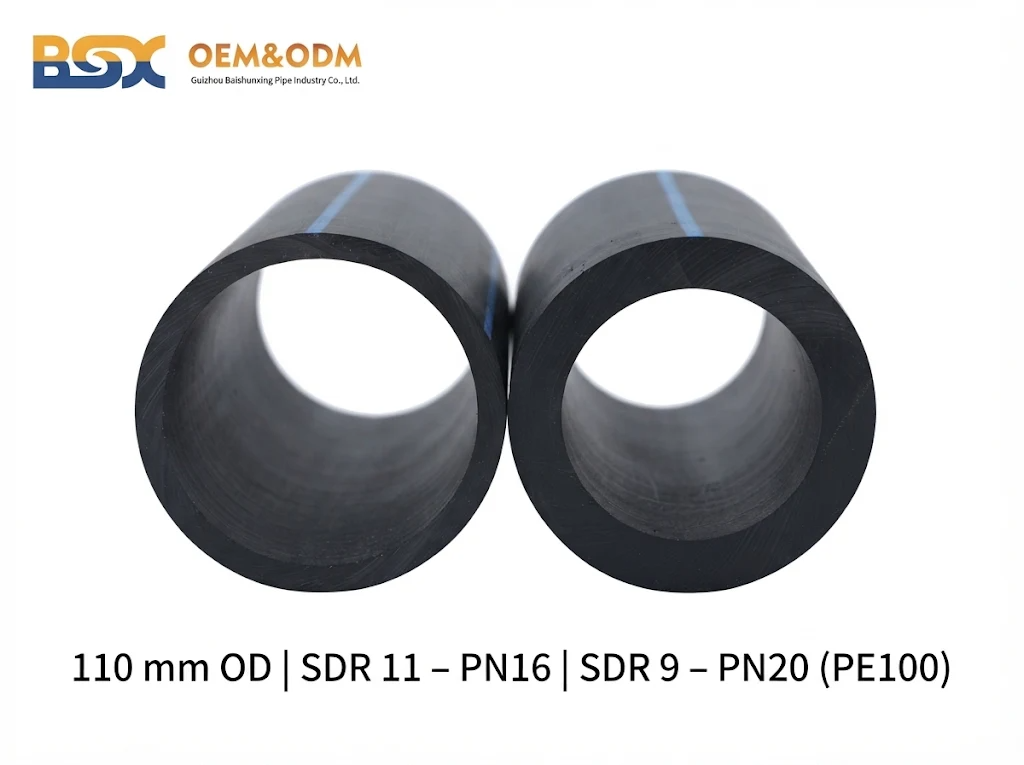
Standard Dimension Ratio (SDR) is the ratio of outside diameter to minimum wall thickness: SDR = OD ÷ wall thickness. A lower SDR indicates a thicker wall for any given outside diameter. Under internal pressure, the pipe resists hoop stress — which scales with pressure × diameter and inversely with wall thickness. Because SDR fixes this geometric proportion, it directly governs hydrostatic strength: halving SDR does not double strength, but reducing SDR from 11 to 9 increases nominal pressure capacity by ~25%, as confirmed by ISO 4427. Crucially, pipes made from the same HDPE resin (e.g., PE100) and manufactured to identical SDR share the same pressure class across all diameters — meaning a 4-inch and a 12-inch SDR 11 pipe both carry PN16 at 20°C. This consistency enables scalable, geometry-based design for water distribution, drainage, and industrial transfer systems.
From SDR to PN Rating: Applying ISO 4427 and PE100 Material Properties
ISO 4427 standardizes how SDR translates into pressure rating for HDPE pipe. For PE100 material — with a Minimum Required Strength (MRS) of 10 MPa and a design coefficient C = 1.25 for water service — the nominal pressure (in bar) is calculated as:
P(bar) = 20 × MRS ÷ [C × (SDR − 1)]
This yields PN16 for SDR 11 and PN20 for SDR 9. The table below summarizes these key ratings:
| SDR | PE100 MRS (MPa) | Design coefficient C | Nominal pressure at 20°C |
|---|---|---|---|
| SDR 11 | 10 | 1.25 | 16 bar (PN16) |
| SDR 9 | 10 | 1.25 | 20 bar (PN20) |
These values represent maximum allowable operating pressures under ideal conditions — they are not burst pressures, nor do they account for real-world variables like temperature, surge, trench loading, or fitting derating. Engineers use PN ratings as the baseline specification, then apply project-specific safety and service factors before finalizing system design.
Performance Comparison: SDR 11 vs SDR 9 HDPE Pipe Under Real Water System Conditions
Burst and Working Pressure at 20°C — Why SDR 9 Delivers ~22% Higher Pressure Rating
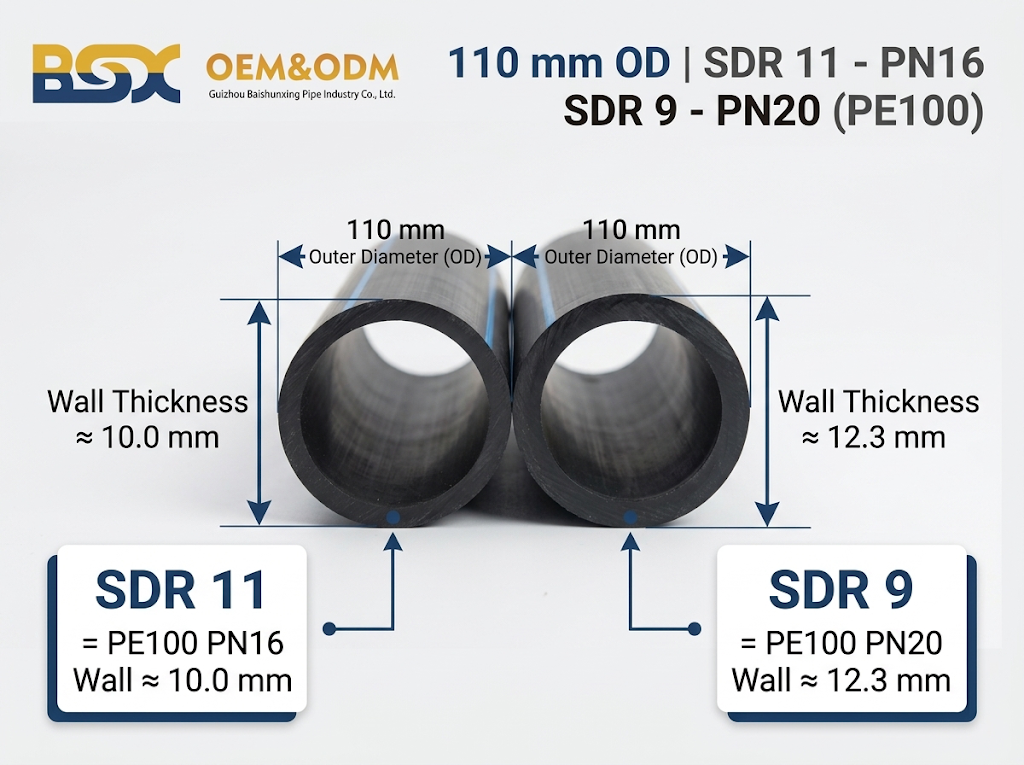
At 20°C, PE100 SDR 9 achieves PN20 (20 bar / 290 psi), while SDR 11 achieves PN16 (16 bar / 232 psi) — a 25% increase in nominal pressure class, commonly cited as ~22% higher working pressure in specifications. This difference stems directly from the thicker wall: for a fixed outside diameter, SDR 9’s wall is ~22% thicker than SDR 11’s, lowering hoop stress at any given pressure. While burst pressure is significantly higher (typically 3–4× PN), it is not a design parameter — working pressure reflects long-term hydrostatic strength with built-in safety margins. For PE80, equivalent classes are PN12.5 (SDR 11) and PN16 (SDR 9). Surge allowance, material grade, and joint integrity further influence final allowable operating pressure.
| SDR | PE100 Pressure Class at 20°C | Common Design Working Pressure |
|---|---|---|
| SDR 11 | PN16 (16 bar / 232 psi) | 160 psi |
| SDR 9 | PN20 (20 bar / 290 psi) | 200 psi |
Temperature Derating Reality Check: How 40°C Reduces SDR 9’s Effective Capacity by One-Third
HDPE pressure ratings assume 20°C water. As temperature rises, polymer ductility increases and long-term strength declines. At 40°C, PE100 derating factors range from 0.70 to 0.74 per ISO 4427 — reducing effective continuous pressure capacity by roughly one-third. Thus, SDR 9 PN20 drops to ~13–14 bar, and SDR 11 PN16 falls to ~11–12 bar. Though SDR 9 retains a relative advantage, the absolute margin shrinks — making temperature-aware design critical for buried lines in hot climates, industrial discharge lines, or systems with sustained warm-water operation. Designers must apply manufacturer-provided or ISO 4427–based derating curves, never rely on 20°C ratings alone.
Application-Specific Selection Criteria for HDPE Pipe in Water Infrastructure
Trench Loading & Burial Depth Limits: When SDR 11 Offers Better Structural Safety for Shallow Installations
For shallow installations, structural performance depends on both internal pressure and external loads — particularly soil and traffic-induced ring deflection. While SDR 9 has higher ring stiffness due to its thicker wall, SDR 11 often provides sufficient structural margin in pedestrian or light-landscape zones when installed correctly. Key success factors include: minimum cover of 0.6 m under light traffic and 1.0 m under heavy traffic; over-excavated, well-compacted bedding (≥90% Proctor density); and full haunch support. In high-groundwater conditions, however, SDR 11’s lower wall thickness reduces buckling resistance — warranting a site-specific global buckling analysis. SDR 9 becomes preferable only where weak native soils, shallow cover under truck loading, or poor embedment control increase deflection risk.
Service Life & Overdesign Risk: Evaluating Long-Term Reliability of SDR 9 in Low-Pressure Municipal Networks
Most municipal water networks operate at 6–10 bar — well below the PN16 (SDR 11) and PN20 (SDR 9) ratings. Using SDR 9 here introduces overdesign: higher material cost, reduced internal flow area for the same OD, and no meaningful gain in service life. With proper installation, surge management, and ISO 4427 temperature derating, PE100 SDR 11 reliably achieves 50-year design life under typical municipal conditions. SDR 9 is justified only where field evidence confirms frequent severe transients, limited maintenance access, or planned upgrades to pumped systems exceeding 12 bar. Long-term reliability hinges more on installation quality, soil stability, and thermal management than excess pressure rating.
Translating PN Ratings into Field-Safe Installation Practices for HDPE Pipe
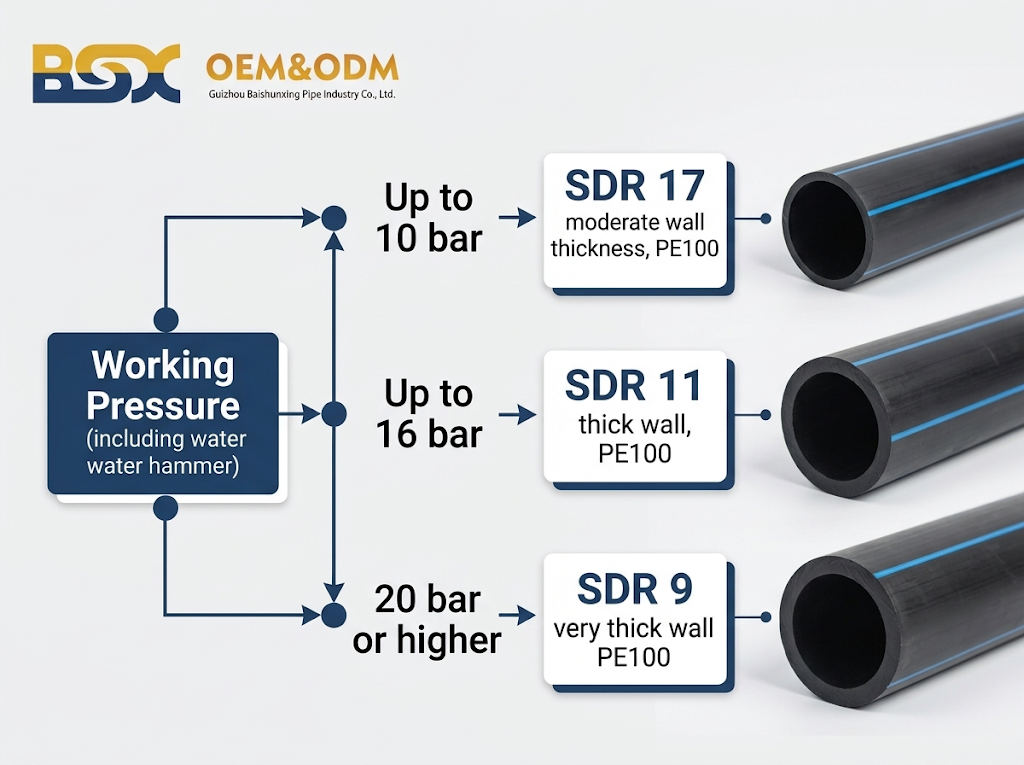
PN (Pressure Nominal) defines the maximum allowable operating pressure at 20°C — not burst pressure, and not a field-ready limit. PN10, PN16, and PN20 correspond to 10, 16, and 20 bar respectively under standard conditions. Field crews must treat PN as the starting point, then adjust for real-world variables before commissioning.
Surge pressure is non-negotiable: a PN16 line must never experience transient pressures exceeding 16 bar. If water hammer risk exists, specify a higher PN class or install surge-suppression devices. Temperature derating is equally essential — at 40°C, PN20 loses ~30% capacity and effectively performs as PN13–14. Always consult the manufacturer’s derating chart before setting operational limits, especially for above-ground runs or warm-water service.
Trench preparation and jointing convert PN theory into long-term reliability. Use a smooth, level trench bottom with granular bedding to prevent point loading. Thicker-wall SDR 9 requires longer fusion heating and cooling cycles than SDR 11 — alignment, bead formation, and cooling time must be verified per ISO 4427 and ASTM D3350 requirements. Only certified fusion operators should perform butt or electrofusion joints, and all joints must pass visual and procedural checks before backfilling. Compliance with local codes — including joint testing protocols — is mandatory for system integrity.
| Field Condition | Installation Practice |
|---|---|
| Operating temperature above 20°C | Apply temperature derating factor to PN rating before setting pressure limits |
| Surge or water hammer present | Select PN rating above worst-case transient pressure |
| Rocky or uneven trench bottom | Use sand bedding and compacted backfill to prevent stress concentration |
| Thicker-wall SDR 9 pipe | Extend fusion heat and cooling cycles; verify alignment and bead size |
| Local code compliance | Follow ISO 4427 and ASTM D3350 material requirements; verify joints per local code |
FAQ
What does SDR mean for HDPE pipes?
SDR (Standard Dimension Ratio) is the ratio of the outside diameter of the pipe to its minimum wall thickness. It determines the pipe's pressure capacity and wall thickness.
How does SDR affect the strength of HDPE pipes?
Lower SDR values result in thicker walls for the same outer diameter, providing higher hydrostatic strength and a greater resistance to internal pressure.
What is PN in reference to HDPE pipes?
PN, or Pressure Nominal, is the maximum allowable operating pressure of a pipe at 20°C. Common PN ratings are PN10, PN16, and PN20, corresponding to 10, 16, and 20 bar, respectively.
How does temperature affect HDPE pipe pressure ratings?
As temperature increases, HDPE's long-term strength declines, requiring a derating factor. For example, at 40°C, SDR 9 (PN20) may operate as PN13–14 instead.
When should engineers choose SDR 9 over SDR 11?
SDR 9 is preferred in conditions requiring higher pressure ratings, such as systems with frequent transients, limited access for maintenance, or pumped systems exceeding 12 bar. However, in low-pressure municipal networks, SDR 11 is often sufficient and more economical.
Table of Contents
- What SDR Means for HDPE Pipe Strength and Pressure Capacity
- Performance Comparison: SDR 11 vs SDR 9 HDPE Pipe Under Real Water System Conditions
- Application-Specific Selection Criteria for HDPE Pipe in Water Infrastructure
- Translating PN Ratings into Field-Safe Installation Practices for HDPE Pipe
- FAQ