 EN
Introduction
Floating pipelines are essential components of many modern dredging operations. They
transport sand, mud, silt, and slurry from dredgers to shorelines, disposal areas, or land
reclamation sites. However, keeping a pipeline stable on the water requires more than selecting a suitable HDPE pipe.
HDPE pipe floats provide additional buoyancy and support, allowing the pipeline to maintain its required position during operation. Their size, spacing, and attachment method directly affect pipeline stability and performance.
Choosing the wrong float can cause uneven flotation, excessive pipe movement, or insufficient support when the pipeline carries heavy slurry.
This guide explains the common types of HDPE pipe floats, how to determine suitable sizes, and how to pair floats with dredging pipes for reliable marine operations.
What Are HDPE Pipe Floats for Dredging?
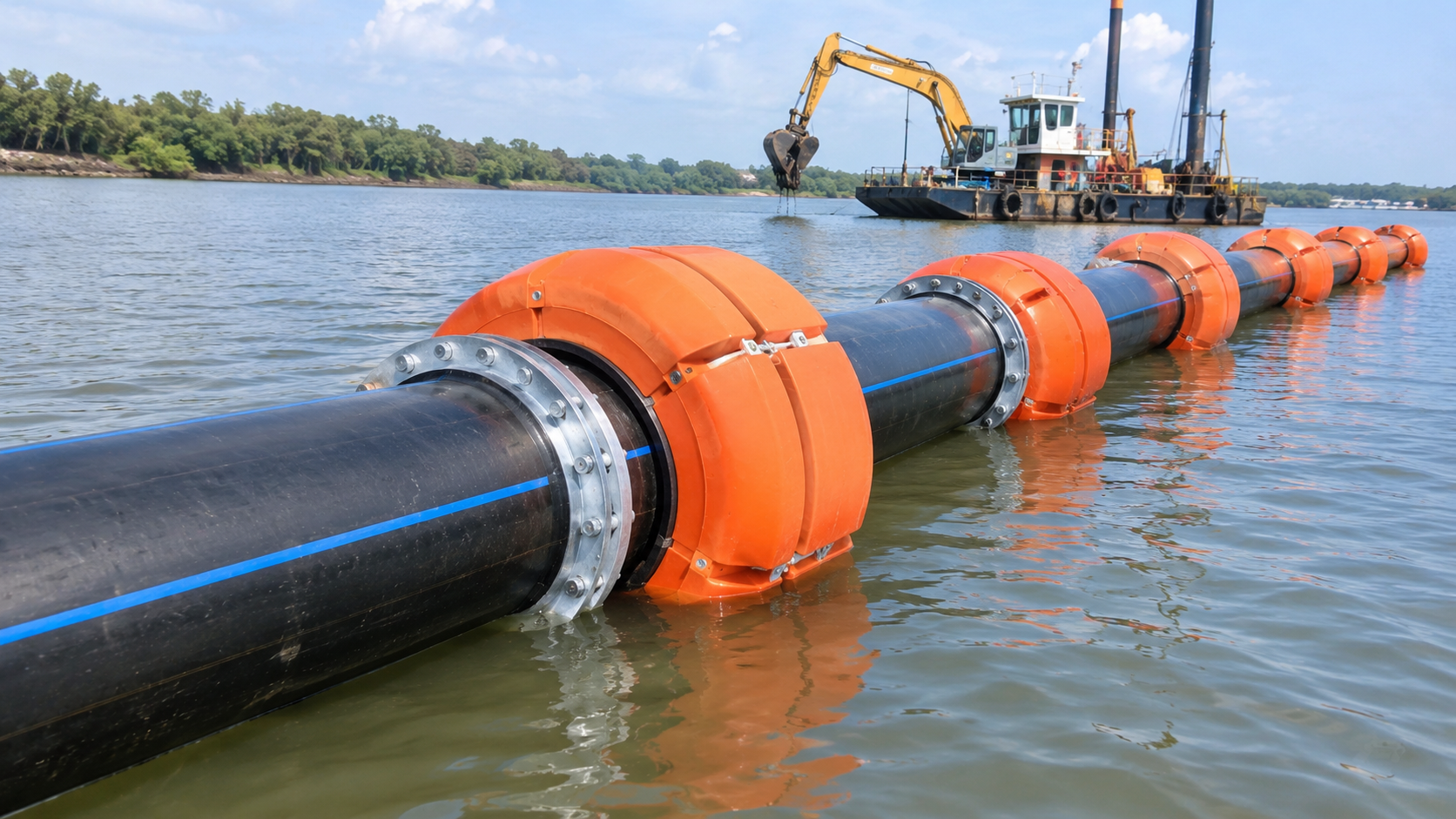
HDPE pipe floats are buoyancy devices installed around or attached to a pipeline to help it remain at the water surface.
They are commonly manufactured using high-density polyethylene because the material offers impact resistance, corrosion resistance, and durability in demanding marine environments.
During dredging, the pipeline transports a mixture of water and solid particles. Depending on
slurry density and pipeline configuration, the combined load may require additional buoyancy to keep the system at the intended water level.
The main functions of pipe floats include:
● Supporting the weight of the pipeline and transported slurry.
● Maintaining a stable floating position.
● Reducing excessive pipeline movement.
● Supporting the pipeline along its floating route.
● Helping maintain the intended pipeline configuration.
A complete floating dredging system may include HDPE pipes, floats, flange connections, steel backing rings, and flexible connections where required.
Common Types of HDPE Pipe Floats
Different dredging projects require different flotation arrangements. The appropriate design depends on pipeline diameter, operating conditions, transportation requirements, and project duration.
Split-Shell or Clamp-On Pipe Floats
Split-shell floats consist of two or more sections that fit around the outside of an HDPE pipe. Bolts or other fastening systems hold the sections together.
They are useful when contractors need to install or remove floats without passing the pipe through a closed structure.
Their advantages include:
● Convenient installation around existing pipelines.
● Easier replacement of damaged sections.
● Flexible positioning along the pipeline.
● Suitability for projects requiring relocation.
These floats are commonly considered for temporary dredging operations and floating discharge lines.
Closed-Shell Pipe Floats
Closed-shell floats use an enclosed buoyant structure surrounding the pipeline.
Depending on the product design, they may include foam filling to help maintain buoyancy if the outer shell becomes damaged.
Their construction, fastening arrangement, and available buoyancy should be checked before selection.
They can be considered for longer-term marine applications where consistent pipeline support is required.
Integrated Floating Pipe Systems
Some pipeline systems use specially designed buoyant pipe sections or integrated flotation arrangements rather than conventional solid-wall HDPE pipes with external floats.
These systems have different structural and buoyancy characteristics.
Their selection should consider required lifting capacity, pipeline configuration, operating conditions, and manufacturer specifications.
How to Select the Correct HDPE Pipe Float Size
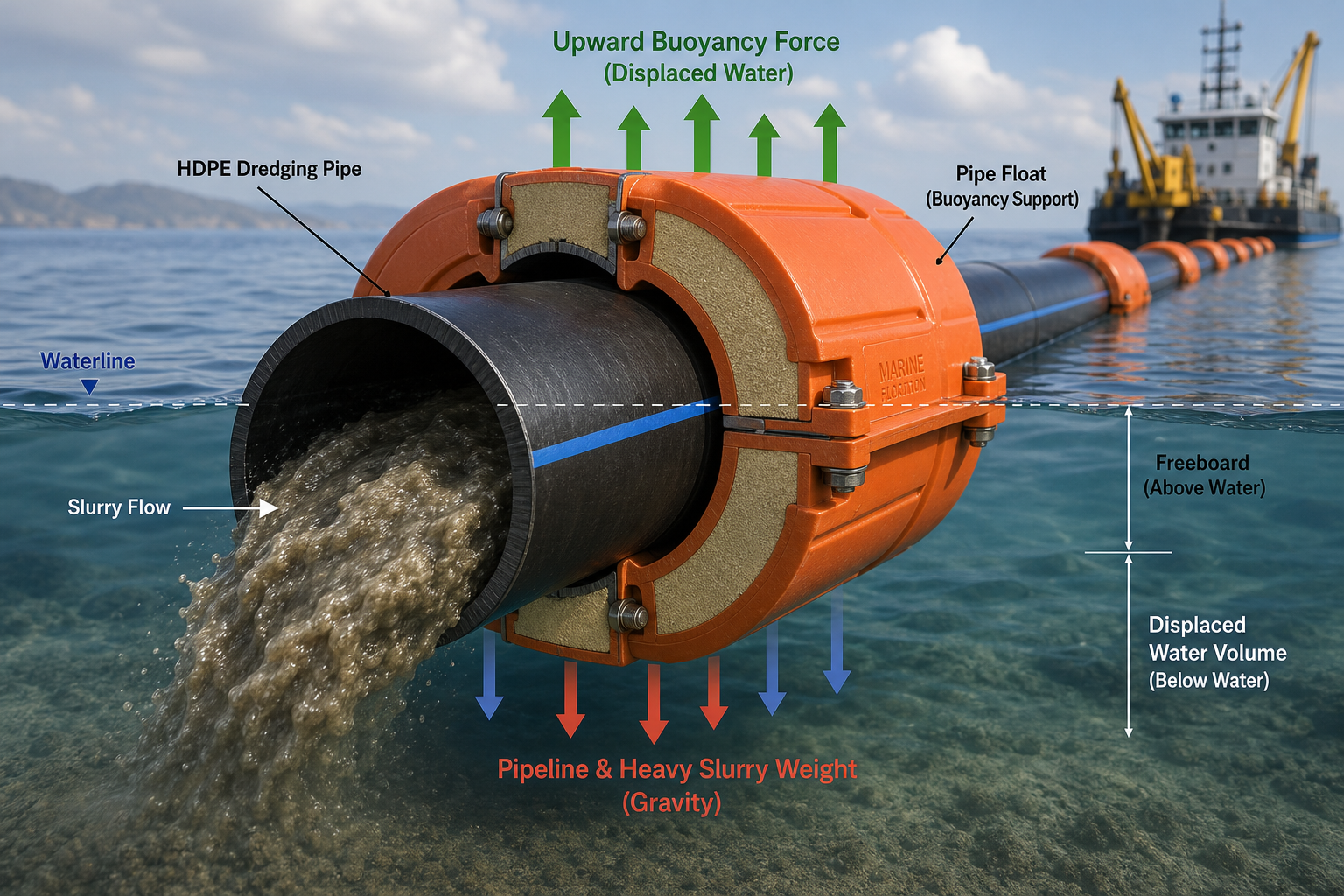
Selecting the correct float requires more than matching its dimensions to the pipe diameter. Engineers must calculate the total supported load and determine the additional buoyancy required.
Match the Float to the Pipe Outside Diameter
The float's internal opening must match the actual outside diameter of the HDPE dredging pipe. A float designed for one pipe dimension may not fit another product with a similar nominal size. Before ordering, confirm:
● Actual pipe outside diameter.
● Pipe wall thickness and SDR.
● Float internal diameter.
● Clamp or fastening dimensions.
● Clearance around flanges and connections.
A secure fit helps prevent unnecessary movement and uneven loading during operation.
Calculate the Total Pipeline Weight
The next step is determining the weight that the flotation system must support.
The calculation should include:
● HDPE pipe weight per meter.
● Weight of the slurry inside the pipe.
● Flanges and backing rings.
● Couplings and flexible connections.
● Float weight and supported accessories.
The operating condition matters. A pipeline carrying dense sand slurry may require considerably more buoyancy than an empty or water-filled pipeline.
Engineers should calculate the actual operating load rather than selecting floats based only on the dry weight of the pipe.
Determine the Required Buoyancy
Buoyancy is the upward force produced when an object displaces water.
For a floating dredging pipeline, the available buoyancy must support the combined pipeline load while maintaining the required freeboard.
A simplified design relationship is:
Required Additional Buoyancy = Total Supported Weight Natural Pipe Buoyancy + Design Allowance
The calculation must consider water density, pipe displacement, float displacement, and the operating configuration.
The Plastics Pipe Institute'sHandbook of Polyethylene Pipe – Chapter 10: Marine Installations provides engineering information about polyethylene pipeline buoyancy, marine installations, and floating pipe design.
A suitable design allowance should be established by the project engineer to account for changing slurry density, waves, movement, and other operating loads.
Determine Float Spacing
Float spacing affects how evenly the pipeline is supported.
If floats are positioned too far apart, unsupported pipe sections may sag or experience greater bending loads. If they are placed too close together, the system may become unnecessarily expensive and heavy.
Spacing should be determined from:
● Required buoyancy per meter.
● Individual float capacity.
● Pipe diameter and wall thickness.
● Slurry density.
● Wave and current conditions.
● Pipeline length and connection locations.
The final spacing should be confirmed through a buoyancy and structural assessment rather than relying on a universal distance.
How to Pair HDPE Pipe Floats with Dredging Pipes
Correct pairing ensures that the pipe and flotation equipment work together as one system.
Pipe Diameter and Float Compatibility
Start by matching the float's internal dimensions with the actual outside diameter of the selected HDPE pipe.
The fastening arrangement should secure the float without damaging the pipe surface or interfering with flange connections.
SDR and Wall Thickness
SDR describes the relationship between pipe outside diameter and wall thickness.
A lower SDR generally means a thicker wall. Different SDR configurations have different pipe weights, internal volumes, and buoyancy requirements.
Therefore, a float selected for an SDR17 pipe should not automatically be assumed suitable for the same nominal diameter in SDR11.
Flange and Coupling Clearance
Many HDPE dredging pipelines use welded stub ends and steel backing flanges.
Floats must be positioned so they do not interfere with bolts, flange assembly, or flexible hose connections.
Contractors should also consider whether individual pipe sections need to be disconnected and relocated during dredging operations.
Pipeline Operating Conditions
A pipeline operating in a calm pond has different support requirements from one exposed to river currents, waves, and changing water levels.
The float configuration should reflect the actual project environment.
The U.S. Army Corps of Engineers' dredging guide explains pipeline dredging operations and the use of floating discharge pipelines. It also discusses operational limitations in rough seas and high-traffic waterways.
Common Mistakes When Selecting Dredging Pipe Floats
Several mistakes can affect floating pipeline performance.
Selecting floats by nominal diameter only: Actual outside diameter and float internal dimensions must be compatible.
Ignoring slurry weight: Dense slurry increases the supported load and can reduce available buoyancy.
Using excessive float spacing: Long unsupported sections may experience greater deflection and mechanical stress.
Ignoring flange locations: Poor positioning can obstruct connections and make maintenance difficult.
Overlooking environmental conditions: Waves, currents, and marine exposure influence pipeline stability.
Failing to inspect floats: Damaged shells, loose fasteners, or water ingress can reduce flotation capacity.
A properly designed flotation system should be inspected before deployment and monitored during operation.
Choosing an HDPE Dredging Pipe and Float Supplier
A reliable supplier should understand both pipe specifications and flotation requirements.
BSX Pipe manufactures HDPE dredging pipes using PE100, PE4710, and PE100RC materials. Its product information includes diameters from DN50mm to DN1000mm, different SDR
configurations, and flange connection options.
Buyers can explore theBSX HDPE Floating Dredging Pipeline for information about floating pipeline configurations.
The product range includes different pipe dimensions and pressure classes for dredging and other industrial slurry transportation applications.
When requesting a quotation, provide the pipe outside diameter, SDR, slurry density, pipeline length, required buoyancy, and operating environment.
These details help determine the appropriate float configuration and support arrangement.
Conclusion
HDPE pipe floats are essential components of many floating dredging pipeline systems. They provide additional buoyancy, support the pipeline and its contents, and help maintain stability during slurry transportation.
Selecting the right floats requires checking actual pipe dimensions, total supported weight, buoyancy capacity, spacing, and environmental conditions.
The best approach is to design the pipe and flotation system together rather than purchasing floats based only on nominal pipe diameter. Proper engineering calculations, compatible
connections, and regular inspection can help improve the reliability of floating dredging operations.
FAQ
What are HDPE pipe floats used for in dredging?
They provide additional buoyancy to floating pipelines, helping support the pipe, slurry, and accessories during dredging and material transportation.
How do I choose the correct float size for an HDPE dredging pipe?
Check the actual pipe outside diameter, float internal dimensions, total supported weight, required buoyancy, and operating conditions before selecting a float.
How many floats are needed for a dredging pipeline?
The number depends on the required buoyancy, individual float capacity, pipe weight, slurry density, and pipeline length. Engineering calculations should determine the final quantity and spacing.
Can HDPE dredging pipes float without external floats?
HDPE has a density lower than fresh water, but a pipe carrying heavy slurry may not have
sufficient natural buoyancy. External floats may therefore be necessary to maintain the required floating position.
Can the same floats be used with different HDPE pipe SDR ratings?
Not automatically. Different SDR ratings affect wall thickness and pipe weight. Float compatibility and the flotation calculation should be checked for each pipe configuration.