 EN

Why HDPE Water Line Is the Preferred Choice for Modern Water Infrastructure
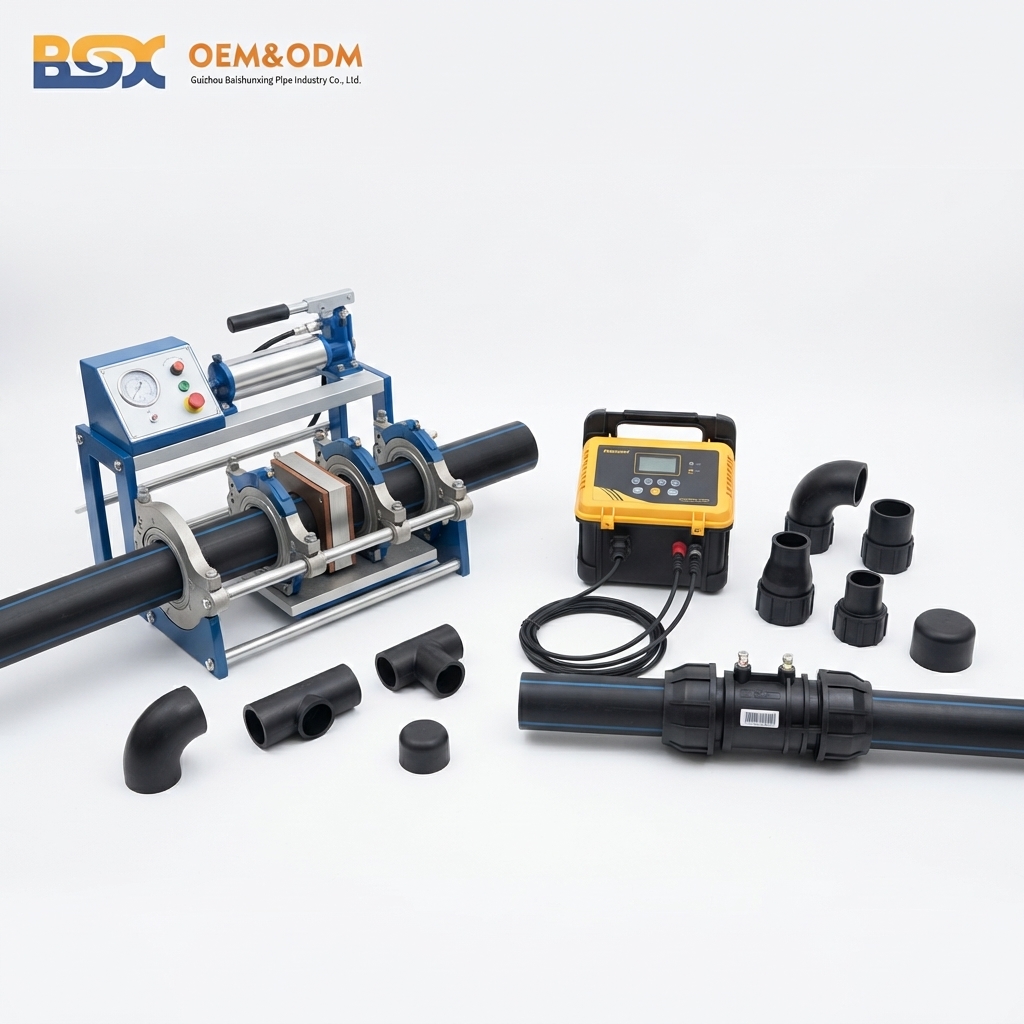
Modern water infrastructure demands pipe that resists corrosion, accommodates ground movement, and minimizes leaks over decades. HDPE water line meets these needs: high-density polyethylene is tough, flexible, and chemically inert. Since the 1960s, HDPE piping systems have delivered leak-free service in water networks worldwide—including dense urban areas where rigid pipe installation is impractical. Its flexibility allows bending without cracking under shifting soils or freeze-thaw cycles, reducing reliance on fittings and eliminating associated failure points in unstable or cold environments.
HDPE is also lightweight and highly efficient to install. Trenchless methods—such as horizontal directional drilling—enable long fused sections to be pulled through existing routes, significantly lowering excavation, traffic control, and surface restoration costs. Butt fusion and electrofusion create monolithic, gasket-free joints that eliminate mechanical coupling failures and gasket-related leaks. Over a service life exceeding 50 years, utilities avoid repeated repairs and the non-revenue water losses common with metallic systems. Fewer interventions and extended replacement intervals also reduce raw material use and embodied carbon. As infrastructure owners increasingly prioritize total cost of ownership and climate resilience, HDPE remains the preferred solution for water mains, service lines, and rehabilitation projects.
Key HDPE Water Line Material Specifications and Industry Standards
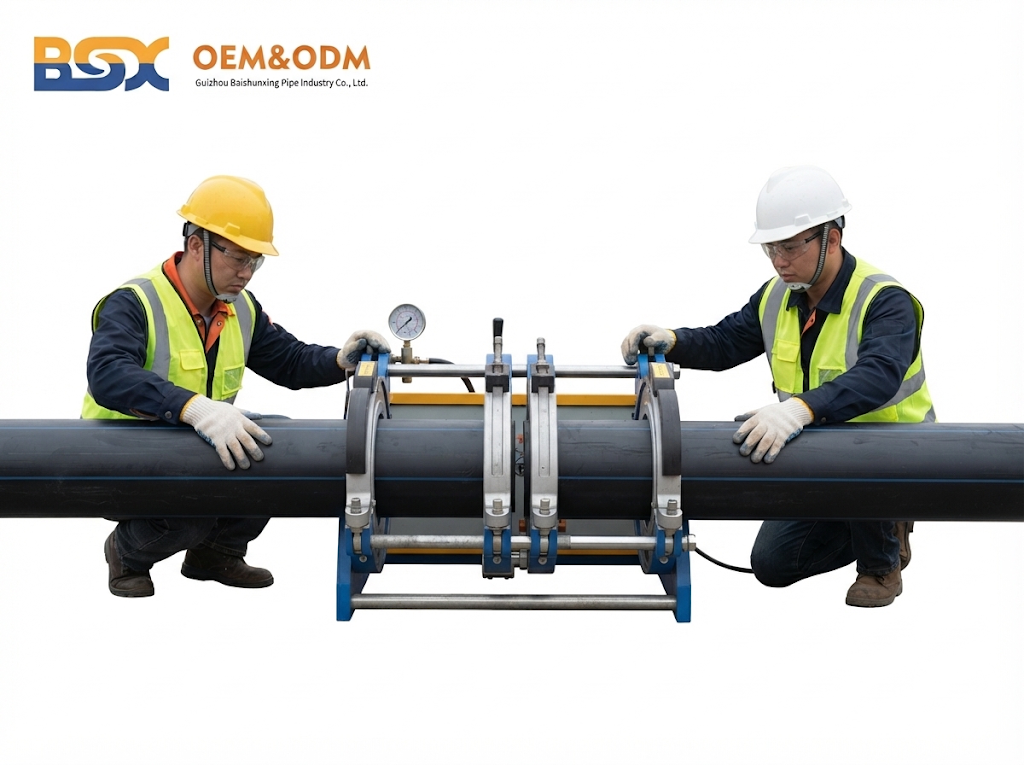
Material specification for HDPE water line begins with resin grade and dimensional standard. Engineers evaluate ASTM test requirements, pressure ratings, and standard dimension ratio (SDR) to match pipe strength to site-specific operating conditions. The following specification areas are critical.
ASTM D3035 and PE4710 Resin Requirements
ASTM D3035 defines dimensions, tolerances, and hydrostatic test criteria for pressure-rated HDPE pipe used in potable water service. PE4710 resin—classified under ASTM D3350—offers superior slow crack growth resistance and long-term hydrostatic strength compared with legacy PE3408 grades. Pipe produced to ASTM D3035 features controlled outside diameter and compatibility with matched fusion fittings, ensuring consistent joint integrity. Potable water applications must additionally comply with NSF/ANSI 61 for health effects and AWWA C906 for municipal distribution. Manufacturers verify density, melt index, and oxidative induction time before release—critical safeguards against brittle failure in cold soils or under sustained load.
Pressure Rating (PN) and SDR Classifications
Pressure rating is expressed as PN (nominal pressure in bar) and SDR (standard dimension ratio). Lower SDR values indicate thicker walls and higher pressure capacity. In metric practice, PN 16 typically corresponds to SDR 11 for PE100 pipe, while PN 10 aligns with SDR 17. For PE4710 water mains, AWWA C906 specifies pressure classes such as 200 psi for DR 11 and 125 psi for DR 17. Engineers select SDR based on working pressure, surge potential, and cover depth—balancing structural safety with material efficiency.
Step-by-Step HDPE Water Line Installation Process
Reliable HDPE water line installation hinges on precise trench preparation and rigorously executed fusion joining. Survey the route, locate existing utilities, and inspect each pipe section before placement. Confirm alignment with specified pressure class and SDR, and ensure fusion equipment is clean, calibrated, and dry.
Trenching, Bedding, and Alignment Guidelines
Excavate the trench to required depth—typically 0.9 to 2.5 meters—with sufficient width for safe joining and compaction. Remove rocks, roots, and sharp debris from the trench bottom, then place a compacted bedding layer of sand or fine gravel. Lay the HDPE water line with gentle, continuous curves and maintain consistent grade. Align pipe ends carefully before backfilling, and compact selected backfill in uniform lifts to prevent point loading. A stable, smooth trench bottom ensures full-length support and avoids stress concentrations.
Fusion Joining Techniques: Butt and Electrofusion Best Practices
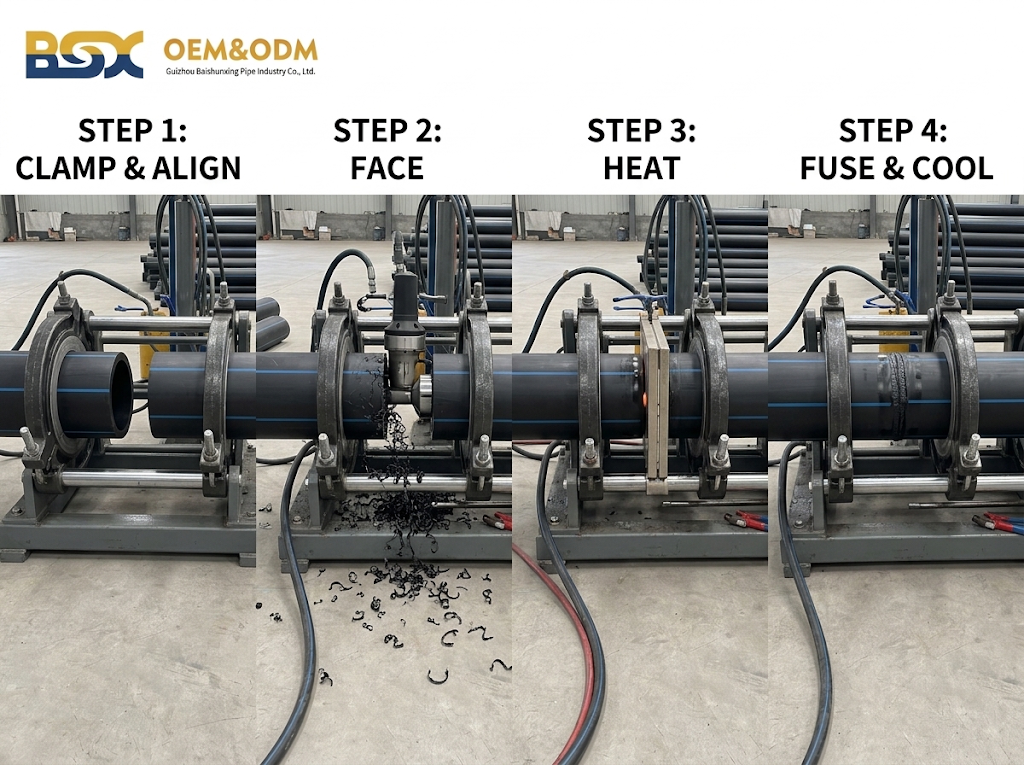
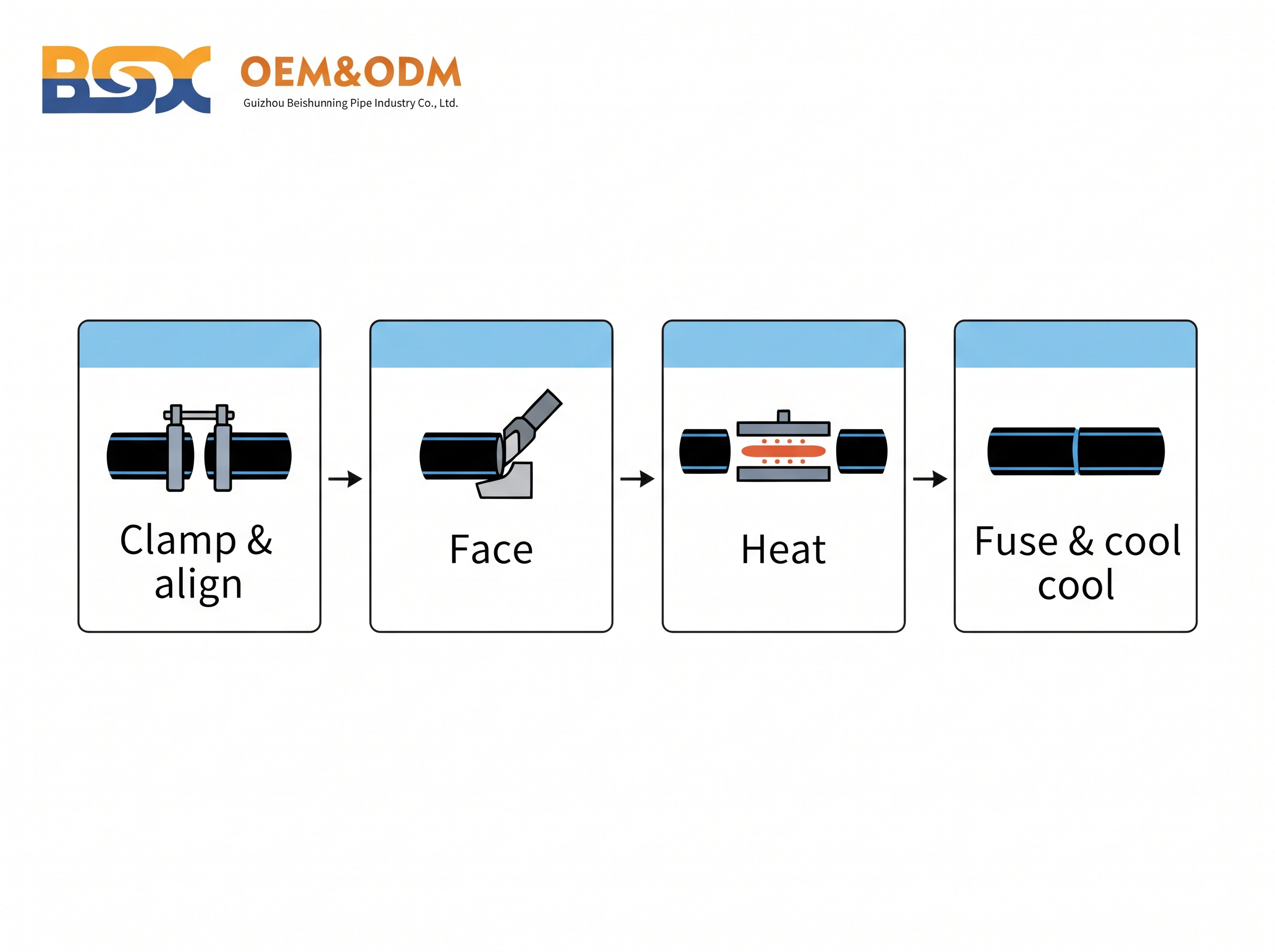
For butt fusion, face pipe ends until flat and parallel, heat them to the manufacturer-specified melt temperature for PE4710 resin, and press together under steady pressure until a uniform double bead forms along the joint circumference. Do not disturb the joint during cooling. For electrofusion, thoroughly scrape the oxide layer from the insertion zone, insert the pipe fully into the coupling, and apply the fitting’s programmed voltage and time cycle. Keep the assembly dry, dust-free, and mechanically stable until the fusion indicator confirms completion—and allow full cooling before pressure testing. Contamination from moisture, oil, or particulates compromises joint integrity; always handle pipe only by external surfaces and wipe ends immediately before fusion.
Long-Term Performance and Maintenance Advantages of HDPE Water Line
HDPE water line systems deliver enduring value across demanding operational and environmental conditions. Unlike rigid metallic or cement-based pipes, HDPE resists chemical degradation, ground movement, and internal scaling—shifting how utilities approach asset management, capital planning, and lifecycle risk.
Corrosion Resistance and Leak Prevention Over 50+ Years
HDPE does not rust, tuberculate, or support biofilm accumulation. It maintains structural integrity in acidic soils, saline environments, and aggressive water chemistries. Thermal and electrofusion joints integrate seamlessly with the pipe wall—eliminating gaskets, bolts, and other mechanical interfaces that commonly fail. Field performance data and accelerated aging studies support service lives of 50 to 100 years under normal operating conditions, even with repeated freeze-thaw cycles and differential settlement. This durability translates directly into fewer emergency repairs, reduced non-revenue water, and longer asset replacement horizons.
Lifecycle Cost Savings vs. PVC and Ductile Iron
While initial material costs vary, HDPE consistently lowers total cost of ownership over its service life. Fusion-welded joints virtually eliminate connection-related leakage—a leading cause of real water loss in ductile iron and PVC systems. Unlike ductile iron, HDPE requires no cathodic protection or external coatings; unlike PVC, it resists impact damage and brittle fracture under soil movement or thermal stress. The absence of bell-and-spigot joints removes a well-documented failure mode, reducing long-term inspection, maintenance, and rehabilitation expenditures. Lower crew deployment frequency, minimal service disruptions, and deferred capital replacement collectively free budget capacity for broader infrastructure investment—making HDPE the most cost-effective choice over a 50-plus-year planning horizon.
FAQ
What is HDPE and why is it preferred for water lines?
HDPE, or high-density polyethylene, is preferred for water lines due to its corrosion resistance, flexibility, durability, and ability to prevent leaks over a lifespan exceeding 50 years.
What installation methods are used for HDPE water lines?
HDPE water lines are installed using trenching and trenchless methods like horizontal directional drilling. Fusion techniques such as butt and electrofusion are commonly employed.
What are the key industry standards for HDPE water lines?
Key industry standards include ASTM D3035 for dimensions and hydrostatic tests, PE4710 resin classification under ASTM D3350, and compliance with AWWA C906 for municipal water distribution.
How does HDPE compare with PVC or ductile iron in terms of cost and durability?
HDPE has a lower total cost of ownership and higher durability compared to PVC and ductile iron, due to resistance against corrosion, chemical damage, soil movement, and the elimination of connection-related leaks.