 EN
ISO 4427: Material Integrity and Structural Performance for Water HDPE Pipe
PE80 vs PE100 Classification and Long-Term Hydrostatic Strength (LTHS) Validation
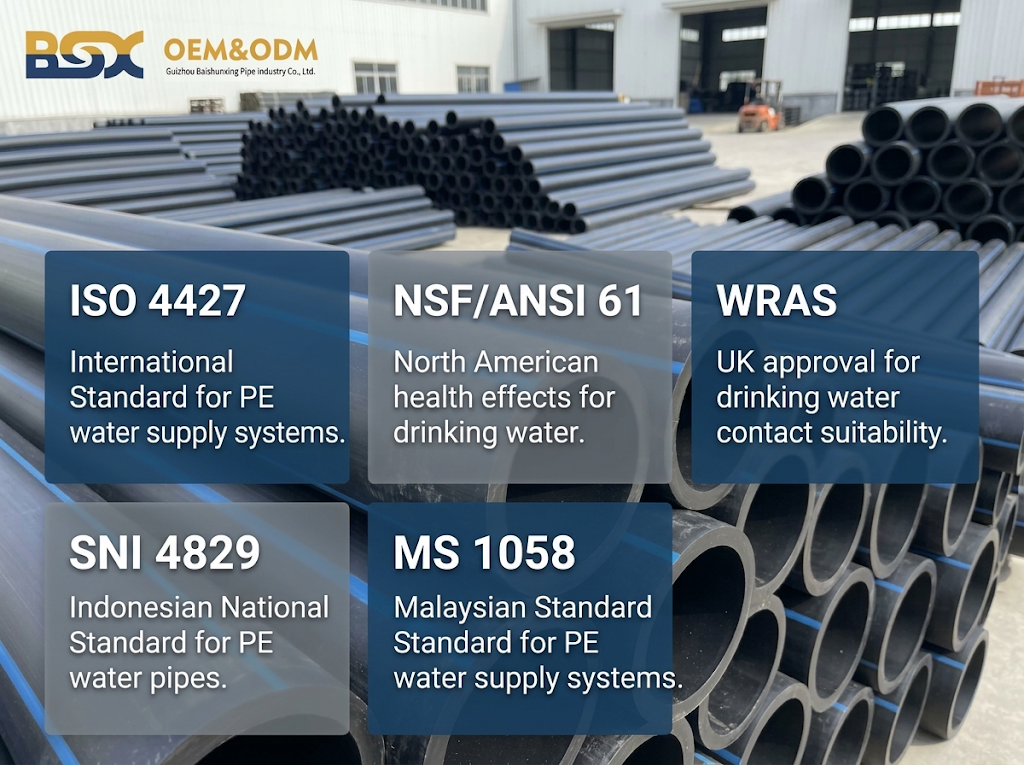
ISO 4427 is the international reference standard for pressure-rated HDPE pipes used in potable water supply. It classifies polyethylene into PE80 and PE100 grades based on Minimum Required Strength (MRS): 8 MPa for PE80 and 10 MPa for PE100. This distinction reflects fundamental differences in molecular structure and long-term creep resistance. Long-term hydrostatic strength (LTHS) is validated through ISO 9080 testing—accelerated pressure-rupture trials at elevated temperatures, extrapolated to 20°C using statistical regression over a 50-year timeframe. This process confirms sustained structural integrity under continuous internal pressure.
Because of its higher MRS and superior resistance to slow crack growth, PE100 delivers greater pressure capacity at equivalent wall thickness. For instance, an SDR 11 PE100 pipe carries a nominal pressure rating of 16 bar at 20°C, while PE80 at the same SDR is typically rated for 12.5 bar. ISO 4427:2019 further specifies dimensional tolerances, mechanical properties, and performance requirements across service temperatures from 0°C to 45°C and working pressures up to 25 bar—enabling precise selection for municipal mains, service lines, and other critical potable water infrastructure without unnecessary over-engineering.
Hydrostatic Design Basis (HDB), Pressure Rating, and Service Life Prediction
The Hydrostatic Design Basis (HDB) is the foundational long-term strength value used to calculate pressure ratings under ISO 4427. Derived directly from LTHS data, HDB is adjusted by a design coefficient—1.25 for cold-water applications—to account for real-world variability in installation, operation, and material behavior. Pressure rating is then determined using the Standard Dimension Ratio (SDR), defined as the ratio of outside diameter to minimum wall thickness. A lower SDR indicates a thicker wall and higher pressure capacity.
Service life prediction relies on the 50-year stress regression curve generated from ISO 9080 testing. Elevated-temperature creep rupture data are time-shifted to 20°C using Arrhenius-based principles, allowing engineers to model decades of performance with high confidence. This methodology mitigates risks associated with slow crack growth and brittle failure. In practice, SDR 11 is commonly selected for PN 16 systems and SDR 17 for PN 10 in PE100 installations. When installed and operated within ISO 4427 limits, such pipes demonstrate a predicted service life exceeding 50 years under continuous rated pressure.
NSF/ANSI 61: Ensuring Drinking Water Safety Through Leaching Control
Extraction Testing Protocols for Metals, VOCs, and Disinfection Byproduct Precursors
NSF/ANSI 61 is the U.S. health effects standard governing components that contact drinking water—including HDPE pipe. Its core mechanism is extraction testing: pipe samples are exposed to standardized “formulated exposure waters” designed to simulate aggressive (low-pH, low-alkalinity) and neutral distribution conditions, including varying chlorine residuals. Extractions occur under controlled temperature, surface-area-to-volume ratios, and contact durations. Leachate is analyzed for regulated metals (e.g., lead, copper, cadmium) using inductively coupled plasma mass spectrometry (ICP-MS), volatile organic compounds (VOCs) via gas chromatography–mass spectrometry (GC-MS), and disinfection byproduct precursors—typically measured as total organic carbon (TOC) after chlorination. These precursors may react with disinfectants to form regulated trihalomethanes (THMs) and haloacetic acids (HAAs).
Each analyte is evaluated against toxicology-derived pass/fail thresholds—not generic concentration limits—ensuring protection against chronic exposure. In addition, U.S. law mandates compliance with the Safe Drinking Water Act’s lead content limit: HDPE pipe formulations must contain no more than a 0.25% weighted average lead content, effective since January 4, 2014. This dual requirement—rigorous leaching validation plus compositional control—forms a robust barrier against contamination risk in certified water HDPE pipe.
Certification Requirements: Third-Party Oversight, Batch Traceability, and Labeling Compliance
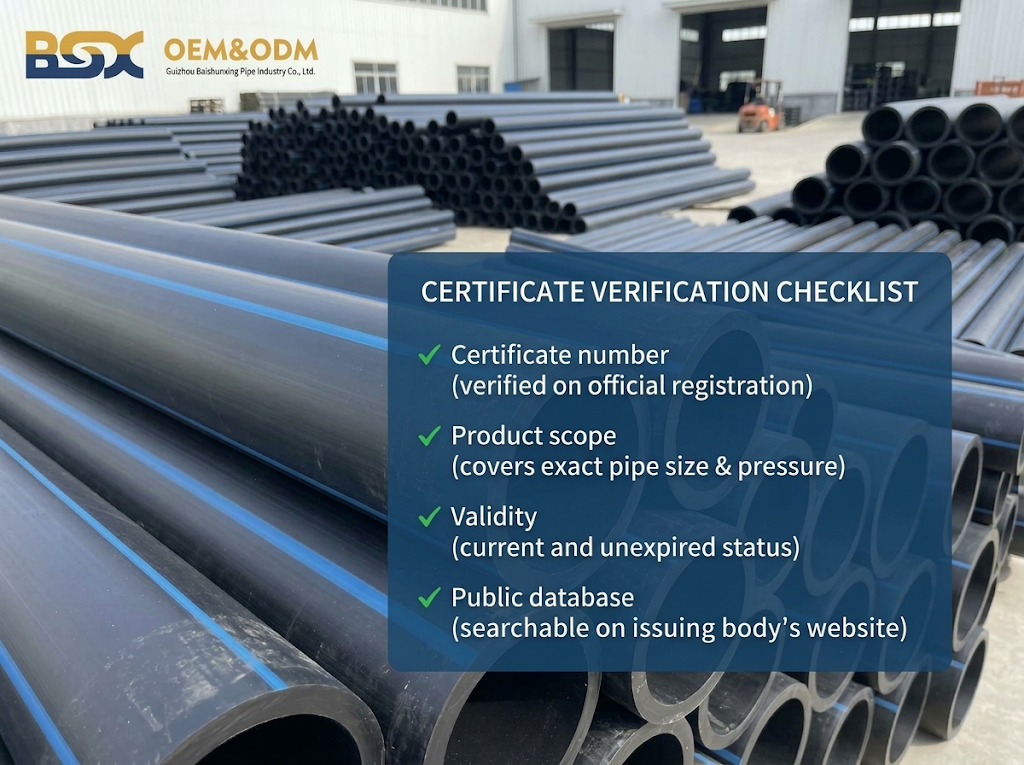
NSF/ANSI 61 certification is not a one-time event but an ongoing assurance program. Certification bodies must be accredited to ISO/IEC 17065, which enforces strict requirements for impartiality, technical competence, and decision consistency. Accredited third parties conduct initial product evaluation and maintain oversight through unannounced facility inspections and periodic surveillance testing of production samples.
Manufacturers must retain full batch traceability records—including resin lot number, extrusion line ID, production date, and QC test results—for each certified HDPE pipe lot. This enables rapid isolation and recall of nonconforming material. Certification documentation must be retained for at least five years to support audits.
Labeling is equally prescriptive: certified pipe must bear the certifier’s mark, standard designation (e.g., “NSF/ANSI 61”), material grade (e.g., “PE100”), pressure rating (e.g., “PN 16”), nominal size, and production date code. Critically, the NSF/ANSI 61 mark confirms only health-effects compliance—not pressure-rated performance. A separate potable-water pressure rating mark (e.g., “WRAS Approved for Potable Water” or “ISO 4427 Compliant”) is required for structural use. Confusing these marks remains a common procurement error with operational and regulatory consequences. Without integrated third-party oversight, traceability, and accurate labeling, field-level leaching control cannot be reliably assured.
WRAS Approval: UK-Specific Validation for Public Water Supply Compatibility
In the UK, WRAS (Water Regulations Advisory Scheme) approval is mandatory for any component—including HDPE pipe and fittings—that connects to public water supplies. It verifies that the product will not waste, misuse, or contaminate drinking water, as required under the Water Supply (Water Fittings) Regulations 1999 and subsequent amendments. WRAS approval draws on BS 6920 for material testing and incorporates broader system-level assessments, including flow performance and backflow prevention compatibility.
WRAS vs NSF 61: Critical Differences in Extraction Media, Exposure Conditions, and Acceptance Criteria
While both WRAS and NSF/ANSI 61 assess leaching, their protocols reflect distinct regulatory priorities. WRAS testing under BS 6920 uses chlorine-demand-free extraction water formulated to mirror typical UK supply chemistry—emphasizing pH stability, low organic load, and residual chlorine compatibility. Tests follow fixed contact times and temperature conditions, with acceptance criteria focused on organoleptic effects (taste, odor, color, turbidity) and metals release aligned to UK Water Regulations’ statutory limits.
NSF/ANSI 61, by contrast, employs multiple extraction waters—including pH 5 (acidic) and pH 8.5 (alkaline)—to challenge material stability across broader chemical conditions. It measures endpoint concentrations for metals, VOCs, and disinfection byproduct precursors over extended exposure windows, applying toxicology-based pass/fail thresholds. As a result, a pipe certified to NSF/ANSI 61 is not automatically accepted by UK water companies—even if structurally sound. Separate WRAS material testing and system approval remain essential for UK deployment.
Integrating Standards: Why Full Compliance Requires All Three for Global Water HDPE Pipe Deployment
Global deployment of water HDPE pipe rarely falls under a single regulatory framework. ISO 4427 validates mechanical integrity, pressure rating, and long-term structural performance. NSF/ANSI 61 addresses health effects under North American drinking-water protocols—including compositional controls and multi-condition leaching validation. WRAS ensures compatibility with UK public water supply regulations, including organoleptic and system-integration requirements.
A product meeting only one standard may pass structural tests yet fail market entry elsewhere. Procurement teams specifying all three certifications significantly reduce cross-border risk. The combined package enables seamless specification transfer between regions—eliminating requalification delays during international tenders or emergency procurements. For example, a Middle East utility may accept ISO 4427 and NSF/ANSI 61–certified pipe, but a UK contractor connecting to a public main must still provide WRAS approval.
Full compliance also strengthens service-life documentation. Because NSF/ANSI 61 and WRAS employ different extraction media, temperatures, and exposure durations, passing both demonstrates formulation stability across a wider range of real-world water chemistries. This broader evidence base reinforces confidence in ISO 4427 pressure ratings—and provides engineers with stronger justification for warranty terms, insurance underwriting, and regulatory audits.
FAQ: Common Questions on HDPE Pipe Standards
What is ISO 4427, and why is it important?
ISO 4427 is the international standard for pressure-rated HDPE pipes used in potable water systems. It ensures mechanical integrity, dimensional tolerances, and long-term structural performance under specific conditions.
What is the difference between PE80 and PE100 grades?
PE80 has a Minimum Required Strength (MRS) of 8 MPa, while PE100 has an MRS of 10 MPa. PE100 offers better long-term strength and resistance to slow crack growth, allowing for greater pressure capacity at the same wall thickness.
How is service life for HDPE pipes predicted?
Service life is predicted using ISO 9080 testing, which involves long-term pressure-rupture trials at elevated temperatures extrapolated to 20°C using statistical regression over 50 years.
What does NSF/ANSI 61 certification ensure?
NSF/ANSI 61 ensures that HDPE pipes are safe for drinking water by testing them against stringent leaching protocols to validate compositional controls and chronic exposure protection.
Why do UK contractors need WRAS approval?
WRAS approval certifies that HDPE pipes meet UK regulations for public water supply, including tests for organoleptic effects and system integration compatibility. NSF/ANSI 61 certification alone does not satisfy UK regulatory requirements.
Table of Contents
- ISO 4427: Material Integrity and Structural Performance for Water HDPE Pipe
- NSF/ANSI 61: Ensuring Drinking Water Safety Through Leaching Control
- WRAS Approval: UK-Specific Validation for Public Water Supply Compatibility
- Integrating Standards: Why Full Compliance Requires All Three for Global Water HDPE Pipe Deployment
- FAQ: Common Questions on HDPE Pipe Standards