 EN

SDR Fundamentals: How Standard Dimension Ratio Determines HDPE Pipe Strength and Pressure Capacity
What Is SDR? Definition, Formula, and Real-World HDPE Pipe Examples
Standard Dimension Ratio (SDR) is the ratio of a pipe’s outside diameter to its minimum wall thickness:
SDR = Outside Diameter / Minimum Wall Thickness
A lower SDR indicates a thicker wall relative to diameter—yielding higher pressure capacity. A higher SDR means a thinner wall and reduced pressure rating. For PE4710 HDPE pipe at 73.4°F, this relationship is direct and predictable:
| SDR Value | Wall Profile | Pressure Rating (PE4710 at 73.4°F) |
|---|---|---|
| SDR 11 | Thicker wall, higher strength | ~200 psi |
| SDR 17 | Medium wall | ~125 psi |
| SDR 21 | Thinner wall, lower strength | ~100 psi |
Because SDR is a dimensionless ratio, pipes of the same material and SDR share identical pressure ratings regardless of diameter—a 4-inch and a 12-inch SDR 11 PE4710 pipe both carry ~200 psi. This consistency makes SDR a reliable, geometry-based selection tool for water supply systems.
The Physics Link: How SDR Governs Wall Thickness, Hydrostatic Design Stress, and Maximum Operating Pressure (MOP)
SDR is more than a geometric descriptor—it directly governs pressure capacity through its role in hoop stress resistance. The fundamental equation linking SDR to operational limits is:
MOP = (2 × HDS) / (SDR − 1)
Where HDS is hydrostatic design stress—the long-term circumferential stress a material can safely sustain at a given temperature—and MOP is the Maximum Operating Pressure, the working pressure limit derived from that stress and pipe geometry.
For PE4710 HDPE, the standard HDS is 1,000 psi at 73.4°F. Plugging values into the formula confirms the pressure ratings shown earlier:
- SDR 11 → MOP ≈ 200 psi
- SDR 17 → MOP ≈ 125 psi
- SDR 21 → MOP ≈ 100 psi
This inverse relationship is physically grounded: as SDR increases, wall thickness decreases, reducing resistance to internal pressure. Engineers use this predictability to select wall thickness with confidence—balancing system pressure, surge allowances, and safety margins without overdesign.
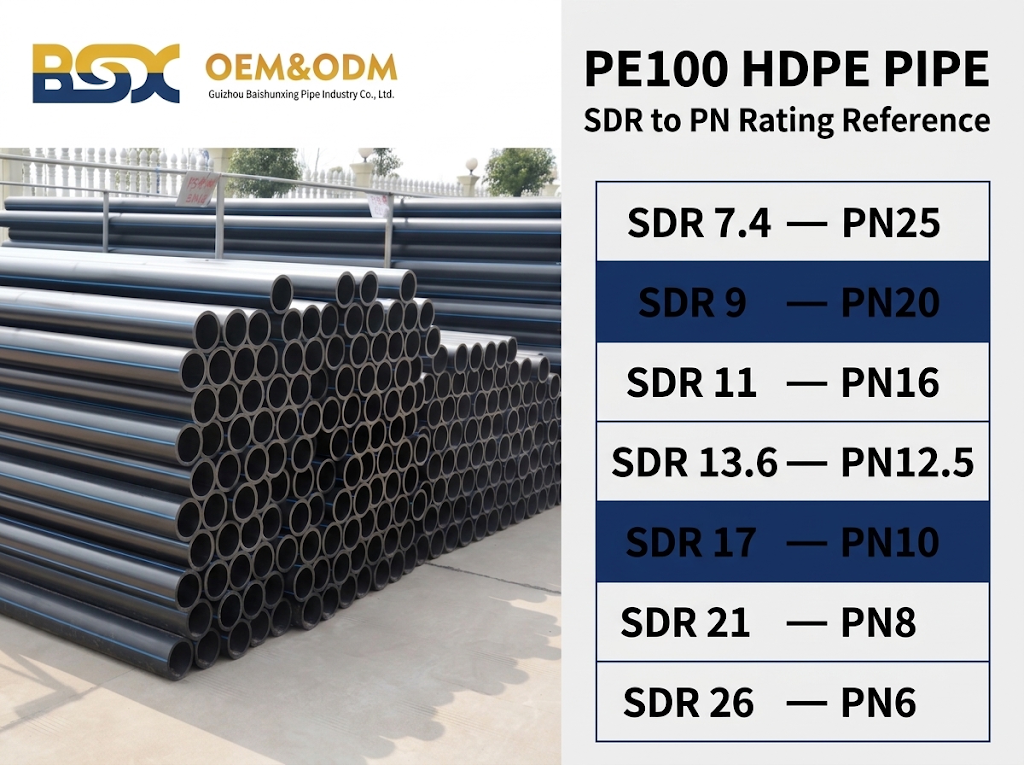
PN Rating Explained: How Nominal Pressure Relates to Material Grade, SDR, and Safety Margins
From MRS to PN: Calculating Nominal Pressure Using Minimum Required Strength and Design Coefficient C
Nominal Pressure (PN) is not an intrinsic property of HDPE pipe—it is a standardized pressure class derived from material performance and safety philosophy. Under ISO 12162, PN is calculated as:
PN = 20 × MRS / (C × (SDR − 1)),
where MRS is Minimum Required Strength (in MPa), C is the design coefficient (typically 1.25 for water at 20°C), and SDR is the dimensional ratio.
For PE100 (MRS = 10.0 MPa), allowable hoop stress is 8.0 MPa; for PE80 (MRS = 8.0 MPa), it’s ~6.3 MPa. Consequently, the same SDR yields different PN values: PE100 SDR 17 = PN 10, while PE80 SDR 17 = PN 8. This underscores a critical specification principle: PN alone is insufficient—material grade and SDR must be specified together to ensure performance alignment.
Why PE4710 HDPE Pipe Delivers Higher PN at Identical SDR vs. PE100 or PE80
Material grade drives real-world pressure capacity—and PE4710 HDPE delivers superior hydrostatic design basis compared to PE80 and, under North American practice, often exceeds PE100 in field-rated performance. While ISO standards define PE100 by MRS, ASTM D3350 defines PE4710 by Hydrostatic Design Basis (HDB) of 1,600 psi at 73.4°F, translating to an HDS of ~1,000 psi (6.9 MPa). That enables higher pressure ratings at equal SDR:
| Material grade | MRS / HDB | Allowable stress | SDR 17 rating |
|---|---|---|---|
| PE80 (ISO) | 8.0 MPa | ≈6.3 MPa | PN 8 |
| PE100 (ISO) | 10.0 MPa | 8.0 MPa | PN 10 |
| PE4710 (ASTM) | HDB 1,600 psi at 73.4°F | ≈1,000 psi (6.9 MPa) | 125 psi (≈8.6 bar) |
Note the key distinction: PE4710’s 125 psi rating at SDR 17 reflects ASTM-based design practice, whereas PN 10 for PE100 reflects ISO conventions using C = 1.25. Direct comparisons require matching design coefficients, temperature bases, and test durations—not just PN class labels. Procurement specifications should therefore reference both material standard (e.g., ASTM D3350 or ISO 4427) and SDR, not PN alone.
Selecting SDR and PN for Real-World Water Supply Applications
Matching HDPE Pipe Ratings to System Requirements: Working Pressure, Surge Events, and Safety Factors
Selecting HDPE pipe requires evaluating both steady-state and transient conditions. Designers first compare the pipe’s Maximum Operating Pressure (MOP) against the system’s maximum expected working pressure—including static head, pump shut-off pressure, and safety factors. A typical safety factor for water transmission ranges from 1.5 to 2.0, depending on cyclic loading, temperature exposure, and service life expectations.
Surge events demand separate analysis. Per the PPI Handbook (2021), occasional surge pressure should not exceed 1.6× the pipe’s pressure class, while repetitive surges must remain ≤1.0× the class. For example, a system operating at 100 psi with a 40 psi surge reaches 140 psi—within the occasional surge allowance for a 100 psi-rated pipe but potentially exceeding limits for frequent cycling. Lower SDR (e.g., SDR 11 instead of SDR 17) provides built-in margin for surge, installation uncertainty, and long-term creep effects.
Temperature also matters: HDPE’s pressure rating declines above 23°C, requiring derating per ASTM D2837 or ISO 13761. Finally, system integrity depends on compatible fittings, joint integrity, and anticipated service life—factors that reinforce why SDR selection must go beyond minimum code compliance.
Installation Context Matters: Why Trenchless Methods (e.g., HDD) Often Require Lower SDR HDPE Pipe
Trenchless installation—especially Horizontal Directional Drilling (HDD)—imposes axial tension, bending, and external pressure loads far exceeding those of open-cut burial. As a result, contractors routinely specify lower SDR (thicker-wall) pipe—even when pressure requirements alone would permit higher SDR.
For instance, HDD projects commonly use SDR 11 or SDR 13.5 instead of SDR 17 for the same nominal pressure class. The thicker wall improves ring stiffness, pullback capacity, and collapse resistance under slurry or hydrostatic loads. Industry guidance suggests limiting maximum pulling stress for PE4710 to 1,000–1,200 psi at 23°C—values often requiring thicker walls than pressure rating alone dictates.
Lower SDR also affects flexibility: thicker walls reduce allowable bending radius, so bore path curvature must be verified against the pipe’s long-term bending limit. In short, HDPE pipe for HDD must satisfy dual criteria—pressure containment and installation survivability—making SDR selection inseparable from construction methodology and site-specific load modeling.
Frequently Asked Questions (FAQ)
What does SDR stand for?
SDR stands for Standard Dimension Ratio, a measure of the ratio between a pipe's outside diameter and its minimum wall thickness.
Why is SDR important for HDPE pipes?
SDR determines the pressure capacity and wall thickness of HDPE pipes. Lower SDR values indicate thicker walls and higher pressure capacity, while higher SDR values mean thinner walls and lower pressure capacity.
How does SDR affect Maximum Operating Pressure (MOP)?
SDR has an inverse relationship with MOP. As the SDR increases, the wall thickness of the pipe decreases, resulting in reduced resistance to internal pressure and lower MOP.
What is PN rating, and how is it calculated?
PN rating, or Nominal Pressure, is a standardized pressure class derived from material performance and safety considerations. It is calculated based on material strength, design coefficient, and the SDR value.
Why are pipes with lower SDR values preferred for trenchless installation methods like HDD?
Pipes with lower SDR values (thicker walls) are preferred for trenchless installations because they provide better resistance to axial tension, bending, and external pressure loads, ensuring installation survivability and system performance.