 EN
EN

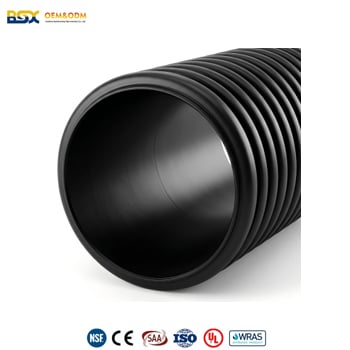
Understanding Ring Stiffness (SN) in HDPE Drainage Pipe Design
How SN Ratings Quantify Structural Resistance to Soil Load
Ring stiffness (SN) is the primary metric for evaluating how HDPE drainage pipes resist deformation under external soil loads. Unlike rigid pipes—whose strength depends solely on wall material—flexible HDPE pipes rely on a synergistic load-transfer mechanism: under vertical soil pressure, the pipe deflects slightly, engaging the surrounding backfill to generate passive lateral resistance. This soil-pipe interaction shifts a substantial portion of the load from the pipe wall to the soil envelope. Higher SN ratings (e.g., SN 8, SN 12, SN 16) reflect increased wall thickness and correspondingly greater resistance to deflection. The standardized SN classification enables engineers to select appropriate pipe stiffness for anticipated burial depth, soil type, and loading conditions—ensuring long-term structural integrity and hydraulic performance without excessive ovality or flow restriction.
Burial Depth Guidelines for SN 8, SN 12, and SN 16 HDPE Drainage Pipe in Cohesive vs. Granular Soils
Burial depth limits for HDPE drainage pipe depend critically on both SN rating and soil classification. Granular soils—such as well-graded sands and gravels—provide superior passive resistance due to interlocking particle structure and higher friction angles. In contrast, cohesive soils like clays offer limited lateral support, especially when saturated or poorly compacted. As a result, SN 8 pipe may be suitable up to 1.5 m in granular backfill but typically limited to 0.8–1.0 m in cohesive soils under equivalent traffic loading. SN 12 extends these ranges to approximately 1.5–3.0 m in granular soils and 1.0–2.0 m in cohesive soils. SN 16 provides the highest standard stiffness, supporting depths beyond 3.0 m in granular soils and up to 2.0 m in cohesive soils—and is essential for heavy surcharge or high-traffic applications. These are general benchmarks; final selection must be validated through site-specific analysis incorporating actual soil properties, compaction levels, and design standards such as ASTM D2321 and AASHTO LRFD.
HDPE Drainage Pipe Performance Under Dynamic Traffic Loads
Load Distribution Mechanisms: How Flexible HDPE Pipes Leverage Passive Soil Support
HDPE drainage pipes withstand dynamic traffic loads not by resisting deformation rigidly, but by controlled elastic deflection into properly engineered backfill. This deflection compresses the sidefill, mobilizing passive soil resistance that counterbalances the applied vertical load—a principle known as soil-pipe interaction. Achieving this behavior requires a well-graded, granular embedment (e.g., crushed stone) compacted in uniform lifts to at least 90% of standard Proctor density. When installed correctly, the system maintains deflection within the 5–7.5% range specified in ASTM D2321. While higher SN ratings—such as SN 12 or SN 16—reduce absolute deflection under a given load, they do not change the fundamental reliance on soil support. Instead, they enhance margin and predictability, particularly where compaction consistency is challenging or cover depth is constrained.
Validated Performance: SN 16 HDPE Drainage Pipe Meeting AASHTO LRFD H-20 Requirements at 1.2 m Cover
Shallow-cover installations demand exceptional load-bearing assurance—especially under repetitive, high-magnitude traffic loads. The AASHTO LRFD H-20 standard specifies an 80 kN (18 kip) axle load applied over a single tire footprint, representing typical heavy vehicle service. Independent third-party testing confirms that SN 16 HDPE pipe, installed with Class I or Class II granular embedment compacted to specification, meets or exceeds H-20 requirements at just 1.2 m of cover. Under full-load testing, deflection remains consistently below 5% and fully recovers post-loading—demonstrating resilient, elastic behavior. This verified performance makes SN 16 the preferred choice for critical shallow-burial applications including roadway crossings, airport aprons, and industrial yard drainage, where long-term reliability under cyclic loading is non-negotiable.
Critical Installation Factors That Determine Real-World HDPE Drainage Pipe Performance
Trench Backfill Quality, Compaction Control, and Their Impact on Achieved Ring Stiffness
The nominal SN rating of an HDPE drainage pipe is only realized in service when the surrounding soil envelope delivers adequate lateral confinement. Trench backfill quality and compaction control are therefore decisive—not secondary—factors in field performance. Poorly graded, fine-grained, or inadequately compacted backfill fails to develop sufficient passive resistance, causing even high-SN pipes to exceed allowable deflection limits. For example, an SN 16 pipe installed in loose clay may perform no better than an SN 8 pipe in well-compacted gravel. Industry best practice mandates granular, free-draining backfill (e.g., ASTM D2321 Class I or II) placed and compacted in maximum 150 mm lifts to ≥90% standard Proctor density. This systematic approach ensures optimal soil-pipe interaction—the very foundation of flexible pipe design. Skipping or shortcutting these steps risks excessive ovality, joint separation, infiltration/exfiltration, and premature structural degradation.
FAQ
What is ring stiffness (SN) in HDPE drainage pipes?
Ring stiffness (SN) measures a pipe's ability to resist deformation under external soil loads using a synergistic load-transfer mechanism between the pipe wall and surrounding soil.
Why are SN ratings important?
Higher SN ratings (e.g., SN 8, SN 12, SN 16) indicate thicker walls and greater resistance to deflection, allowing for optimized pipe selection based on burial depth, soil type, and load conditions.
How do soil types affect burial depth for HDPE pipes?
Granular soils offer better passive resistance and allow deeper burial depths compared to cohesive soils, which provide less lateral support, particularly when poorly compacted or saturated.
What does an SN 16 pipe achieve under shallow cover?
SN 16 pipes can meet AASHTO LRFD H-20 requirements under 1.2 m of shallow cover with verified performance under heavy repetitive traffic loads.
Why is backfill quality critical for HDPE pipe performance?
Proper trench backfill and compaction provide the lateral support needed for the soil-pipe interaction to maximize ring stiffness and maintain structural integrity over time.