 EN
EN

In conclusion: if you plan to use this irrigation system for more than five years, and it inevitably involves exposure to sunlight, being buried in the soil, and running fertilizer water, HDPE irrigation pipes are generally a more worry-free choice than PVC irrigation pipes. PVC is cheap, lightweight, and easy to buy—that's true; but the two things that are most abundant in farmland are precisely what it fears most—excessive sunlight and acids/alkalis. This article will not be abstract; it will focus on two things: how PVC pipes typically fail in the fields, and how a large Thai farm calculated its costs after switching to HDPE irrigation pipes.
What are the differences between HDPE irrigation pipes and PVC irrigation pipes?
Material determines characteristics. PVC pipes are hard and brittle, but cheap; HDPE pipes are tough and more expensive, but they effectively fill in most of the potholes that are common in agricultural environments. A table to illustrate:
|
Comparison items |
PVC irrigation pipe |
HDPE irrigation pipe |
|
Material and feel |
Hard and brittle, easily cracked when bumped or hit. |
Flexible, bendable, and impact resistant |
|
UV protection |
Without protection, it is easily powdered and brittle when exposed to the sun. |
The pipe wall contains an anti-UV formula, allowing for long-term outdoor use. |
|
Low temperature performance |
It becomes brittle at low temperatures and is prone to cracking in winter. |
It remains resilient even at -40℃ and is not easily damaged by freezing. |
|
High temperature performance |
Long-term high-temperature water transport can easily soften and deform |
Stable water supply can be maintained for extended periods below 60℃. |
|
Connection method |
The joints are mainly glued or socketed, and are prone to leakage. |
Hot-melt butt welding, the joint strength is not lower than that of the pipe body. |
|
Inner wall and resistance |
Relatively rough, prone to scaling |
Smooth surface, low resistance, and more energy-efficient water delivery |
|
Design life |
Generally, it takes more than ten years, and even shorter in the open air. |
Designed for a 50-year lifespan (using PE100 grade raw materials) |
|
Full life cycle cost |
Cheap to buy, but frequent repairs and replacements later on. |
Slightly expensive initially, but requires virtually no maintenance later on. |
After looking at the table, you'll notice a pattern: almost every advantage of HDPE corresponds to a specific way PVC dies in farmland.
How do PVC pipes in farmland usually break?
Anyone who works in irrigation projects knows that PVC pipes rarely die of old age; most of them fail in the following ways:
- It's sun-damaged. The ultraviolet rays first cause the pipe surface to powder and turn white, then it gradually becomes brittle, crumbling easily when scratched. In places like Thailand with strong year-round sunlight, PVC pipes laid outdoors often start to have problems after two or three years.
- Damaged by freezing or heat. In cold winter regions, the brittle pipe walls crack directly when the water inside freezes; in tropical regions or regions with sustained high summer temperatures, the pipes soften and deform after carrying hot water for extended periods.
- The leak started at the joint. The glued socket is the weakest link in the entire pipeline: the glue ages, and the pipe expands and contracts with temperature changes. Nine times out of ten, leaks in the field start at the joint, and they are difficult to repair.
- It was damaged by being soaked in fertilizer solution. Irrigation water often contains dissolved fertilizers and acidic chemicals, and PVC exposed to these for extended periods ages much faster than PVC in clean water.
These four points correspond precisely to the four strengths of HDPE irrigation pipes.
Why are HDPE irrigation pipes more durable in the fields?
- UV resistant. An anti-UV aging formula is added during production, and the pipe wall has its own protective layer. According to accelerated aging tests, after simulating 20 years of continuous sunlight exposure, the tensile strength of HDPE irrigation pipes still retains approximately 92%; under the same conditions, PVC only retains about 65%. The difference is immediately apparent when laid outdoors.
- It is resistant to both cold and heat. From the frigid winter of -40℃ to the high temperature of 60℃ water, HDPE remains within its stable operating range and will not become brittle when cold or soft when hot.
- Flexible and impact-resistant. After being buried, it can adapt to soil pressure and slight geological settlement, and will not crack due to water hammer impact during water transport.
- A welded joint is essentially no joint at all. Butt fusion fuses two pipe sections into one, ensuring the joint strength is no less than that of the pipe body itself. This eliminates weak points in the entire pipeline, naturally reducing leakage.
- Incidentally, the smooth inner wall also has a hidden benefit: for the same pipe diameter and flow rate, HDPE has lower water transmission resistance, which can save a significant amount on pump station electricity costs over the years.
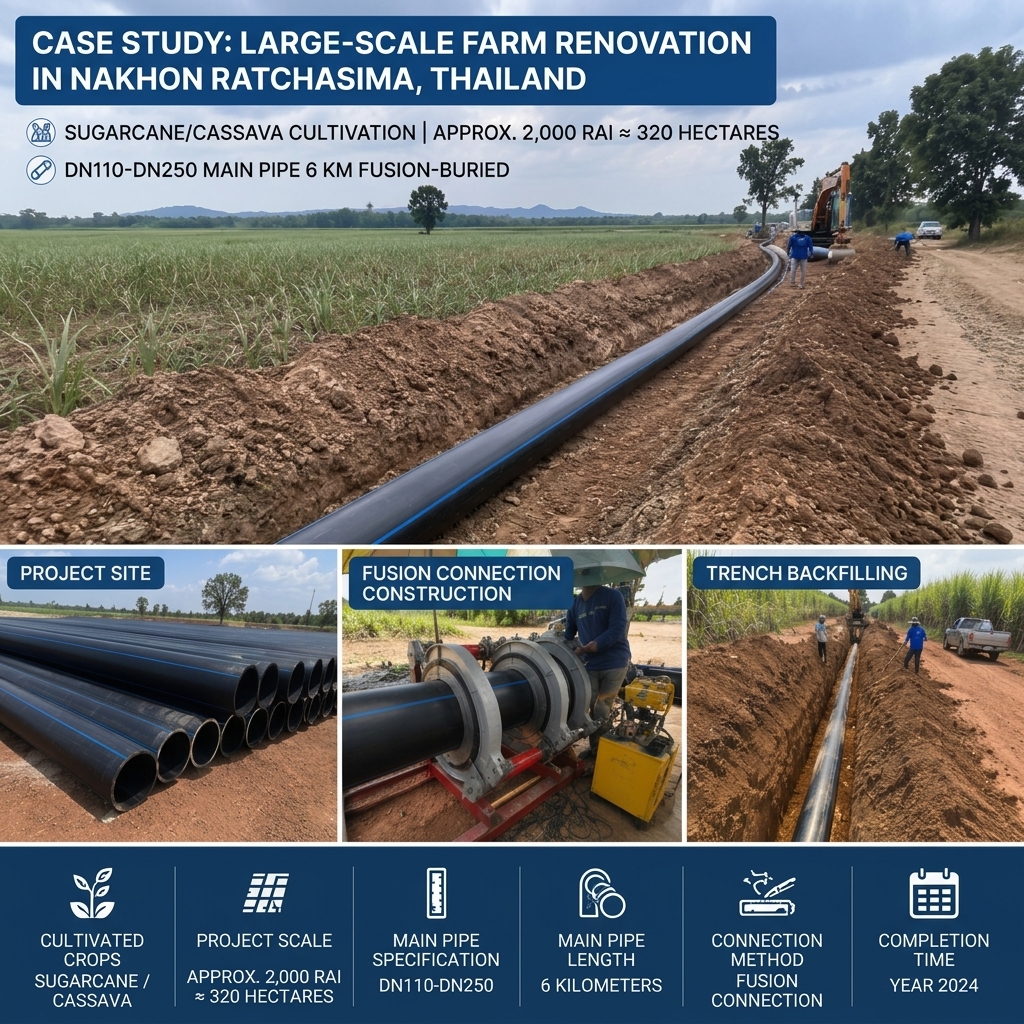
Case Study: The Transformation Account of a Large Farm in Nakhon Ratchasima Province, Thailand
Instead of just listing parameters, let's look at a case study. In Nakhon Ratchasima province, Thailand, there's a large farm primarily engaged in sugarcane and cassava cultivation, with an irrigated area of approximately 2,000 rai (about 320 hectares). The pumping station's distance to the furthest plot exceeds 5 kilometers. Before the upgrade, the farm used PVC main pipes that had been in service for seven or eight years, connected to open channels at the end.
- The adhesive joints of the PVC main pipes began to leak, and the exposed sections became brittle from the sun. During the dry season when water was scarce, the pumps had to be stopped several times a month to repair the leaks.
- Leakage and evaporation at the end of the open channel result in visible water loss, requiring pumps to run for longer periods to provide enough water.
In 2024, the farm replaced its entire main pipeline network with PE100 grade HDPE irrigation pipes, ranging in diameter from DN110 to DN250, with a total length of approximately 6 kilometers. All pipes were hot-melt welded and buried underground, with construction starting in phases on the two furthest plots. After a full dry season in 2025, the farm's financial situation was clear:
- The water conveyance process has essentially stopped leaking, the pumping station's operating time has decreased by about 20% compared to previous years, and electricity costs have followed suit.
- No irrigation interruptions or emergency repairs were needed due to leaks or burst pipes throughout the dry season—a routine operation that typically occurs 3-5 times a year.
- The farm manager put it bluntly: "In the past, during the dry season, we were most afraid of getting a call in the middle of the night saying that a section had leaked again. Now we can get a full night's sleep."
The core of this calculation is actually quite simple: the renovation costs can be recouped in about two years through savings in electricity, water, and maintenance fees, while HDPE irrigation pipes are designed for a lifespan of 50 years.
HDPE irrigation pipes are more expensive per unit, so why is the overall cost actually lower?
While HDPE irrigation pipes are indeed more expensive per meter than PVC pipes, farms aren't buying just a meter of plastic; they're buying a complete water supply system that will last for twenty years.
- The lifespan difference is two to three times or more; when spread out over a year, the more expensive option actually becomes cheaper.
- Leak-free operation and water and electricity savings happen every day;
- Maintenance-free; no need to stock up on glue, connectors, or hire someone to repair leaks every year.
- Construction is not slow: hot-melt welding is fast, and small-diameter pipes can be shipped in coils and transported to the construction site in whole rolls, saving loading, unloading and hoisting costs.
For farms with tight budgets, industry experts usually recommend replacing the main pipeline from the pump station to the field first, and then replacing the branch pipelines year by year—this is how most farms transitioned, and the results were just as noticeable.
Several frequently asked questions by farmers regarding HDPE irrigation pipes
Q: How many years can HDPE irrigation pipes be used?
A: PE100 grade raw materials are designed for a 50-year lifespan. Under normal underground conditions with normal water temperature and pressure, a lifespan of 20 to 30 years is common. For outdoor use, it is recommended to choose black pipes with UV-resistant formulations.
Q: Can it be buried directly in the ground? Won't it be damaged by the soil?
A: Yes, and burying is recommended. HDPE has good flexibility and can adapt to slight geological settlement; with a burial depth of 0.6–1 meter and avoiding sharp rocks during backfilling, there is basically no need to worry about soil pressure issues.
Q: Can it be connected to the existing PVC pipe?
A: Yes, but a special adapter must be used for the transition; PVC glue cannot be used on PE pipes. During phased renovations, retaining some PVC branch pipes and connecting them with adapters is a common practice.
Q: Is HDPE suitable for the main pipes of drip irrigation and sprinkler irrigation systems?
A: Yes, it's suitable. It's the preferred choice for main pipes in most drip irrigation and sprinkler irrigation projects. Drip irrigation requires stable pressure and high cleanliness, and HDPE's smooth inner wall is less prone to scaling and resistant to water hammer, making it a perfect fit.
Q: How do you ensure quality? I'm worried about buying recycled materials.
A: Look for PE100/PE80 raw materials and markings on the pipe body (implementation standard, SDR, wall thickness); cut it open to check if the cross-section is dense and uniform; check if the flanges are uniform during heat fusion. Buying recycled pipes just to save money will cause problems after two or three years of burial.
In conclusion
There's no standard answer when choosing irrigation pipes, but here's a piece of advice: for temporary lines and short-term projects, cheap pipes are sufficient; for any fixed irrigation system planned for more than ten years, going straight for HDPE irrigation pipes is likely the last decision you'll make. Before purchasing, ask the supplier to send two samples, bury them in the ground and let them dry for a rainy season—the answer will speak for itself.
Table of Contents
- What are the differences between HDPE irrigation pipes and PVC irrigation pipes?
- How do PVC pipes in farmland usually break?
- Why are HDPE irrigation pipes more durable in the fields?
- Case Study: The Transformation Account of a Large Farm in Nakhon Ratchasima Province, Thailand
- HDPE irrigation pipes are more expensive per unit, so why is the overall cost actually lower?
- Several frequently asked questions by farmers regarding HDPE irrigation pipes
- In conclusion