 EN

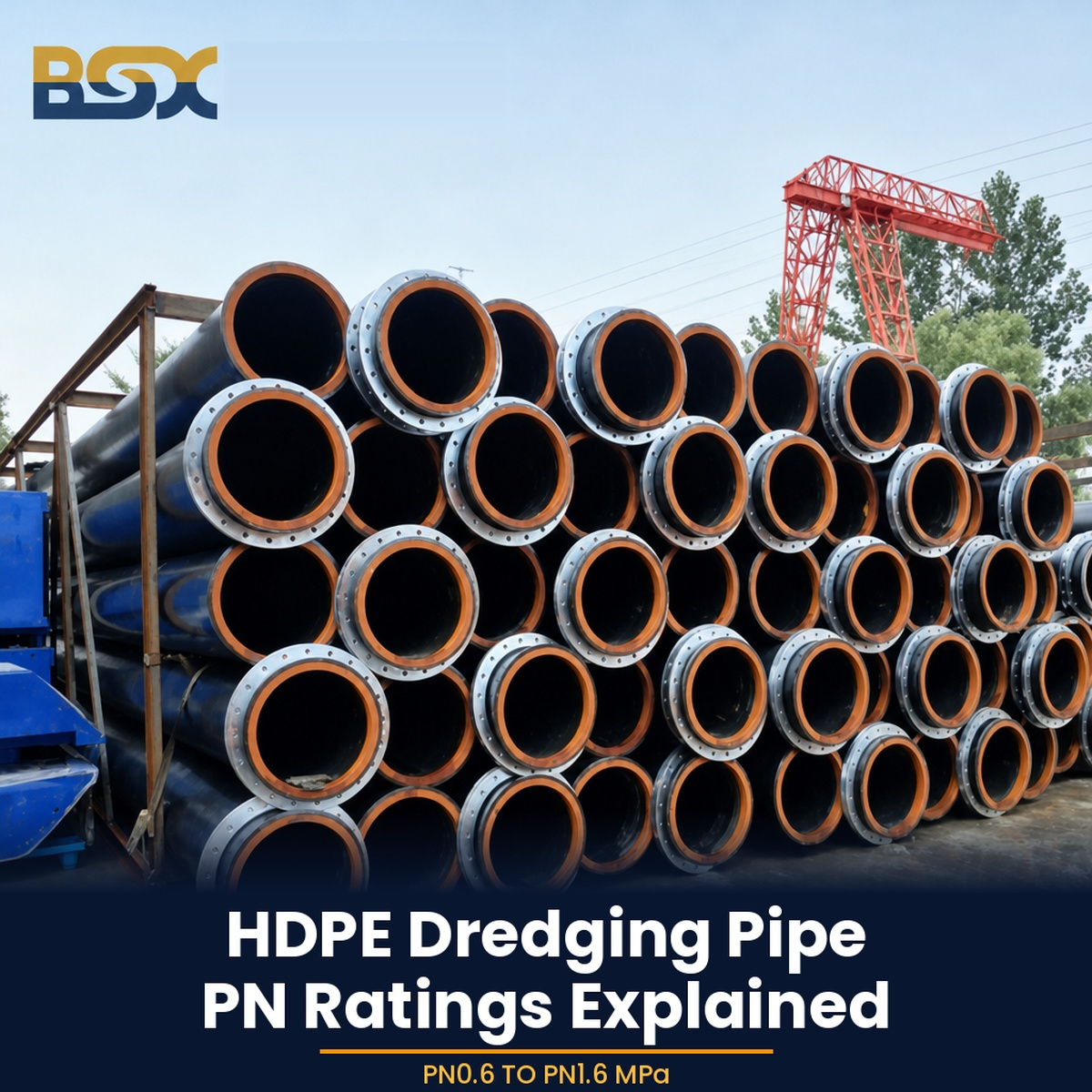
Quick answer: PN is the nominal pressure class of an HDPE pipe, expressed in bar (10 bar = 1.0 MPa).
For PE100, SDR26, SDR17, SDR13.6 and SDR11 correspond to roughly PN6, PN10, PN12.5 and PN16 at the
reference temperature. Choose the class from pump pressure, surge pressure, temperature and material
grade, not from PN alone.
Introduction
Selecting the correct pressure rating is an important part of designing an HDPE dredging
pipeline. The pipe must transport water mixed with sand, mud, silt, and other materials while handling the pressure created by the pumping system.
HDPE dredging pipes are available in different pressure classes, commonly specified according to PN ratings. These ratings help buyers and engineers understand the nominal pressure
capacity of a pipe under defined reference conditions.
For dredging projects, pressure selection requires particular attention because pipeline
conditions can change during operation. Pump pressure, transportation distance, elevation differences, slurry characteristics, and sudden flow changes can all affect the system.
This guide explains HDPE dredging pipe PN ratings from PN0.6 to PN1.6, their relationship with SDR and wall thickness, and how to select a suitable pressure class for different dredging
applications.
What Does PN Mean in HDPE Dredging Pipes?
PN stands for Nominal Pressure. It indicates the nominal pressure classification of a pipe under specified reference conditions.
For HDPE pipes, PN is commonly expressed in bar. Some manufacturers and project specifications express the same pressure classes in MPa.
The conversion is:
● 0.6 MPa = 6 bar (PN6)
● 1.0 MPa = 10 bar (PN10)
● 1.25 MPa = 12.5 bar (PN12.5)
● 1.6 MPa = 16 bar (PN16)
These values represent nominal pressure classes, not guaranteed operating limits under every condition.
For example, a PE100 pipe classified as PN1.6 MPa is generally associated with a 16-bar nominal pressure rating at the applicable reference temperature and design conditions.
However, the allowable operating pressure can change with temperature, material grade, design coefficient, and service requirements.
Buyers should therefore check the manufacturer's technical datasheet before selecting a pipe.
HDPE Dredging Pipe PN Ratings: PN0.6 to PN1.6
Different pressure classes are suitable for different pipeline requirements. The following table explains the four pressure levels covered in this guide.
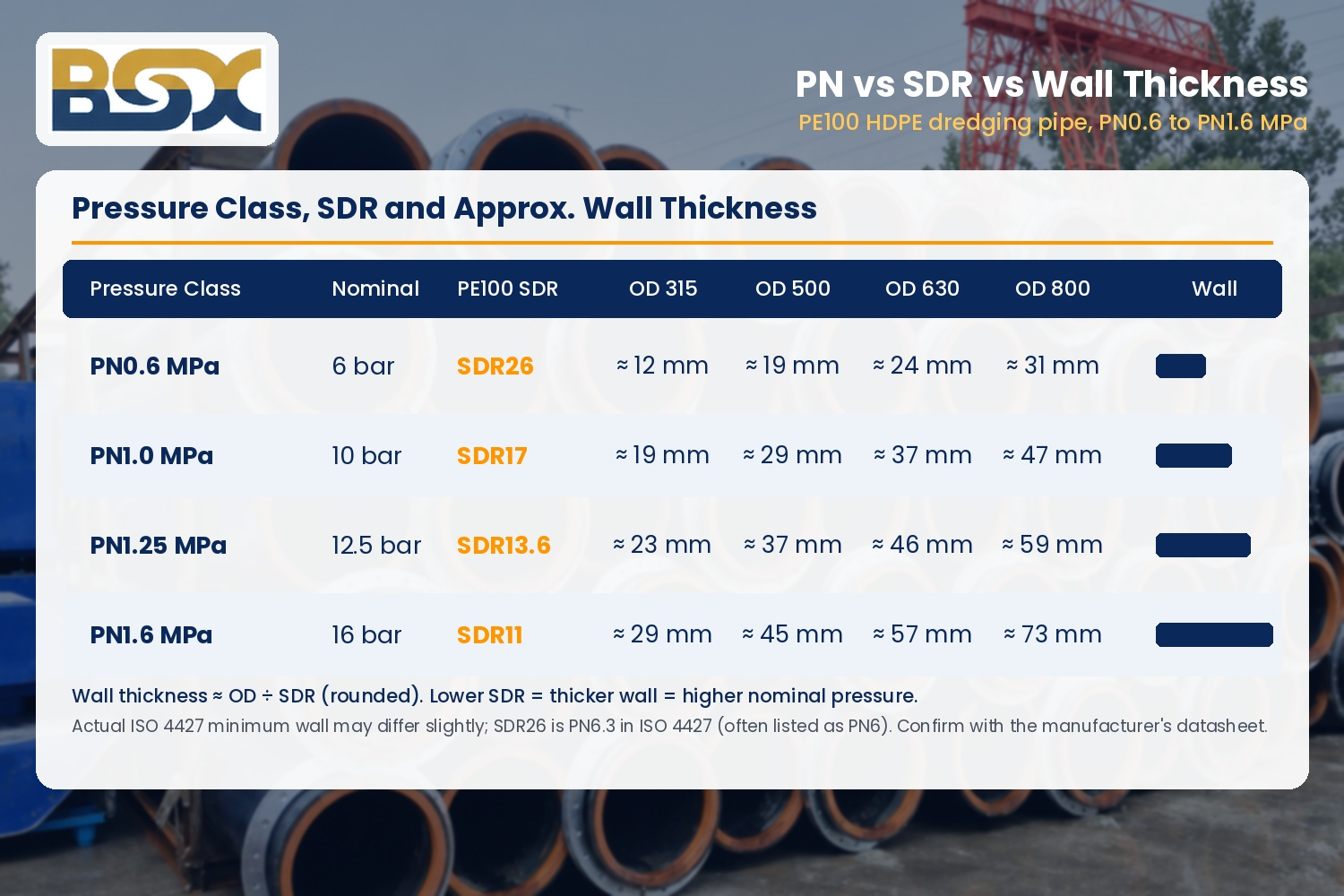
Lower SDR means a thicker wall and a higher nominal pressure class.
These are commonly used PE100 water-pressure classifications based on the applicable ISO dimensional and design conventions. Actual product availability and dimensional tolerances should be confirmed with the manufacturer.
PN0.6 MPa (6 Bar) HDPE Pipe
PN0.6 MPa represents a nominal pressure class of 6 bar.
It may be considered for lower-pressure pipeline applications where the calculated operating pressure remains within the allowable design limit.
Potential applications include certain low-head discharge systems, water transportation lines, and dredging projects with suitable pumping and pipeline conditions.
However, a lower pressure class should not be selected simply because the pipeline is relatively short. Pump discharge pressure, elevation differences, and transient pressure must also be
considered.
PN1.0 MPa (10 Bar) HDPE Pipe
PN1.0 MPa corresponds to a nominal pressure rating of 10 bar.
This pressure class offers a higher nominal pressure capacity than PN0.6 and may be suitable for medium-pressure pumping and transportation systems.
It is important to evaluate the required flow rate, pipeline length, pump performance, and pressure losses before selecting this class.
For PE100 pipes under the relevant reference conditions, PN10 is commonly associated with SDR17.
PN1.25 MPa (12.5 Bar) HDPE Pipe
PN1.25 MPa represents a nominal pressure rating of 12.5 bar.
It may be considered for projects with higher pumping requirements or greater system pressure demands.
For PE100 pipes, this pressure class is commonly associated with SDR13.6.
Its thicker wall compared with SDR17 can provide greater pressure capacity at the same outside diameter. However, the internal diameter is smaller, which can influence flow velocity and friction losses.
PN1.6 MPa (16 Bar) HDPE Pipe
PN1.6 MPa corresponds to a nominal pressure rating of 16 bar.
It is commonly used where higher pressure resistance is required, subject to the applicable pipe design and operating conditions.
For PE100 pipes, PN16 is generally associated with SDR11.
The thicker wall can improve resistance to internal pressure, but it also increases pipe weight and reduces the internal diameter compared with lower-pressure configurations of the same outside diameter.
For dredging applications, engineers should verify whether the additional pressure capacity is necessary and whether the complete pipeline system can accommodate the selected pipe
configuration.
How PN Rating and SDR Are Connected
PN rating and SDR are closely related when selecting HDPE pressure pipes.
SDR stands for Standard Dimension Ratio. It is calculated by dividing the pipe's outside diameter by its wall thickness.
SDR = Outside Diameter ÷ Wall Thickness
A lower SDR means a thicker wall relative to the outside diameter. This generally allows the pipe to withstand a higher internal pressure.
For example, at the same outside diameter:
● SDR26 has a relatively thinner wall.
● SDR17 has a thicker wall than SDR26.
● SDR13.6 has a thicker wall than SDR17.
● SDR11 has a thicker wall than SDR13.6.
For PE100 pipes, these configurations commonly correspond to PN6, PN10, PN12.5, and PN16 respectively under the applicable reference conditions.
TheVinidex PE Pipe Selection Technical Guide explains the relationship between polyethylene material grades, SDR, wall thickness, and nominal pressure ratings.
This relationship is important because buyers should specify both the material grade and SDR rather than ordering HDPE pipes using PN ratings alone.
Factors to Consider When Selecting a Dredging Pipe PN Rating
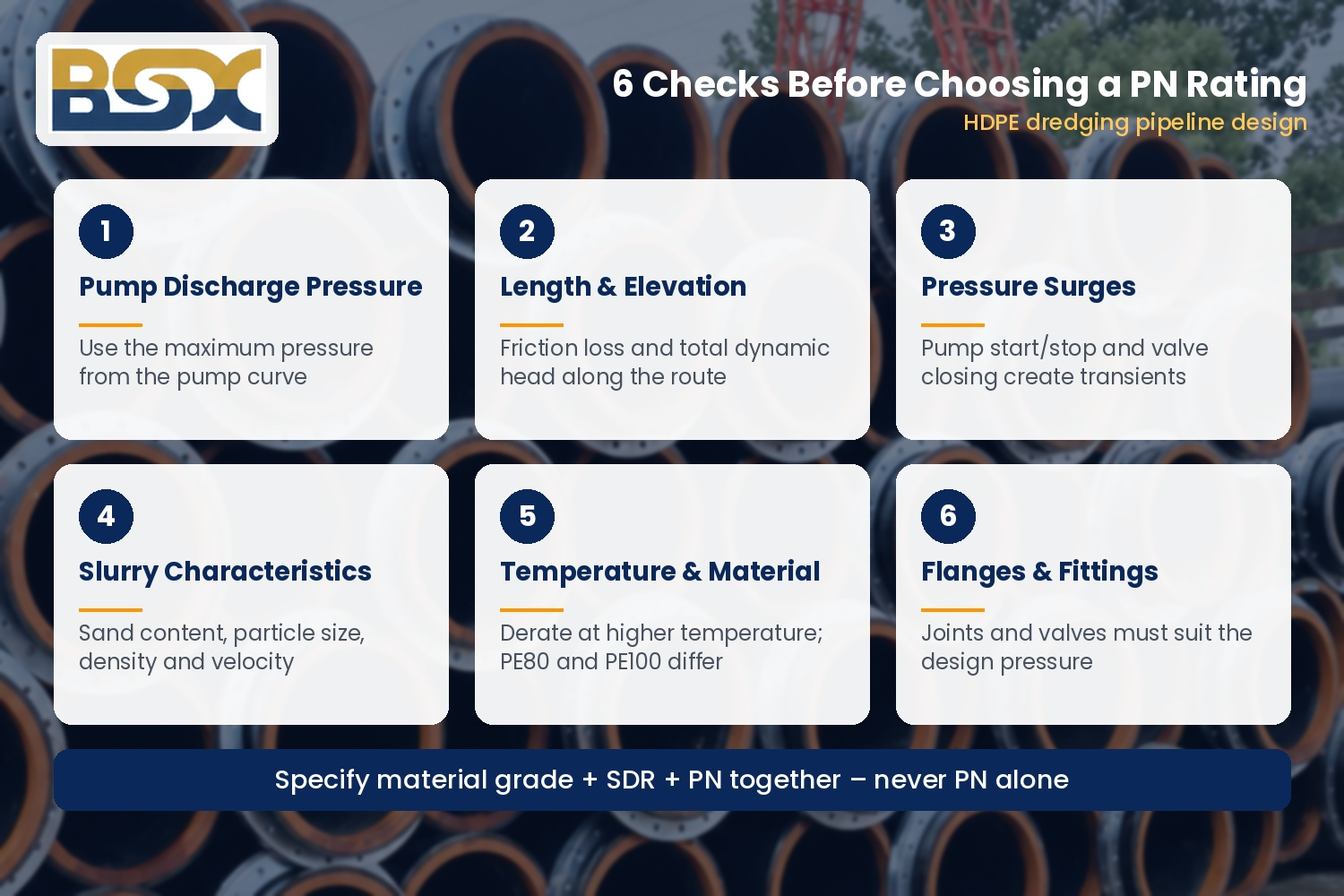
Check these six factors together, not the PN rating alone.
Pump Discharge Pressure
The pump's operating pressure is one of the main factors in pipe selection.
Check the pump performance curve and identify the maximum expected discharge pressure under the intended operating conditions.
The selected pipe must accommodate the required pressure without exceeding its allowable design limit.
Pipeline Length and Elevation
Longer pipelines can experience greater friction losses.
Changes in elevation also influence the pressure required to transport slurry between the dredging location and discharge point.
Engineers should calculate the total dynamic head and determine the pressure requirements throughout the pipeline route.
Pressure Surges
Pressure can increase suddenly when pumps start or stop, valves close, or flow conditions change.
These transient events are particularly important in long dredging pipelines.
The design should account for surge pressure rather than relying only on normal operating pressure.
Slurry Characteristics
Dredging pipelines transport mixtures of water and solid particles.
Sand concentration, particle size, slurry density, and flow velocity influence the operating conditions.
Although PN rating primarily describes pressure capacity, engineers must also evaluate abrasion resistance, pipe wall thickness, and suitable transportation velocity.
Temperature and Material Grade
HDPE pressure ratings are based on defined reference conditions.
Higher operating temperatures may require pressure derating. Material grade also matters because PE80 and PE100 pipes with the same SDR do not necessarily have the same
pressure rating.
The Plastics Pipe Institute's HDPE Technical Resources provide further information about polyethylene pipe design, material properties, and pressure applications.
Common Mistakes When Selecting HDPE Dredging Pipe PN Ratings
Several mistakes can create unnecessary costs or operational risks.
Selecting PN without checking SDR: Pressure rating and wall thickness should be considered together.
Ignoring material grade: PE80 and PE100 have different pressure performance at the same SDR.
Overlooking pressure surges: Normal operating pressure does not represent every possible pipeline condition.
Ignoring internal diameter: Thicker walls reduce the available internal diameter and can affect hydraulic performance.
Choosing pressure class without calculations: The pump, pipeline length, elevation, and slurry conditions must all be evaluated.
Ignoring connection ratings: Flanges, fittings, valves, and joints must also be suitable for the design pressure.
A properly designed dredging system should consider every component rather than relying on the pipe's PN rating alone.
Choosing the Right HDPE Dredging Pipe Supplier
A reliable supplier should provide accurate information about material grade, SDR, pressure class, outside diameter, wall thickness, and available connection options.
BSX Pipe offers HDPE dredging pipes manufactured using PE100, PE4710, and PE100RC materials.
Its published product range includes DN50mm to DN1000mm diameter options and different SDR configurations, including SDR17, SDR13.6, SDR11, and SDR9.
Buyers can explore theBSX HDPE Dredging Pipe range for available specifications and produc information.
For floating and underwater pipeline applications, theBSX HDPE Floating Dredging Pipeline provides additional information about dredging pipeline configurations.
When requesting a quotation, provide the required diameter, material grade, SDR, PN rating, pipe length, connection type, and operating conditions.
This information helps the supplier identify a suitable configuration for the intended dredging project.
Conclusion
HDPE dredging pipe PN ratings help buyers understand the nominal pressure classification of a pipeline. PN0.6, PN1.0, PN1.25, and PN1.6 MPa correspond to nominal pressure classes of 6, 10, 12.5, and 16 bar respectively.
However, selecting the right pressure class requires more than comparing these numbers.
Material grade, SDR, wall thickness, pump pressure, pipeline length, temperature, and pressure surges all influence the final decision.
For reliable dredging operations, engineers should evaluate the complete pipeline system and confirm the manufacturer's technical specifications before ordering.
FAQ
What does PN1.6 mean in HDPE dredging pipes?
PN1.6 MPa represents a nominal pressure class of 1.6 megapascals, equivalent to 16 bar, under applicable reference conditions.
What is the difference between PN1.0 and PN1.6 HDPE pipes?
PN1.0 represents 10 bar, while PN1.6 represents 16 bar. For PE100 pipes, these commonly correspond to SDR17 and SDR11 respectively.
Does a lower SDR mean a stronger HDPE pipe?
A lower SDR means a thicker wall relative to the outside diameter. This generally provides greater internal pressure capacity, assuming the same material grade and design conditions.
Is PN16 always better than PN10 for dredging?
No. PN16 offers a higher nominal pressure rating, but it may increase material costs and reduce internal diameter. The appropriate class depends on the calculated system pressure and project requirements.
Can HDPE dredging pipes handle pressure surges?
They can be designed for systems involving pressure transients, but surge pressure must be calculated. The pipe, fittings, flanges, and connections must all meet the resulting design
requirements.
References
ISO 4427-2:2019:https://www.iso.org/standard/72184.html
PPI Handbook of Polyethylene Pipe:https://plasticpipe.org/Municipal_Industrial/Publications/Download-HDPE-Handbook-Chapters.aspx
PPI Handbook :Design of PE Piping Systems:http://plasticpipe.org/pdf/chapter06.pdf
PPI Handbook :Marine Installations:http://plasticpipe.org/pdf/chapter10.pdf
Marine Link::https://www.marinelink.com/news/plastics-pipe-institutes-handbook-updated-537766
Table of Contents
- Quick answer: PN is the nominal pressure class of an HDPE pipe, expressed in bar (10 bar = 1.0 MPa).For PE100, SDR26, SDR17, SDR13.6 and SDR11 correspond to roughly PN6, PN10, PN12.5 and PN16 at thereference temperature. Choose the class from pump pressure, surge pressure, temperature and materialgrade, not from PN alone.
- Introduction
- What Does PN Mean in HDPE Dredging Pipes?
- HDPE Dredging Pipe PN Ratings: PN0.6 to PN1.6
- How PN Rating and SDR Are Connected
- Factors to Consider When Selecting a Dredging Pipe PN Rating
- Temperature and Material Grade
- Common Mistakes When Selecting HDPE Dredging Pipe PN Ratings
- Choosing the Right HDPE Dredging Pipe Supplier
- Conclusion
- FAQ