 EN

What Is PVC Well Casing Pipe? Core Functions and Material Advantages
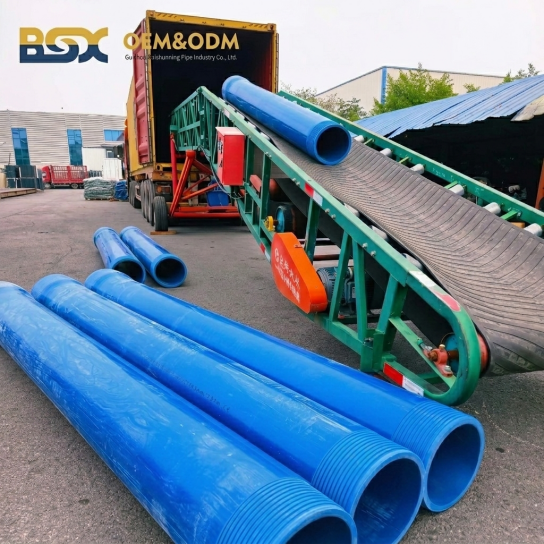
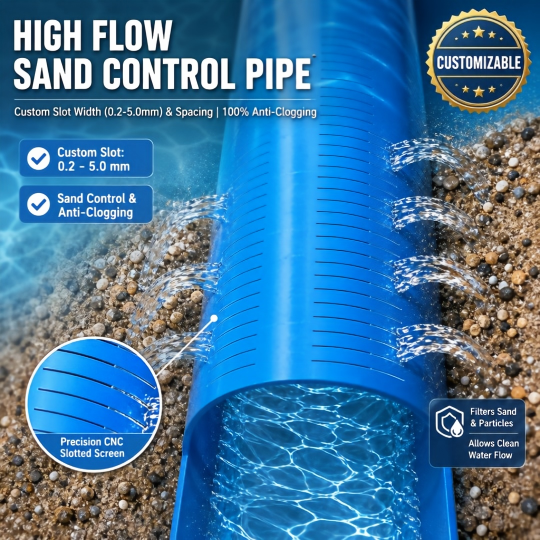
PVC well casing pipe is a rigid polyvinyl chloride tube installed in a drilled borehole to support the well structure, isolate selected geological formations, and provide a stable passage for groundwater extraction. Depending on the well design, casing may be installed with a screen to allow water to enter while limiting the movement of sand and other formation materials.
PVC is widely used in groundwater applications because it resists rust and many common forms of chemical corrosion. Its relatively low weight also simplifies transportation, handling, and installation compared with many metal alternatives. The smooth interior can help limit friction losses and reduce mineral scale accumulation under suitable water conditions. For residential wells, environmental monitoring, and dewatering projects, PVC casing can be a practical option when its dimensions, stiffness, joint design, and material properties meet the requirements of the site.
For drinking-water applications, buyers should verify whether the specific casing, screen, and relevant joining components have the required potable-water certification. NSF/ANSI/CAN 61 evaluates the health effects of materials and products that contact drinking water; certification should be confirmed for the actual product rather than assumed for all PVC pipe. Well design must also account for borehole stability, groundwater conditions, installation loads, and local regulations.
PVC Well Casing Pipe Types and Standards: Schedule 40, Schedule 80, and SDR
PVC well casing selection depends on more than wall thickness. The casing must resist the loads expected during installation and service, including external pressure from groundwater and surrounding soil, handling impacts, and forces transferred through joints. Schedule and SDR designations describe pipe dimensions, but they should not be used alone to determine whether a product is suitable for a particular well.
Understanding Schedule and SDR Ratings for PVC Well Casing
Schedule 40 and Schedule 80 pipes generally share the same outside diameter for a given nominal size, while Schedule 80 has a thicker wall and a smaller internal diameter. A thicker wall can provide greater resistance to certain loads, but actual performance depends on the material, pipe dimensions, manufacturing specification, and product testing.
SDR, or Standard Dimension Ratio, expresses the relationship between a pipe's specified outside diameter and wall thickness. A lower SDR indicates a thicker wall relative to the outside diameter. However, a lower SDR does not automatically establish the allowable external collapse pressure of a casing installation. External-pressure resistance also depends on pipe stiffness, ovality, material properties, unsupported length, groundwater conditions, and the support provided by the surrounding formation or grout.
ASTM F480 covers thermoplastic well casing pipe and couplings made in specified SDR, Schedule 40, and Schedule 80 dimensions. Its scope includes products used in water wells, groundwater monitoring, dewatering, and related applications, with requirements addressing pipe stiffness, impact resistance, joints, and other performance characteristics. The selected product should be checked against the relevant standard edition and local requirements.
ASTM F480 vs. ASTM D1785: Choosing the Appropriate Pipe Standard
ASTM F480 is specifically intended for thermoplastic well casing pipe and couplings. It addresses characteristics relevant to well construction, including dimensions, pipe stiffness, impact performance, and joint strength. These requirements help buyers evaluate whether a product is designed for casing service.
ASTM D1785 covers PVC Schedule 40, Schedule 80, and Schedule 120 pipe intended for distributing compatible pressurized liquids. It specifies requirements such as dimensions, sustained pressure, burst pressure, workmanship, and material classification. Although pipe made to ASTM D1785 may be suitable for some fluid-handling applications, compliance alone does not establish suitability for every well casing installation.
When sourcing PVC well casing, confirm the product's stated application, applicable standard, joint system, and mechanical performance data. Where potable water is involved, verify any required drinking-water certification for the actual product. Neither a pressure-pipe designation nor a material description by itself proves that the complete well system is suitable for drinking-water use.
PVC Well Casing Pipe Sizes, Dimensions, and Structural Performance
PVC well casing is available in different nominal diameters, wall thicknesses, and connection configurations. Nominal size should not be confused with actual outside or inside diameter. For example, a nominal 4-inch Schedule 40 PVC pipe made to the relevant dimensional specification has a nominal outside diameter of 4.5 inches and an inside diameter of approximately 4.026 inches. Other casing products may use different dimensional series, so the manufacturer's dimensional table should always be consulted.
Wall thickness and outside diameter influence pipe stiffness and the space available for water flow, pumps, and other well components. The correct casing diameter must accommodate the intended pump assembly and provide adequate clearance for installation and retrieval. Screen openings, where used, must also be selected to suit the formation and groundwater conditions.
Pressure classes are relevant to products designed for internal pressure, but well casing often faces substantial external loads. A casing may experience groundwater pressure, soil pressure, installation forces, and loads created by grouting or changes in water levels. Internal pressure ratings alone cannot demonstrate resistance to these conditions. Product-specific stiffness and collapse data, where available, provide a more appropriate basis for evaluation.
Matching PVC Casing Diameter and Wall Thickness to Well Conditions
The required diameter and wall thickness depend on borehole dimensions, geological conditions, well depth, groundwater levels, installation method, and the expected loads. Deeper installations may increase the demands on the casing, but depth alone does not determine which schedule or SDR should be selected.
Hydrostatic pressure increases with the height of a water column, at approximately 0.433 psi per foot for freshwater under typical conditions. This relationship describes the pressure associated with a water column; it does not, by itself, determine the external collapse capacity required for a well casing. Groundwater levels inside and outside the casing, soil support, temporary dewatering, and installation conditions all affect the actual pressure differential.
For this reason, it is not reliable to assign a universal SDR 26, SDR 21, or SDR 17 recommendation to a particular well depth without evaluating the site. A thicker-wall product may be appropriate where greater stiffness or external-load resistance is needed, but the choice should be supported by manufacturer data and engineering assessment. Larger diameters may improve hydraulic capacity and provide more room for equipment, while also increasing material cost and handling requirements.
Installation Methods and Joint Integrity for PVC Well Casing Pipe
Joint integrity is essential to a reliable groundwater system. The connection method influences installation speed, alignment, sealing, and the ability of the casing to withstand loads during lowering and operation. The appropriate method depends on the casing design, diameter, well conditions, and manufacturer's instructions.
Solvent-Cemented, Threaded, and Bell-End Connections
Solvent-cemented connections are used with compatible PVC pipe and fittings designed for this joining method. Correct preparation, suitable cement, full insertion, alignment, and adequate curing time are important to joint performance. Solvent cement should not be assumed to be appropriate for every well casing product or installation depth.
Threaded casing systems allow sections to be connected mechanically and may be useful for products designed for well construction or groundwater monitoring. Thread form, engagement, tightening procedure, and joint strength must match the manufacturer's specifications. Excessive tightening or incompatible threads can damage the connection.
Bell-end connections may use an elastomeric gasket or another manufacturer-specific joint design. These systems can simplify assembly, but the seal, insertion depth, alignment, and joint restraint must be appropriate for the intended installation. The term “bell-and-spline” should be used only when the specific product actually employs that design; it is not a universal name for all bell-end casing connections.
| Connection method | Main characteristic | Key consideration | Typical application |
|---|---|---|---|
| Solvent-cemented | Permanent bonded joint | Material compatibility and curing | Compatible PVC casing systems |
| Threaded | Mechanical connection | Thread design and joint strength | Casing products designed for threaded assembly |
| Bell-end gasketed | Push-on sealed joint | Gasket condition and insertion depth | Compatible casing systems with gasketed bells |
Connection methods should not be ranked universally by depth or treated as interchangeable. Select a system with documented joint performance for the intended well conditions, and follow the manufacturer's assembly and installation instructions.
Applications of PVC Well Casing in Groundwater Systems
PVC well casing is used in residential water wells, groundwater monitoring boreholes, environmental investigation, and many dewatering projects. Its resistance to corrosion and relatively low weight can simplify installation and help reduce corrosion-related maintenance. The product must nevertheless be matched to the demands of the particular application.
Residential Wells, Environmental Monitoring, and Dewatering
Residential water wells require casing that supports the borehole and works with the selected screen and pump arrangement. The required diameter depends on pump dimensions, expected water demand, borehole size, and local well-construction requirements. A fixed diameter or wall thickness should not be recommended without these details.
Environmental monitoring wells may use casing and screens designed to limit cross-contamination between geological layers and allow reliable groundwater sampling. Flush-threaded connections are used in some monitoring-well systems where a consistent internal profile is beneficial. Material selection and installation should follow the monitoring plan and applicable well-construction practices.
Dewatering systems use wells, screens, and pumps to lower groundwater levels around construction sites or other work areas. Casing selection must consider external loads, changing groundwater levels, installation conditions, and the potential for collapse. Slotted casing or screen products must be selected to match the formation and required flow capacity. Local codes and the product manufacturer's instructions should be checked before installation.
Frequently Asked Questions
What is the purpose of PVC well casing pipe?
PVC well casing pipe supports the borehole, helps separate selected geological formations, and provides a stable passage for groundwater extraction. When used with a suitable screen, it can help limit the entry of formation materials into the well.
What is the difference between Schedule 40 and Schedule 80 PVC pipe?
Schedule 80 generally has a thicker wall and a smaller inside diameter than Schedule 40 of the same nominal size. Its suitability for well casing depends on the product specification, mechanical performance, joint design, and installation conditions.
What does SDR mean for PVC well casing?
SDR is the ratio of a pipe's outside diameter to its wall thickness. A lower SDR indicates a thicker wall relative to the outside diameter, but it does not independently determine collapse resistance under all well conditions.
Why is ASTM F480 important for PVC well casing?
ASTM F480 addresses thermoplastic well casing pipe and couplings, including requirements relevant to dimensions, stiffness, impact resistance, and joint performance. Buyers should verify the applicable edition and confirm that the specific product meets the requirements for the intended use.
Which connection method is best for PVC well casing?
Solvent-cemented, threaded, and bell-end connections can all be used in suitable systems. The best option depends on the casing design, installation requirements, joint strength, sealing needs, and manufacturer guidance.
What sizes and pressure ratings are available for PVC well casing?
Available diameters and wall configurations vary by manufacturer and product standard. Pressure ratings apply to specified products and conditions; they should not be treated as direct indicators of external collapse resistance. Confirm the product's dimensional data and mechanical performance before selecting casing for a well.
Table of Contents
- What Is PVC Well Casing Pipe? Core Functions and Material Advantages
- PVC Well Casing Pipe Types and Standards: Schedule 40, Schedule 80, and SDR
- PVC Well Casing Pipe Sizes, Dimensions, and Structural Performance
- Installation Methods and Joint Integrity for PVC Well Casing Pipe
- Applications of PVC Well Casing in Groundwater Systems
-
Frequently Asked Questions
- What is the purpose of PVC well casing pipe?
- What is the difference between Schedule 40 and Schedule 80 PVC pipe?
- What does SDR mean for PVC well casing?
- Why is ASTM F480 important for PVC well casing?
- Which connection method is best for PVC well casing?
- What sizes and pressure ratings are available for PVC well casing?