 EN

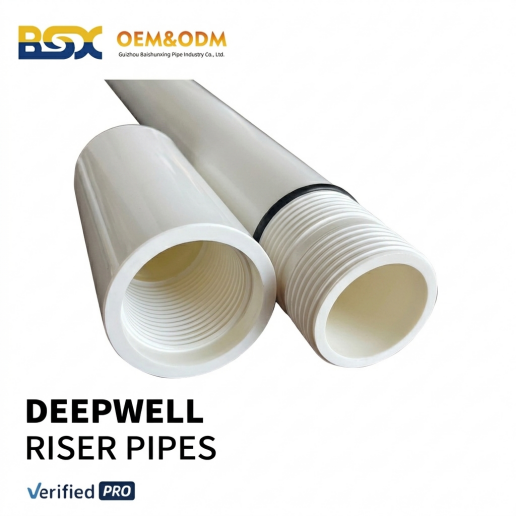
PVC Riser Pipe Fundamentals: Definition, Function, and System Integration
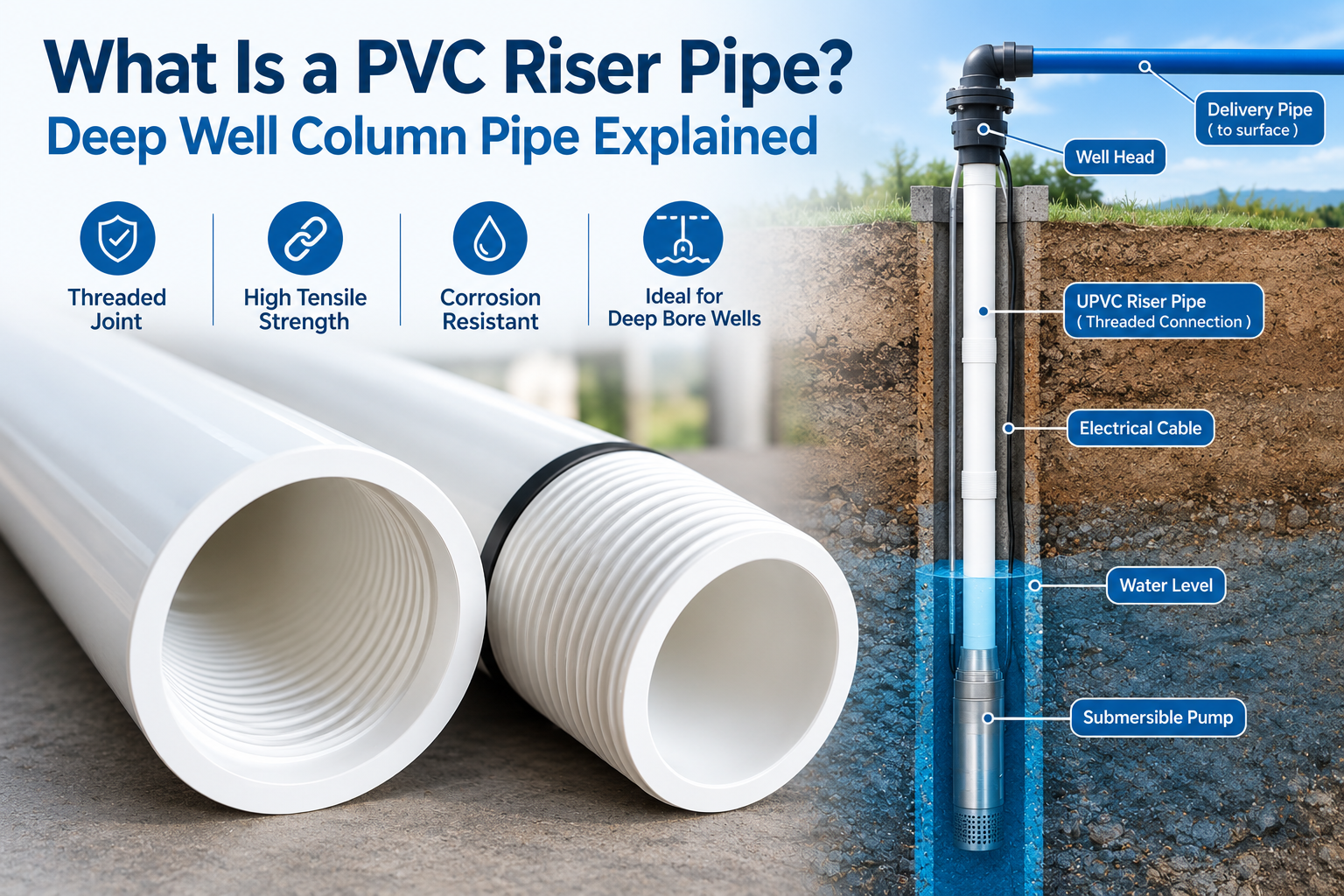
A PVC riser pipe, also known as a drop pipe or pump discharge pipe, connects a submersible pump to the surface wellhead. It transports water vertically while withstanding internal pressure and the mechanical loads associated with pump installation and operation. Selecting the right riser requires more than considering well depth: pipe pressure rating, joint strength, pump shut-off pressure, flow rate, and installation conditions must all be evaluated.
Core Function: Conveying Water from a Submersible Pump to the Surface
A PVC riser pipe forms the vertical discharge line in a deep-well pumping system. Its primary function is to carry water from the pump to the surface while maintaining sufficient flow and pressure. Depending on the installation design, the pipe may also carry part of the suspended load of the pump assembly and the water column. The allowable load depends on the pipe specification, coupling design, connection method, and manufacturer's installation requirements.
Pump cables are usually secured alongside the riser using suitable cable supports or fasteners. They must be installed without damaging the pipe or interfering with lowering and retrieval. In deeper wells, installers should follow the manufacturer's recommendations for pump support, cable management, centering devices, and torque control rather than assuming the pipe alone can safely support the entire assembly.
PVC is resistant to rust and many common groundwater constituents, making it suitable for a range of residential, agricultural, and industrial well applications. However, not every PVC pressure pipe is designed for use as a threaded drop pipe. The selected product must be specifically suitable for the intended installation, including continuous immersion, pressure loading, and the mechanical demands of pump operation.
Hydraulic and Structural Requirements: Static Head, Pressure Surges, and Joint Integrity
A deep-well riser is exposed to both static and dynamic loads. The water column creates hydrostatic pressure, while the pump produces discharge pressure according to its operating point. Pump shut-off pressure, starting and stopping cycles, and changes in flow can introduce additional transient loads. These conditions must be considered when checking the pipe's allowable working pressure.
Mechanical loading is equally important. The riser may carry the weight of the suspended pipe, water, pump, and fittings, depending on the system design. Threaded couplings, solvent-cement joints, or other connection types have different installation requirements and load capacities. Joints must be compatible with the selected pipe and suitable for the expected pressure and tensile loading.
PVC's smooth internal surface can help limit friction losses, but hydraulic performance depends on the actual internal diameter, flow rate, pipe length, fittings, and water properties. A single coefficient such as K = 0.01 should not be used as a universal performance value without defining the calculation method and supporting data. Correct sizing and a properly designed pump system are more reliable ways to control energy consumption and maintain consistent delivery.
Why PVC Pipe Is Used for Deep-Well Riser Applications
Deep-well pumping systems require pipe that can withstand sustained pressure, mechanical loads, and prolonged exposure to groundwater. PVC offers a combination of corrosion resistance, relatively low weight, and smooth internal surfaces, making it a practical option when the selected product is rated for the application.
Corrosion Resistance in Groundwater Environments
Metal riser pipes can experience rust, pitting, or other forms of corrosion depending on groundwater chemistry and operating conditions. PVC does not rust and is not subject to electrochemical corrosion in the same way as steel. This can reduce corrosion-related maintenance and help preserve the pipe's internal diameter over time.
PVC also resists many common substances found in groundwater, but its chemical compatibility should not be described as universal. Acidity, dissolved salts, temperature, and other contaminants may affect different materials and components in different ways. Pumps, seals, fittings, and connection materials must also be considered when evaluating the complete system.
Unlike metal pipes, PVC does not release iron corrosion products into the water. Nevertheless, water quality depends on the condition and suitability of the entire well system, not just the riser material. Appropriate product selection and installation remain essential, particularly in wells with unusual water chemistry.
Pressure Performance and ASTM D1785
ASTM D1785 specifies requirements for PVC plastic pipe in Schedule 40, Schedule 80, and Schedule 120 dimensions for pressure-liquid distribution. It covers areas such as dimensions, material classification, sustained pressure, burst pressure, and workmanship. The standard does not automatically establish that every compliant pipe is suitable for deep-well drop-pipe service; the intended application and the manufacturer's pressure and installation limits must also be checked.
Pressure ratings vary with nominal pipe size, schedule, material designation, and temperature. Therefore, a general statement that all ASTM D1785 PVC pipe can withstand 16 bar (232 psi) is not technically reliable. The rating for the exact product must be verified from its technical data.
For well installations, the pressure check should include pump shut-off pressure and potential surge pressure, with any applicable design allowances. The pipe must also be checked for axial loading and joint capacity. Cooler groundwater may be favorable for PVC pressure performance, but operating temperature alone does not establish whether a pipe is suitable for a particular depth.
Selecting PVC Pipe for Deep Wells: Diameter, Schedule, and Operating Depth
Sizing Principles: Matching Pipe Diameter to Flow Rate and Total Dynamic Head
The appropriate pipe diameter depends on the pump's discharge capacity, the required flow rate, available internal diameter, pipeline length, and total dynamic head (TDH). TDH includes the relevant elevation lift, pressure requirements at the discharge point, and friction losses through the pipe and fittings. An undersized pipe can increase velocity and friction loss, while an unnecessarily large pipe may add cost and installation weight.
Matching the riser diameter to the pump outlet is a useful starting point, but it should not replace a hydraulic calculation. The required flow velocity depends on the system design, pipe material, transient-pressure risk, and acceptable energy loss. A target of less than 1.8 m/s may be appropriate for some designs, but it is not a universal requirement for every well.
For example, a four-inch well casing does not automatically require a one-inch riser. The correct size depends on the pump's rated flow, discharge connection, operating head, and allowable friction loss. Higher-flow systems may need a larger diameter, while the available space inside the well casing must accommodate the pump, riser, cable, and other components.
Before finalizing a selection, confirm that the pipe's pressure rating at the expected temperature exceeds the maximum design pressure, including relevant transient loads. Also verify the internal diameter, joint compatibility, and allowable tensile load for the complete riser assembly.
Schedule 40 vs. Schedule 80: Why Depth Alone Is Not Enough
Schedule 40 and Schedule 80 pipes differ in wall thickness and internal diameter for a given nominal size. Schedule 80 generally has a thicker wall and a smaller internal diameter than Schedule 40 of the same nominal size. Its pressure capacity is often higher, but the actual rating must be checked for the specific size and product.
It is not reliable to assign Schedule 40 exclusively to wells under 150 m and Schedule 80 to wells deeper than 200 m. Installation depth is only one consideration. Pump shut-off pressure, water-column effects, pressure surges, pipe weight, joint capacity, and the manufacturer's allowable installation depth all influence the final selection.
| Factor | Schedule 40 | Schedule 80 |
|---|---|---|
| Wall thickness | Generally thinner | Generally thicker |
| Internal diameter | Generally larger for the same nominal size | Generally smaller for the same nominal size |
| Pressure capacity | Depends on size and product rating | Often higher for the same nominal size |
| Weight and cost | Generally lower | Generally higher |
| Selection basis | Verify pressure, load, and joint limits | Verify pressure, load, and joint limits |
For deeper installations, use the manufacturer's well-depth or drop-pipe selection tables where available. These should account for the pipe's pressure rating and the pump's shut-off pressure. The complete assembly must also be assessed for suspended load and connection strength. A thicker schedule alone does not guarantee suitability for every deep-well application.
Installation and Long-Term Reliability of PVC Riser Pipe
Correct installation is essential to reliable operation. Before lowering the pump, installers should inspect the pipe ends, threads or sockets, couplings, and sealing surfaces for damage. Components must be compatible, and joints must be assembled according to the manufacturer's instructions. Where solvent cement is specified, surface preparation, cement selection, assembly technique, and curing time must be observed.
The riser should be lowered without excessive bending, impact, or twisting. Pump cables should be secured using suitable supports that avoid sharp edges and excessive compression. The pump's weight should be supported using the method specified for the system; a safety cable or support line may be required depending on the design. Torque arrestors and centering devices should be used when recommended by the pump or pipe manufacturer.
Before commissioning, verify that the assembly is correctly connected and that the system can operate within its pressure and flow limits. Pressure testing, where required, must follow the applicable product instructions and safety procedures. Compressed-air testing should not be used unless specifically permitted by the manufacturer and the applicable procedure, because stored pneumatic energy can create serious hazards.
Long-term performance depends on pipe quality, pressure cycles, groundwater conditions, installation workmanship, and maintenance. PVC's corrosion resistance can reduce certain failure risks, but it does not eliminate mechanical damage, joint failure, excessive pressure, or unsuitable loading. Periodic checks of pump performance, operating pressure, and any accessible connections can help identify problems before they lead to service interruptions.
A service life of 50 to 100 years should not be presented as a guaranteed lifespan for every PVC riser installation. Durability estimates depend on the product design, standards, loading conditions, and operating environment. For deep-well systems, the most reliable approach is to select a product rated for the intended use, follow the manufacturer's installation guidance, and keep the operating conditions within documented limits.
FAQs
1. What is a PVC riser pipe?
A PVC riser pipe is a vertical discharge pipe that connects a submersible pump to the surface wellhead. It carries pumped water upward and must be suitable for the system's pressure and mechanical loads.
2. Why is PVC used for well riser pipes?
PVC offers corrosion resistance, relatively low weight, and a smooth internal surface. Its suitability depends on the product's pressure rating, connection design, and approval for the intended well application.
3. How do I select the right PVC pipe for my well?
Consider the pump's flow rate, discharge connection, total dynamic head, shut-off pressure, pressure surges, pipe dimensions, and installation loads. Verify the product's allowable pressure and depth using manufacturer data rather than relying on depth alone.
4. What is the difference between Schedule 40 and Schedule 80 PVC pipe?
Schedule 80 generally has a thicker wall and a smaller internal diameter than Schedule 40 of the same nominal size. It often offers higher pressure capacity, but the actual rating depends on the pipe size and product specification.
5. How long can PVC riser pipe last in a deep well?
Service life depends on product quality, operating pressure, installation, joint performance, groundwater conditions, and maintenance. Use documented product specifications and manufacturer guidance instead of assuming a universal lifespan.