 EN

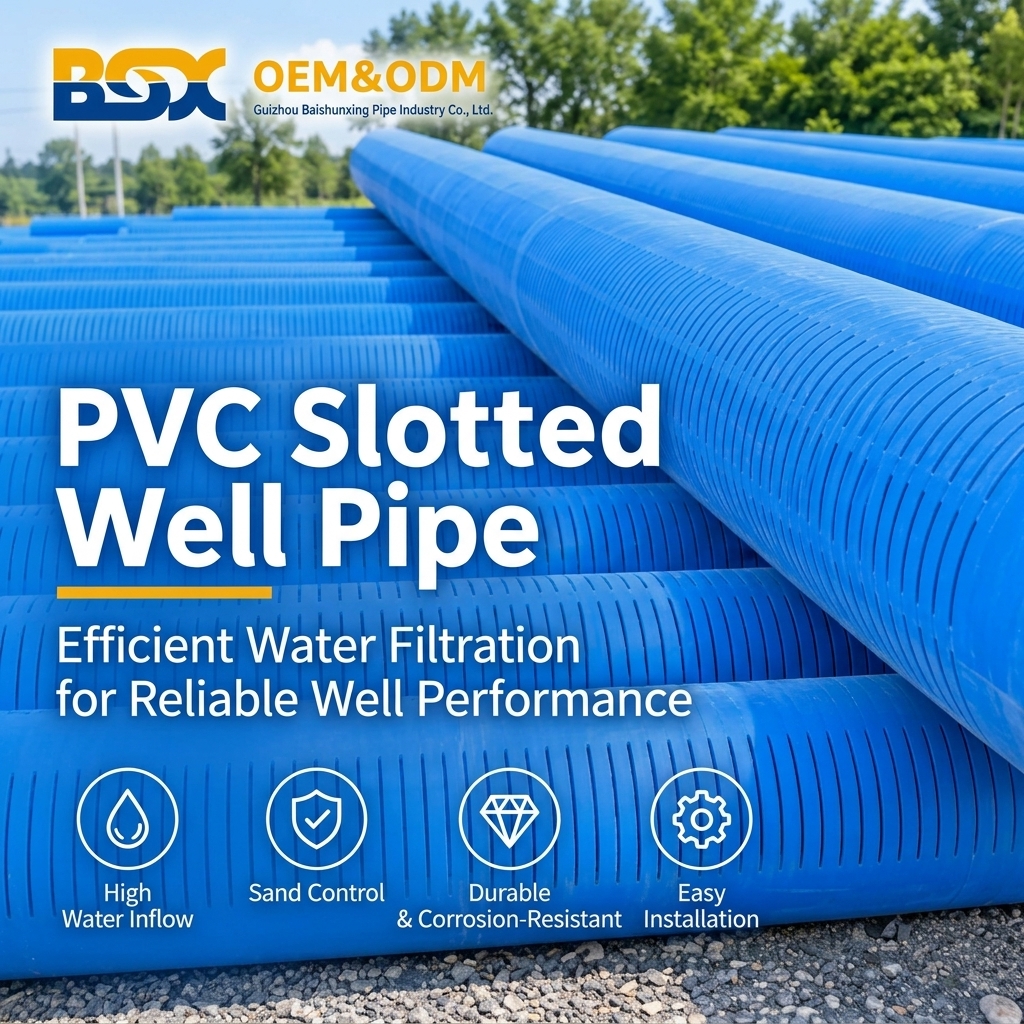
A successful water well depends on more than drilling depth and pump capacity. The well screen must allow groundwater to enter efficiently while preventing excessive sand and sediment from reaching the pumping equipment.
A PVC slotted well pipe performs this important function. Installed across water-bearing
formations, it contains narrow openings that allow groundwater to pass through while helping control the movement of surrounding particles.
However, slot size directly affects filtration performance. Openings that are too small may
restrict water flow and increase clogging risks. Oversized openings may allow sand to enter the well, increasing pump wear and maintenance costs.
Selecting the correct slot size requires understanding aquifer grain size, filter pack design, screen open area, and expected pumping conditions.
This guide explains how PVC slotted well pipe works, how slot size affects groundwater filtration, and what engineers and buyers should consider before selecting a well screen.
What Is a PVC Slotted Well Pipe?
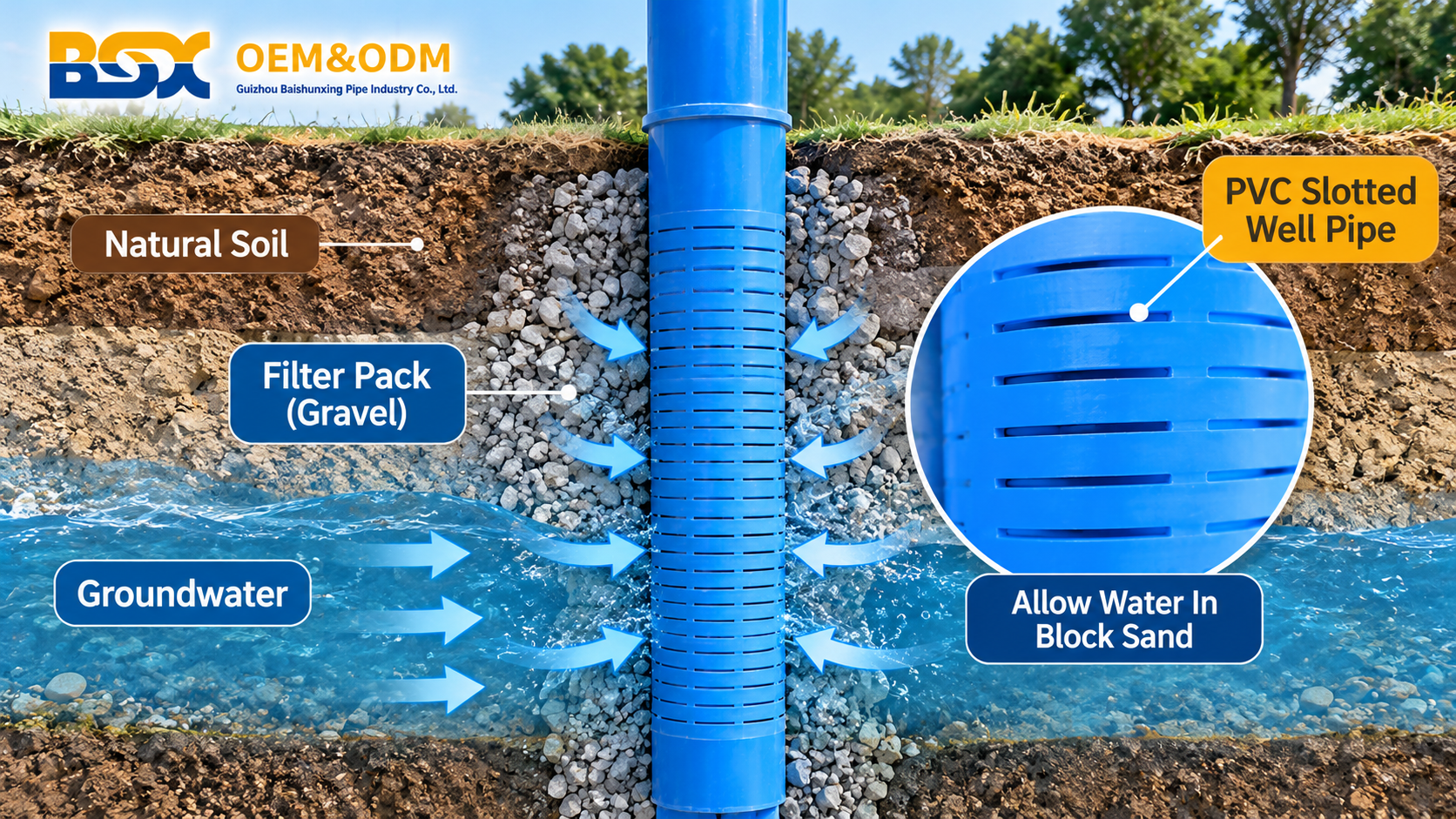
A PVC slotted well pipe is a specialized PVC-U pipe manufactured with narrow openings along its surface. These openings allow groundwater to enter the well while helping retain surrounding formation materials.
It is normally installed opposite productive water-bearing formations and connected to solid casing sections.
Its primary functions include allowing groundwater entry, controlling sediment movement,
supporting well development, and reducing the amount of sand reaching pumping equipment.
PVC-U is commonly selected because it is lightweight, corrosion-resistant, and relatively easy to handle during installation.
Unlike solid casing, a slotted well screen must balance hydraulic performance with mechanical strength.
Its effectiveness depends on slot width, screen diameter, wall thickness, opening distribution, and compatibility with the surrounding aquifer.
Why Slot Size Matters in Groundwater Filtration
Slot size refers to the width of an individual opening in the well screen.
It influences which particles can pass through the screen and which remain outside.
Correctly sized openings allow groundwater to enter while the surrounding formation or filter pack helps retain sediment.
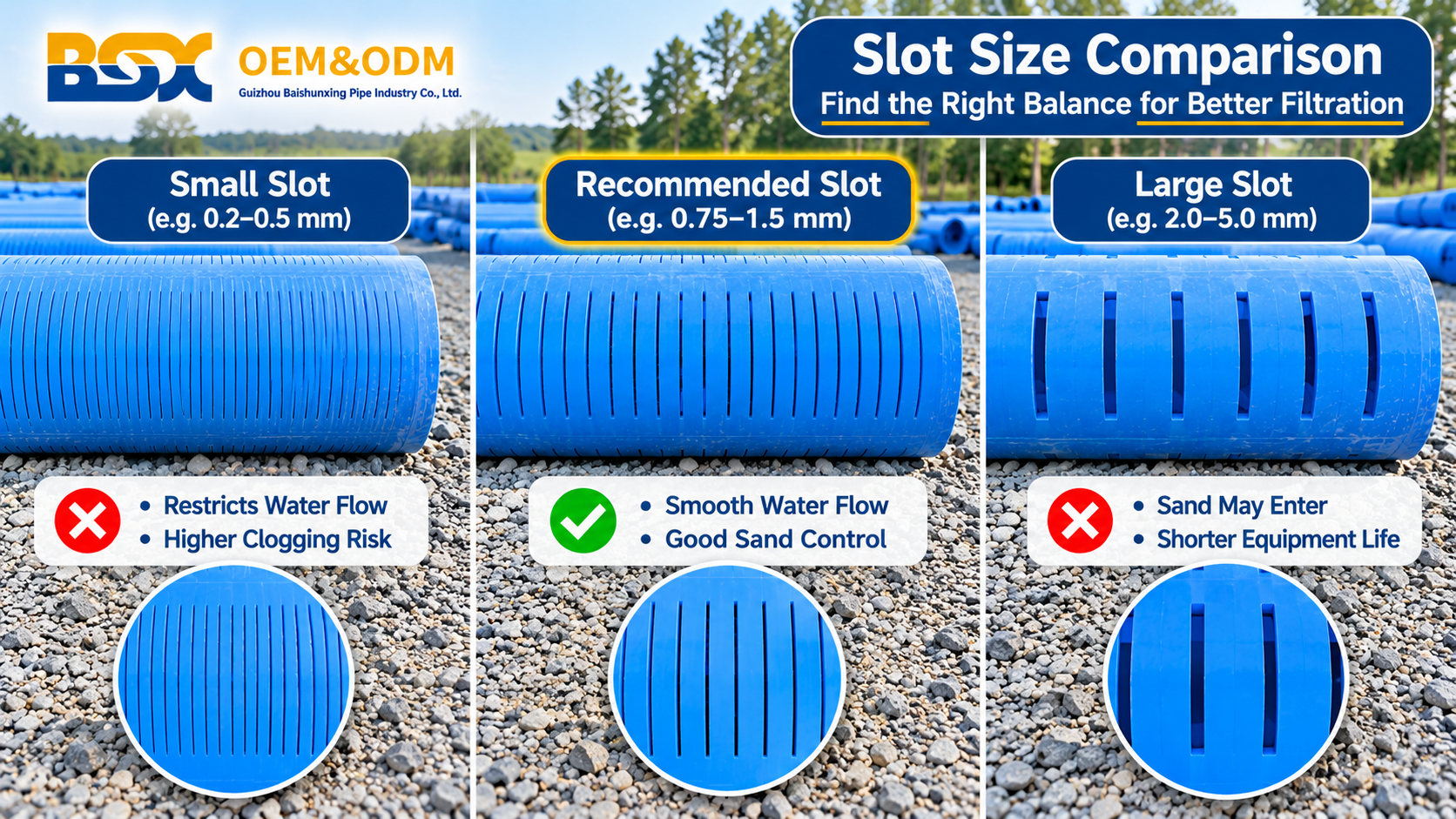
When Slots Are Too Small
Narrow openings may restrict water entry and increase resistance near the screen.
They can also become blocked by fine particles, mineral deposits, or biological growth.
This may reduce well efficiency and increase maintenance requirements.
When Slots Are Too Large
Oversized openings may allow excessive sand and fine sediment to enter the well.
Continuous sand production can increase water turbidity, accelerate pump wear, and reduce equipment service life.
Finding the Correct Balance
The smallest available slot is not automatically the best choice.
Engineers must balance sediment retention, groundwater flow, and the characteristics of the surrounding formation.
TheOntario Government's Water Supply Wells Best Practices discusses well construction considerations, including screens and filter packs.
How to Select the Correct Well Screen Slot Size
Slot selection should be based on representative formation samples and the planned well construction method.
Two common approaches are naturally developed wells and artificial gravel-packed wells.
Naturally Developed Wells
In naturally developed wells, the screen is installed directly against the water-bearing formation without an artificial gravel pack.
Slot openings are selected using the formation's grain-size distribution.
During development, finer particles are removed from the area surrounding the screen, allowing a more stable zone of coarser material to form.
If openings are excessively large, sand production may continue. If they are too small, groundwater entry may be restricted.
The selected slot width must therefore match the aquifer characteristics and development method.
Artificial Gravel-Packed Wells
Gravel-packed wells use specially selected sand or gravel around the screen.
This filter pack creates a permeable transition between the natural formation and the screen openings.
In this design, slot width is selected according to the filter pack rather than directly from the original formation.
Many designs aim to retain approximately 90% or more of the filter pack material, although the precise criterion depends on the engineering method.
The filter pack must also be properly graded to retain formation particles while allowing groundwater to move toward the screen.
Common PVC Well Screen Slot Sizes
PVC slotted well pipes are available with different opening widths.
In some markets, slot numbers represent thousandths of an inch.
Slot
Designation
10 slot
20 slot
30 slot
40 slot
Opening Width
0.010 inch (0.254 mm)
0.020 inch (0.508 mm)
0.030 inch (0.762 mm)
0.040 inch (1.016 mm)
These dimensions are examples rather than recommendations for particular soil types.
A 20-slot screen may perform well in one formation but allow excessive sediment entry in another.
Buyers should confirm whether the manufacturer's published measurements are nominal or actual opening dimensions.
Custom slot widths may also be available depending on the production method and order requirements.
How Sieve Analysis Helps Determine Slot Size
Sieve analysis is an important laboratory method for determining the particle-size distribution of aquifer materials.
Representative samples are collected from the water-bearing formation and passed through sieves with different opening sizes.
The amount of material retained on each sieve is measured.
These results are used to prepare a grain-size distribution curve showing the proportions of fine and coarse particles.
Engineers use this information to select screen openings and determine whether an artificial filter pack is necessary.
For example, two wells with similar depths may require different slot sizes because their aquifers contain different particle distributions.
TheOntario Government's Test Holes and Dewatering Wells Guidance provides additional information about screen design, grain-size analysis, and filter pack selection.
Without representative soil analysis, selecting a screen based only on diameter or drilling depth can produce unreliable results.
How Slot Size Affects Water Flow and Well Efficiency
Slot size influences water entry, but it does not determine well performance independently. Screen length, diameter, open area, aquifer permeability, and pumping rate also matter.
Screen Open Area
Open area is the total area available for groundwater to pass through the screen.
A greater effective open area can reduce water-entry velocity when other operating conditions remain comparable.
However, increasing open area must not compromise screen strength.
Entrance Velocity
Entrance velocity describes how quickly groundwater passes through screen openings.
A commonly used preliminary design guideline is approximately 0.1 ft/s (0.03 m/s) or less, although the appropriate value depends on the well design.
Higher velocities can increase entrance resistance and contribute to operational problems.
Screen Length
Longer screens may provide more water-entry area when correctly positioned within productive aquifer sections.
However, extending a screen into unsuitable formations can introduce additional sediment or water-quality concerns.
The screen should be designed around the actual water-bearing intervals.
Other Factors Affecting PVC Slotted Well Pipe Performance
Several additional factors influence long-term well performance.
Pipe Diameter and Wall Thickness
Pipe diameter affects available screen area and compatibility with the casing system.
Wall thickness influences mechanical strength and the screen's ability to withstand installation and external loads.
Slot Shape and Manufacturing Accuracy
Uniform openings support consistent filtration.
Irregular slot widths, damaged edges, or poor manufacturing tolerances may create uneven sediment entry.
Filter Pack Compatibility
The screen and filter pack must operate as one system.
An unsuitable combination can cause sand movement, clogging, or excessive hydraulic resistance.
Groundwater Chemistry
Mineral precipitation, biological activity, and groundwater chemistry can affect screen performance over time.
PVC-U resists corrosion in many groundwater environments, but chemical compatibility should still be verified.
Installation and Well Development
Even a correctly selected screen may perform poorly if it is installed incorrectly.
Proper placement, connection integrity, and well development are essential for removing unwanted fines and establishing stable groundwater flow.
Common Mistakes When Selecting PVC Slotted Well Pipes
Several purchasing and installation mistakes can reduce well efficiency.
Ignoring sieve analysis: Slot size should reflect actual formation or filter pack characteristics. Choosing oversized slots: Large openings may increase sand production and pump abrasion.
Selecting excessively small slots: Narrow openings may restrict groundwater entry and increase clogging.
Overlooking open area: Suitable slot width alone does not guarantee adequate water flow.
Ignoring screen strength: Wall thickness and slot arrangement must support installation requirements.
Poor installation: Damaged slots, weak connections, or incorrect screen positioning can affect the entire well.
Avoiding these mistakes requires coordination between drilling contractors, well designers, and pipe manufacturers.
Choosing the Right PVC Slotted Well Pipe Supplier
A reliable supplier should provide accurate information about slot width, wall thickness, pipe diameter, material quality, and connection options.
BSX Pipe supplies PVC-U casing and screen pipe products for groundwater extraction, agricultural irrigation, municipal water supply, and other well applications.
Buyers can review theBSX PVC-U Well Casing and Screen Pipe range for product information.
The company also offersPVC-U Snap Lock Well Casing Pipe for projects requiring specific casing connection arrangements.
When requesting a quotation, provide the required pipe diameter, slot width, screen length, wall thickness, borehole depth, connection type, and expected pumping rate.
Where available, include formation sieve analysis and filter pack specifications.
This information helps the manufacturer assess the required screen configuration and identify suitable product options.
Conclusion
PVC slotted well pipe plays an important role in groundwater filtration and well performance.
Its slot size affects sediment retention, groundwater entry, and the risk of clogging or sand production.
Openings that are too small may restrict water flow, while oversized openings can allow unwanted sediment to enter the well.
The correct selection depends on formation grain size, sieve analysis, filter pack design, screen open area, and operating conditions.
For reliable groundwater extraction, engineers should evaluate the complete well screen system rather than selecting slot size alone.
FAQ
What is the best slot size for PVC slotted well pipe?
There is no universal best slot size. The correct opening depends on the aquifer's grain-size distribution or the selected filter pack. Sieve analysis helps determine a suitable size.
What happens if well screen slots are too large?
Oversized openings may allow excessive sand and sediment into the well, increasing turbidity, pump abrasion, and maintenance requirements.
Do smaller slots provide better groundwater filtration?
Not necessarily. Smaller openings may retain more particles but can also restrict groundwater flow and increase clogging risks.
Why is sieve analysis important for well screen design?
Sieve analysis identifies the distribution of particle sizes in the formation. Engineers use the results to select appropriate screen openings and filter pack materials.
How does slot size affect groundwater flow?
Slot size influences the passage of water and particles through the screen. Proper selection balances sediment control with sufficient water-entry capacity, considering open area and pumping requirements.
Table of Contents
- What Is a PVC Slotted Well Pipe?
- Why Slot Size Matters in Groundwater Filtration
- When Slots Are Too Small
- When Slots Are Too Large
- Finding the Correct Balance
- How to Select the Correct Well Screen Slot Size
- Naturally Developed Wells
- Artificial Gravel-Packed Wells
- Common PVC Well Screen Slot Sizes
- How Sieve Analysis Helps Determine Slot Size
- How Slot Size Affects Water Flow and Well Efficiency
- Other Factors Affecting PVC Slotted Well Pipe Performance
- Common Mistakes When Selecting PVC Slotted Well Pipes
- Choosing the Right PVC Slotted Well Pipe Supplier
- FAQ
- What is the best slot size for PVC slotted well pipe?
- What happens if well screen slots are too large?
- Do smaller slots provide better groundwater filtration?
- Why is sieve analysis important for well screen design?
- How does slot size affect groundwater flow?