 EN

Introduction
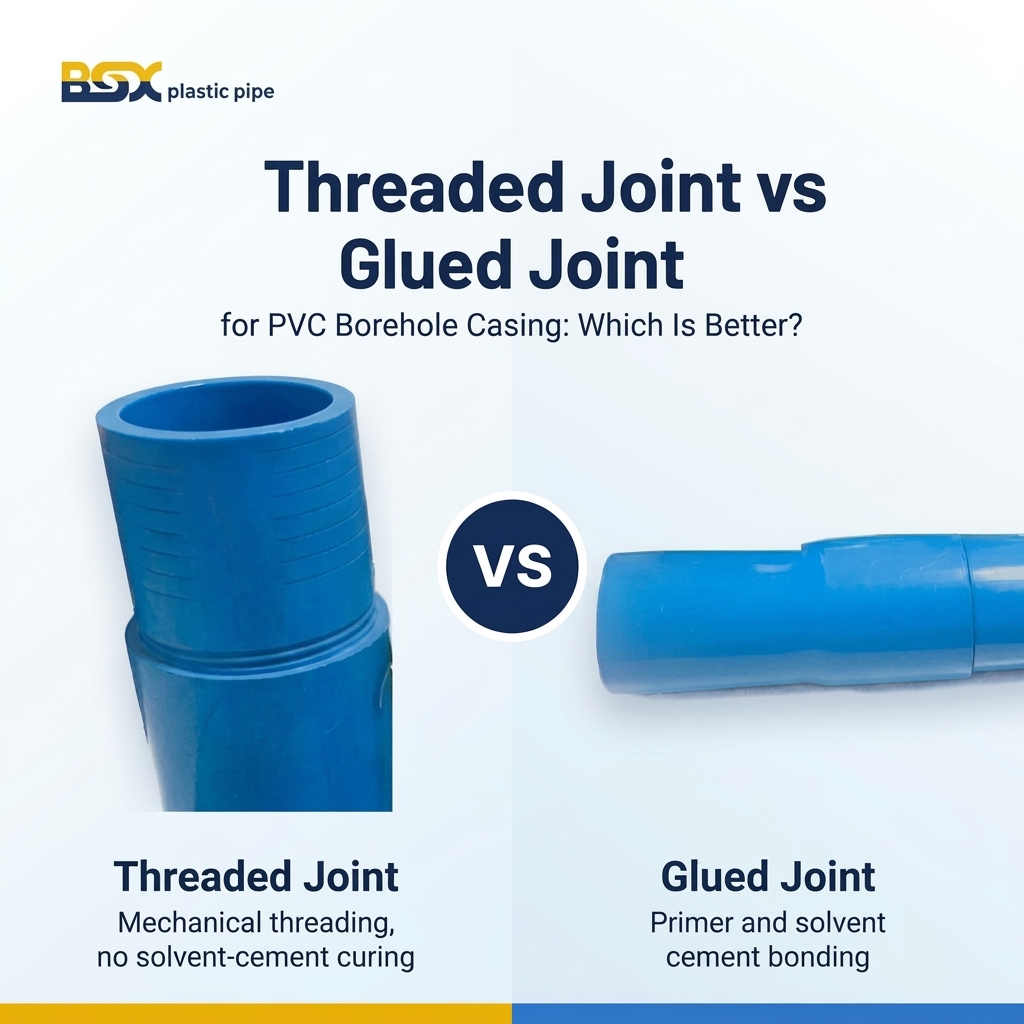
Choosing the right joint connection is an important part of PVC borehole casing installation.
Individual pipe sections must be connected securely to create a continuous casing system that can withstand installation loads and groundwater conditions.
Two common connection methods are threaded joints and glued joints. Threaded joints connect pipe sections through compatible male and female threads, while glued joints use PVC primer and solvent cement to bond compatible pipe and fitting surfaces.
Both methods can provide reliable connections when the products are designed for the application and installed correctly. However, they have different installation requirements, connection characteristics, and maintenance considerations.
So, which option is better for PVC borehole casing? The answer depends on the pipe design, borehole depth, installation method, required watertightness, and applicable well construction regulations.
This guide compares both connection methods to help contractors, engineers, and buyers make an informed decision.
What Is a Threaded Joint in PVC Borehole Casing?
A threaded joint connects two PVC casing sections through matching threads. One pipe end typically has an external thread, while the other section or coupling has a compatible internal thread.
The sections are joined by rotating them together until the specified engagement is achieved.
Threaded connections are commonly used in well casing systems because they can provide a mechanical connection without requiring solvent cement.
Their main characteristics include:
● Mechanical engagement between pipe sections.
● No solvent-cement curing period.
● Potentially convenient assembly at the installation site.
● Availability of flush-joint and coupling-based designs.
● Compatibility with manufacturer-specific connection systems.
Some PVC well casing products use threads formed directly on the pipe. Others use separate threaded couplings.
The connection design matters because different manufacturers may use different thread profiles and dimensions. Two pipes with similar nominal diameters are not necessarily
compatible.
What Is a Glued Joint in PVC Borehole Casing?
A glued joint, more accurately called a solvent-cemented joint, connects compatible PVC pipe and fittings using primer and solvent cement.
Unlike ordinary surface adhesives, PVC solvent cement softens the joining surfaces so that they bond as the solvent evaporates.
The connection process generally involves:
1. Cutting the pipe squarely.
2. Removing burrs and cleaning the joining surfaces.
3. Applying the recommended primer where required.
4. Applying compatible PVC solvent cement.
5. Inserting the pipe into the fitting socket.
6. Holding the connection according to the manufacturer's instructions.
7. Allowing the joint to cure before handling or pressure testing.
The finished connection forms a permanent joint between the pipe and fitting.
For borehole applications, the solvent cement must be compatible with the pipe material and suitable for the intended water contact. Product instructions and local potable-water
requirements should be checked before installation.
Threaded Joint vs Glued Joint: Key Differences
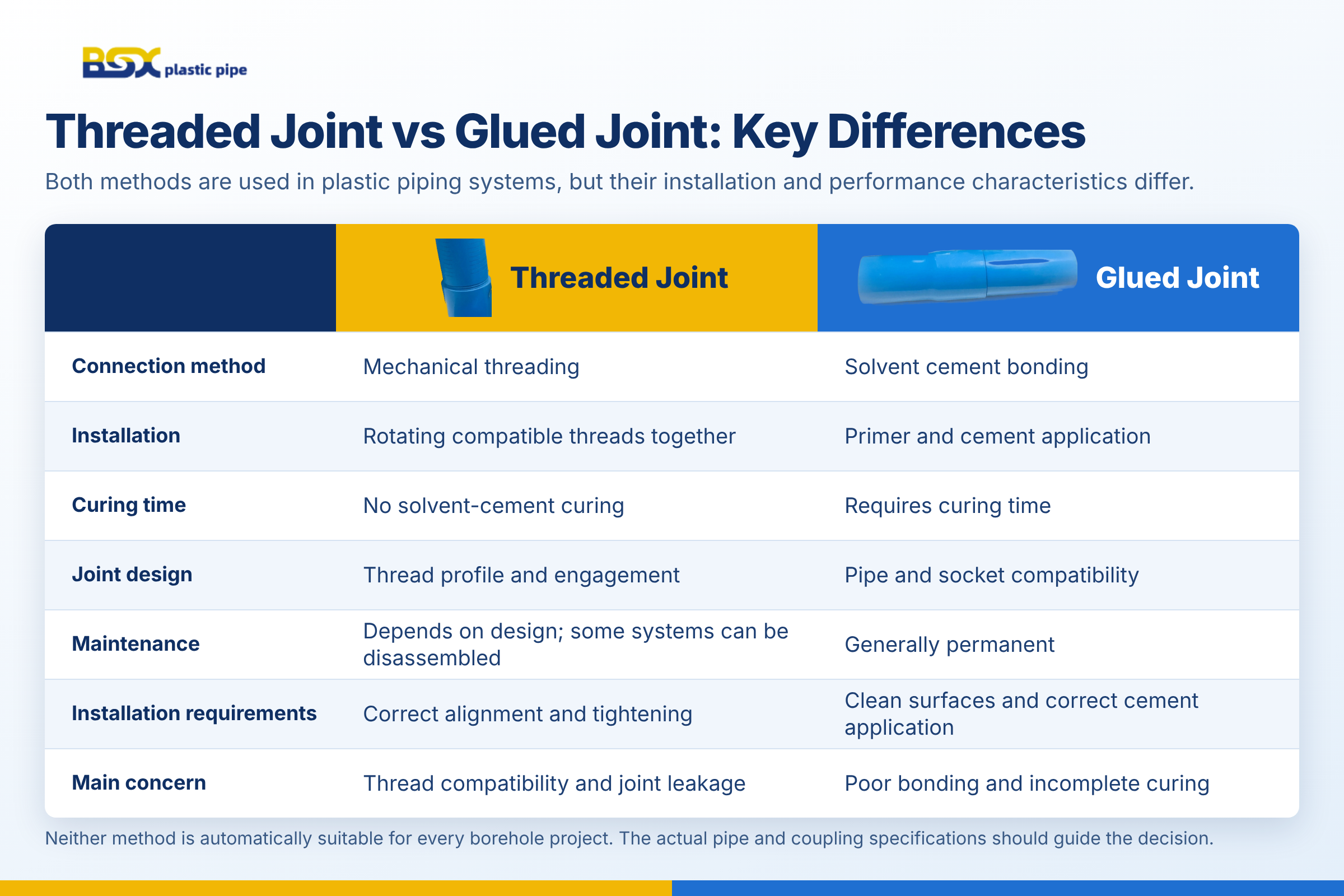
Neither method is automatically suitable for every borehole project. The actual pipe and coupling specifications should guide the decision.
Advantages of Threaded PVC Casing Joints
Easier Assembly Without Solvent Cement
One practical advantage of threaded joints is that they do not require solvent cement to create the mechanical connection.
This can simplify installation in locations where adhesive handling, curing time, or environmental conditions create difficulties.
However, certain threaded systems require O-rings or approved thread seal arrangements to achieve the required watertightness.
Convenient Installation
Threaded sections can be assembled by engaging compatible threads and following the manufacturer's tightening instructions.
This can make the connection process straightforward when the pipe sections are properly aligned and the threads are undamaged.
Consistent Joint Dimensions
Some well casing systems use flush-threaded connections. These designs can maintain a relatively uniform inside and outside diameter across connected pipe sections.
This is useful when the casing must accommodate downhole equipment or when a consistent external profile is important for filter pack placement.
No Solvent-Cement Curing Period
Threaded connections do not depend on solvent evaporation to develop joint strength. This removes one installation step, although other sealing and inspection requirements still apply.
Advantages of Glued PVC Casing Joints
Permanent Connection
A properly prepared solvent-cemented joint forms a permanent bond between compatible PVC pipe and fittings.
This can be useful in casing systems where a fixed connection is preferred and future disassembly is not expected.
Established Installation Procedures
Solvent-cemented PVC connections have well-established preparation and installation practices.
ASTM D2855 describes the practice for making solvent-cemented joints with PVC pipe and fittings. Following the appropriate procedure helps achieve consistent bonding.
No Thread Matching Required
Glued joints do not depend on matching male and female thread profiles.
Instead, the pipe and fitting must have compatible socket dimensions and material specifications.
Suitable for Approved Well Casing Systems
Certain PVC well casing systems are specifically designed for solvent-cemented connections. When the product, cement, and installation procedure meet the applicable requirements, these joints can provide dependable service.
Which Connection Provides Better Watertight ness?
Watertightness is one of the most important requirements for borehole casing.
A leaking joint can allow unwanted water or contaminants to move between the well and
surrounding formations. It may also interfere with proper casing isolation and well construction.
A threaded connection can provide a watertight seal when the thread design includes an
appropriate sealing arrangement, such as a compatible O-ring or approved tapered-thread seal.
A glued joint can also provide a watertight connection when the joining surfaces are prepared correctly and the solvent cement is compatible with the pipe and fitting.
However, poor installation can compromise either method.
Ontario's government guidance on constructing and casing water wells discusses PVC casing joint options, including threaded connections, O-ring sealing, and approved primer and solvent cement.
The important consideration is not simply whether a joint is threaded or glued. It is whether the complete connection system meets the required watertightness and performance standards.
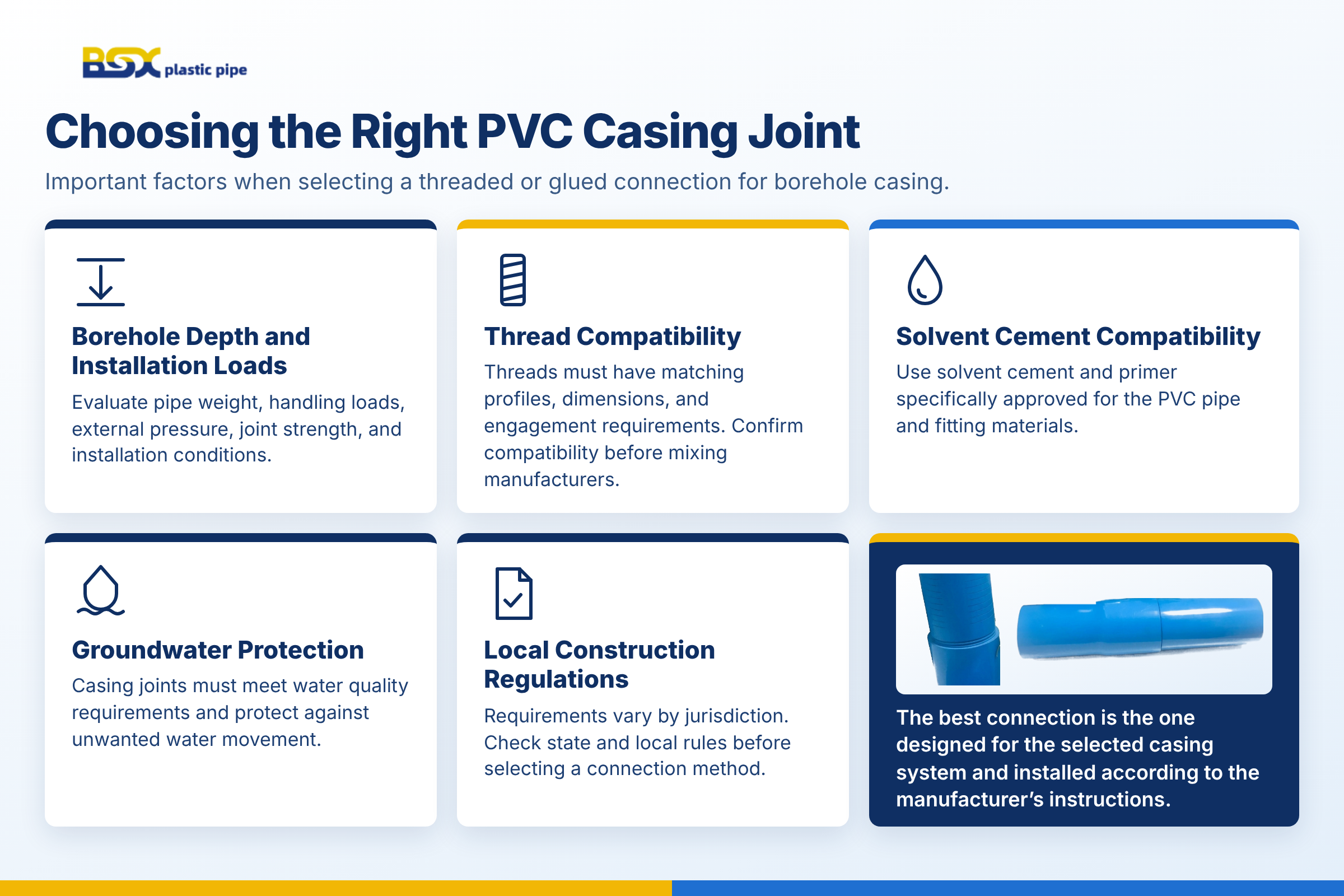
Important Factors When Selecting a PVC Casing Joint
Borehole Depth and Installation Loads
Deeper installations may place greater mechanical demands on casing sections and their connections.
Engineers should evaluate pipe weight, handling loads, external pressure, joint strength, and installation conditions.
The connection must be suitable for the complete casing assembly, not just the individual pipe section.
Thread Compatibility
Threaded connections must have matching profiles, dimensions, and engagement requirements.
Using incompatible threads can cause damage, leakage, or joint failure. Avoid mixing threaded pipes and couplings from different manufacturers unless compatibility is confirmed.
Solvent Cement Compatibility
For glued connections, use solvent cement and primer specifically approved for the PVC pipe and fitting materials.
Application temperature, surface preparation, assembly time, and curing requirements can affect joint quality.
Groundwater Protection
All casing joints must meet the project's requirements for water quality and protection against unwanted water movement.
For potable water wells, confirm that the materials and joining compounds are suitable for the intended contact with drinking water.
Local Construction Regulations
Well construction requirements vary by jurisdiction.
For example, ASTM F480 covers thermoplastic well casing pipe and couplings, including
threaded well casing configurations and joint performance requirements. Review theASTM F480-25 specification when evaluating applicable casing products.
Some jurisdictions also specify which joint configurations are permitted. Therefore, contractors should check state and local requirements before selecting a connection method.
Choosing the Right PVC Borehole Casing Supplier
A reliable manufacturer should provide clear information about pipe dimensions, connection design, material specifications, and applicable testing standards.
BSX Pipe offers PVC-U well casing and screen pipe products for groundwater extraction, irrigation wells, municipal water supply, and other borehole applications.
Buyers can explore theBSX PVC-U Well Casing and Screen Pipe range for available product information.
For projects requiring an alternative connection configuration, theBSX PVC-U Snap Lock Well Casing Pipe provides another option to evaluate.
Before requesting a quotation, provide the supplier with the required pipe diameter, wall thickness, borehole depth, connection preference, and applicable project standards.
Requesting technical drawings and joint performance information can also help confirm whether the selected casing system is appropriate for the installation.
Conclusion
Threaded and glued joints both have important roles in PVC borehole casing systems.
Threaded connections offer mechanical assembly without solvent cement, while glued
connections provide a permanent bond between compatible pipe and fittings. Their suitability depends on product design, installation conditions, watertightness requirements, and local regulations.
For deep well applications, joint strength and reliable sealing should receive particular attention. Buyers should verify thread compatibility, solvent cement specifications, and applicable well
casing standards before making a selection.
Ultimately, the best connection is the one designed for the selected casing system and installed according to the manufacturer's instructions.
FAQ
Are threaded joints better than glued joints for PVC borehole casing?
Neither method is universally better. Threaded joints can simplify assembly, while
solvent-cemented joints provide permanent bonding. The appropriate option depends on pipe design, installation conditions, and local regulations.
Are threaded PVC casing joints watertight?
They can be watertight when compatible threads and approved sealing arrangements are used. O-rings or suitable thread seals may be required depending on the connection design.
How long should a glued PVC joint cure before installation?
Curing time depends on pipe diameter, solvent cement formulation, temperature, humidity, and manufacturer instructions. The specified curing period should be followed before the joint is
subjected to handling or pressure.
Can threaded PVC casing pipes from different manufacturers be connected?
Not necessarily. Manufacturers may use different thread profiles and dimensions. Compatibility should be confirmed before connecting products from different suppliers.
Which standards should buyers check for PVC borehole casing joints?
ASTM F480 is an important well casing specification. ASTM D2855 covers solvent-cemented PVC joints. Buyers should also review applicable state and local well construction regulations.
Table of Contents
- Introduction
- What Is a Threaded Joint in PVC Borehole Casing?
- What Is a Glued Joint in PVC Borehole Casing?
- Threaded Joint vs Glued Joint: Key Differences
- Advantages of Threaded PVC Casing Joints
- Advantages of Glued PVC Casing Joints
- Which Connection Provides Better Watertight ness?
- Borehole Depth and Installation Loads
- Choosing the Right PVC Borehole Casing Supplier
- Conclusion
-
FAQ
- Are threaded joints better than glued joints for PVC borehole casing?
- Are threaded PVC casing joints watertight?
- How long should a glued PVC joint cure before installation?
- Can threaded PVC casing pipes from different manufacturers be connected?
- Which standards should buyers check for PVC borehole casing joints?