 EN
EN
HDPE Pipe Specifications for Trenchless Construction: SDR, Wall Thickness and HDD Design Guidelines
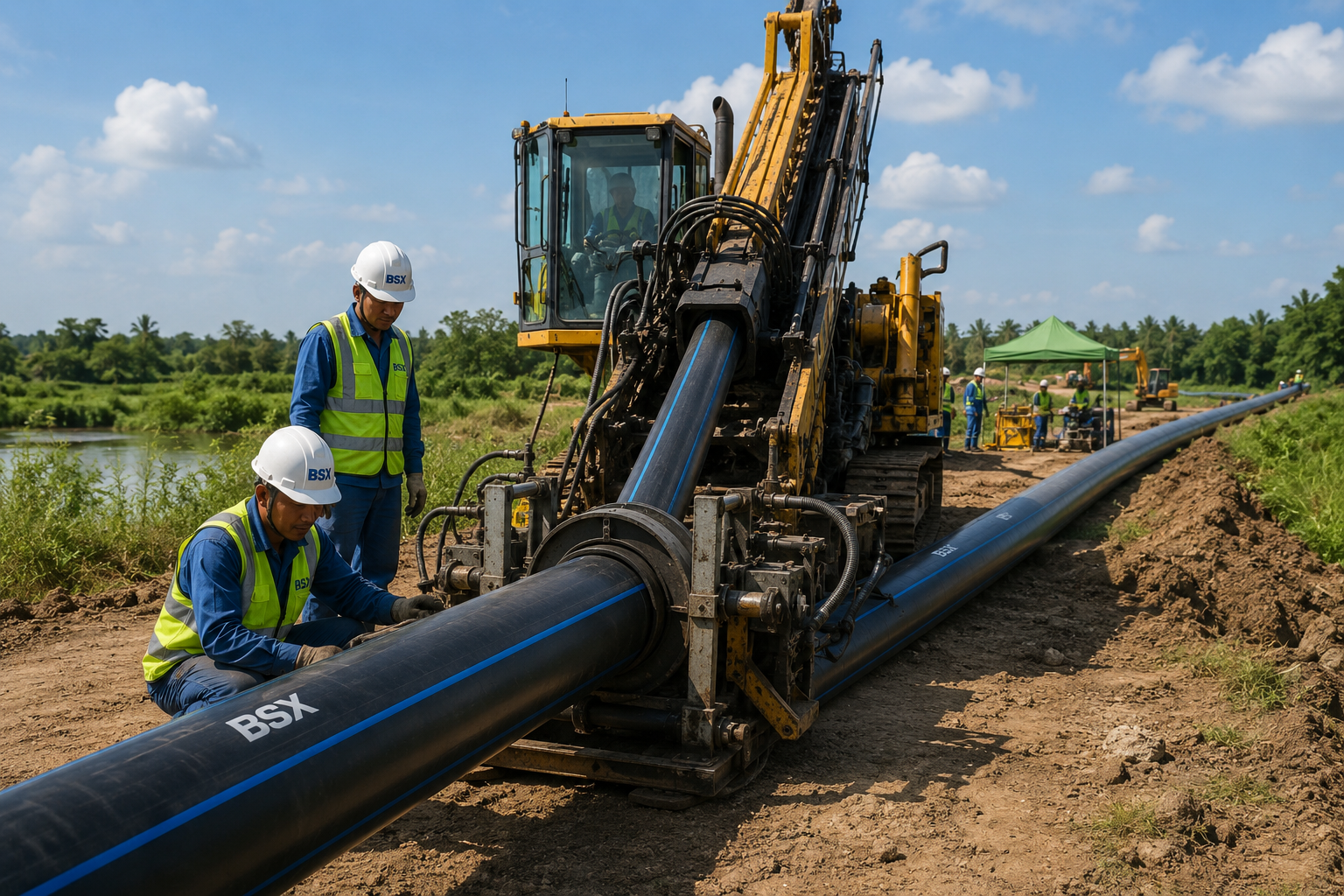
When selecting HDPE pipes for trenchless construction, factors go far beyond pipe diameter and pressure rating. Horizontal directional drilling (HDD) generates unique mechanical loads, including tensile forces, bending stresses, and external soil pressure during pullback. Therefore, pipe selection must consider both mechanical properties and long-term service reliability.
Why are HDPE pipes suitable for trenchless construction?
At construction sites, people often wonder: why do underground pipelines require frequent excavation and maintenance? There are many reasons, the most common being damage caused by material aging, joint cracking, or external loads during long-term underground service—for example, when heavy vehicles pass over the road, pressure is transmitted through the ground to the pipeline, and pipelines with insufficient material strength or weak joints are easily crushed. With the development of pipe technology, HDPE (high-density polyethylene) pipes, due to their mechanical properties and cost advantages, have gradually become the mainstream choice for municipal and industrial trenchless engineering. The following explains its applicability from several key dimensions.
1. Good flexibility, suitable for dragging and curved laying.
HDPE pipes are highly resilient and can be bent to a certain extent, allowing them to follow the borehole trajectory and curve around obstacles such as underground pipelines and structures during directional drilling. During pull-back and expansion operations, the pipes need to withstand tension, torsion, and continuous friction from sand and gravel on the borehole wall; HDPE is less prone to cracking. In contrast, PVC and cast iron pipes are more rigid, have less bending allowance, and are more likely to crack and break during long-distance pulling. HDPE pipes also adapt well to uneven foundation settlement and soil vibration, helping to reduce the risk of later breakage and leakage.
2. Lightweight, reducing equipment and construction difficulty.
HDPE pipes weigh about 1/8 of steel pipes, allowing for transportation and laying without the need for large hoisting equipment. The lighter weight also means less pullback resistance in directional drilling and a lower rig load, enabling longer single-laying distances, reducing the number of working and receiving wells to be excavated, and improving the feasibility of projects crossing rivers, highways, railways, etc.
3. Hot-melt/electrofusion integrated connection, with joint strength not lower than that of the pipe body.
Before trenchless construction, pipes can be hot-melt butt-jointed on the ground to form a single long pipe before being dragged underground in one go, eliminating the need for mechanical joints underground. The hot-melt joint forms an integrated structure with the pipe body, and its tensile strength is no less than that of the parent material, preventing joint separation or leakage during dragging. In contrast, PVC glue bonding and cast iron rubber ring socket connections are more prone to joint separation under tensile force, which is a common hidden danger in trenchless engineering.
4. Strong resistance to chemical corrosion and long service life.
HDPE does not undergo electrochemical corrosion and exhibits excellent resistance to acids, alkalis, salts, sewage, and some fuel media in soil, typically requiring no additional anti-corrosion coating. Under normal operating conditions, its design service life can reach approximately 50 years (the specific lifespan depends on relevant product standards and operating condition testing), significantly reducing the maintenance and repair costs of pipeline networks in the later stages. It is particularly suitable for buried trenchless projects such as chemical, sewage, and fuel oil transportation.
5. Smooth inner wall, high conveying efficiency
PE pipes have a low coefficient of friction on their inner wall, making them less prone to scaling and buildup. For the same pipe diameter, their flow capacity is typically superior to traditional steel pipes. After installation, the pipelines consume less energy during long-term operation, helping to reduce maintenance costs for pumping stations. This benefits applications such as water supply, irrigation, and oil and gas transportation.
6. Excellent low-temperature impact resistance, adaptable to complex climatic conditions.
HDPE pipes are less prone to brittleness and cracking in low-temperature environments. Therefore, when performing trenchless towing construction in northern winters or cold regions, they will not become brittle at low temperatures or crack during the backhaul process like some PVC pipes. They are better able to adapt to construction requirements under different climate and geological conditions.
7. The construction yields significant overall economic benefits with minimal ground disturbance.
When using trenchless technologies such as directional drilling, internal lining, or pipe replacement, only small working wells need to be excavated, eliminating the need for large-scale demolition of road surfaces or green belts. This reduces costs associated with earthwork excavation, waste removal, and road restoration. Compared to traditional excavation methods, the construction period is typically significantly shorter, with less impact on traffic and residents' lives, and approval processes are correspondingly easier, making it particularly suitable for pipeline renovation projects in urban main districts. Directional drilling can cover distances of hundreds of meters or even longer in a single pass, depending on pipe diameter, geological conditions, and drilling rig capabilities.
8. Wide process compatibility, covering mainstream trenchless solutions.
- Horizontal directional drilling with dragging: Suitable for new pipeline laying scenarios such as crossing roads and rivers.
- Pipe-cracking replacement: Crush the old cast iron or steel pipe and simultaneously pull the new PE pipe into the original position.
- Repairing old pipe linings: The PE pipe is inserted into the existing old pipe to complete the repair, without the need for re-drilling.
Key Technical Specifications of HDPE Pipes Used in Horizontal Directional Drilling (HDD)
When selecting HDPE piping for horizontal directional drilling (HDD) projects, the following core technical specifications are typically considered:
|
project |
Technical Specifications |
|
Material |
PE100 or crack-resistant PE100-RC |
|
SDR (Standard Ratio) |
Common models include SDR11, SDR17, and SDR21. Choose based on pull-back force and working pressure. |
|
Pipe diameter |
DN110 to DN1200 |
|
Connection method |
Hot-melt butt welding, the joint strength is not less than that of the pipe body. |
|
Installation process |
Designed specifically for HDD pull-back installation |
In short, HDPE pipes in HDD projects generally use PE100 or crack-resistant PE100-RC materials, with pipe diameters ranging from DN110 to DN1200, meeting different pullback requirements from municipal water supply networks to large-diameter industrial pipelines. The connection method uniformly adopts hot-melt butt welding to ensure that the joint strength is not lower than that of the pipe body, preventing leakage or detachment during pullback. The SDR rating is the core parameter determining the pipe's pressure-bearing capacity and wall thickness, requiring further selection based on specific operating conditions (see below).
How to choose an SDR rating for an HDD project
SDR (Standard Size Ratio, i.e., the ratio of the nominal outer diameter to the nominal wall thickness) is one of the most critical parameters when selecting HDPE pipes for HDD trenchless laying. The smaller the SDR value, the thicker the pipe wall and the stronger the pressure resistance; for example, under the same diameter, the wall thickness of SDR11 is greater than that of SDR17, and its pressure resistance is correspondingly higher, making it safer and more reliable when subjected to the same pressure.
The commonly used SDR grades for PE100/PE100+ pipes in HDD projects are as follows:
|
SDR rating |
Wall thickness characteristics |
Applicable Scenarios |
|
SDR 11 |
Thick walls, highest pressure resistance |
Long-distance HDD crossings (rivers, highways), high-pressure water supply or industrial pipelines, and situations requiring high pull-back force. |
|
SDR 17 |
Moderate wall thickness, high cost performance |
For municipal water supply HDD projects, medium-length directional drilling is currently the mainstream choice for urban water supply network upgrades. |
|
SDR 21 |
Thin-walled, economical |
Low-pressure, gravity flow, or short-distance dragging are not recommended for long-distance HDD traversal. |
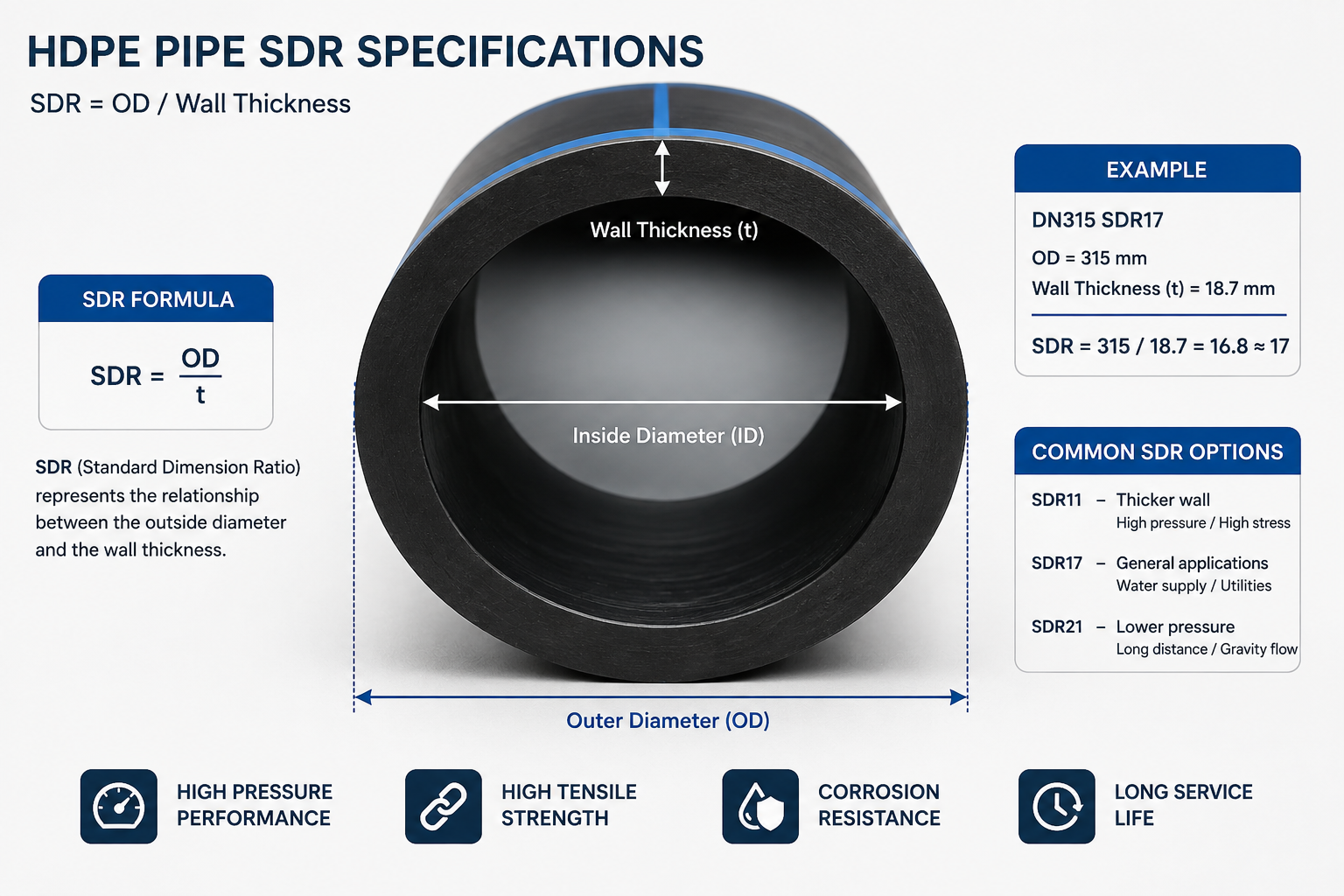
In summary, SDR11 has the thickest wall and the strongest pressure resistance, making it the first choice for long-distance HDD crossings of rivers, highways, and other high-tensile conditions, as well as high-pressure water supply and industrial pipeline projects. SDR17 has a moderate wall thickness, achieving a good balance between pressure rating, tensile strength, and project cost, and is currently the most widely used grade in municipal water supply HDD pipeline network renovation projects. SDR21 is a thin-walled, economical grade, only suitable for low-pressure, gravity flow, or short-distance pullback scenarios, and is generally not recommended for long-distance HDD crossing projects.
It should be noted that the specific SDR grade selection should also take into account factors such as pullback force calculation, working pressure, drilling length and geological conditions, and be comprehensively determined by the designer based on relevant industry standards (such as GB/T 13663). The grades listed in this article are only common selection references.
HDD Design Guidelines: Key Points for Backlash and Safety Verification
The first two parts address the question of "what material and SDR grade to choose," but actual HDD design also needs to answer a more crucial question: is this selection safe and feasible given the specific project's borehole length, geological conditions, and trajectory curvature? The following five aspects are the core elements that typically need to be calculated and verified in HDD design, and are provided for reference in the early stages of project evaluation.
1. Minimum bending radius
The curvature of the drilling trajectory must be greater than the minimum allowable bending radius of the pipe; otherwise, local buckling, stress concentration, or even cracking may occur during the pullback process. The minimum bending radius is related to the pipe's outer diameter, SDR grade, material grade, and construction temperature, and the multiples given by different standards and manufacturers are not entirely consistent. In actual projects, the technical parameters provided by the pipe manufacturer and applicable design specifications (such as ASTM F1962 or relevant industry standards) should be followed, and a uniform coefficient should not be directly applied.
2. Allowable tensile stress and safety factor
The maximum allowable tensile force that a pipe can withstand during pullback depends on the product of the pipe's short-term yield strength (or design stress) and the pipe's cross-sectional area, divided by a safety factor. The industry typically sets a certain safety factor (such as approximately 2:1, commonly found in ASTM F1962) for HDD pullback conditions to cover uncertainties during construction. The specific allowable tensile force value needs to be calculated item by item based on pipe testing reports and relevant design standards; it should not be directly applied to construction based on empirical estimations.
3. Common components of pullback force
Actual pullback force is typically composed of multiple factors, including the buoyancy of the pipe in the drilling mud (rather than its own weight in air), the frictional resistance between the pipe's outer wall and the borehole wall and the mud, the additional friction generated at bends in the borehole trajectory (similar to the "winch effect," where the greater the bend angle and the coefficient of friction, the more significant the additional resistance), and the viscous resistance generated by the mud flow. Commonly used estimation methods in the industry (such as PRCI-related models) provide predicted values by combining these factors, but it is still recommended that designers calculate these values based on on-site geological survey data and verify them through tensile force monitoring during construction.
4. Annular space and drilling mud
The borehole diameter typically needs to allow for a certain annular clearance compared to the outer diameter of the pipe. The specific ratio depends on the pipe diameter, geological conditions, and mud properties. If the clearance is too small, it will significantly increase pullback resistance and the risk of pipe seizing, while if the clearance is too large, it may affect borehole stability. Drilling mud plays multiple roles in this process, including lubricating the pipe wall, reducing frictional resistance, stabilizing the borehole wall, and carrying drill cuttings. Mud mix ratio and circulation parameters are also aspects that need to be specifically evaluated in HDD design.
5. Anti-buoyancy and counterweight design
Empty pipes in boreholes filled with drilling mud tend to float because their density is lower than that of the mud, especially in projects with large pipe diameters and shallow burial depths. Common solutions include injecting water into the pipe during pullback to increase its sinking weight, installing temporary ballast devices inside or outside the pipe, or reducing the risk of floating through reasonable burial depth and trajectory control during the design phase. The specific solution needs to be determined based on the project cross-section and geological conditions.
The above content explains the basic logic of HDD design and the key factors to consider, helping to determine the feasibility of pipe material selection in the early stages of a project. Specific values for bending radius, allowable tensile force, pullback force, and anti-buoyancy schemes in actual engineering projects must be formally calculated and verified by a qualified design unit based on current national and industry standards, combined with actual geological data and pipe material testing reports. This document cannot replace professional engineering design.
Comparison of Trenchless Applicability of HDPE Pipes and Traditional Pipes
When selecting materials for trenchless projects, HDPE pipes have different advantages compared to PVC pipes, cast iron pipes, and steel pipes. The table below provides a brief comparison based on several key aspects of trenchless construction, facilitating judgment in conjunction with specific project conditions:
|
Comparison Dimensions |
HDPE pipe |
PVC pipe |
cast iron pipe |
steel pipe |
|
Flexible/curved laying |
Okay, it can bend along the drilling path. |
Poor, small bending allowance |
Poor, basically inflexible |
Poor quality, requires a special bend. |
|
Interface reliability (drag and drop conditions) |
The material is hot-melted and has a strength no less than that of the base material. |
Adhesive bonding is prone to separation under tension. |
The rubber ring socket is prone to detachment under tension. |
It has high welding strength, but the on-site welding cycle is long. |
|
Corrosion resistance |
Excellent, no electrochemical corrosion occurs. |
better |
Poor quality, prone to rust |
Poor quality, relies on anti-corrosion coating |
|
Weight / Lifting Difficulty |
Lightweight, about 1/8 the weight of a steel pipe |
Lighter |
Heavy |
Heavy, requires large lifting equipment |
|
Low temperature impact resistance |
good |
Low temperature makes it brittle |
generally |
good |
|
Applicability of common trenchless processes |
Applicable to directional drilling, pipe fracture replacement, and lining repair. |
Mostly used for lining repair |
Rarely used for trenchless construction |
Mostly used in special working conditions such as pipe jacking |
Overall, HDPE pipes are significantly superior to PVC and cast iron pipes in terms of flexibility, joint reliability, and corrosion resistance, and are much lighter than steel pipes. They are currently the most versatile pipe material for trenchless processes such as directional drilling and pipe replacement. PVC pipes are more often used in auxiliary scenarios such as the repair of old pipe linings, cast iron pipes are basically no longer used in new trenchless projects, and steel pipes are mostly used in special working conditions with particularly high rigidity requirements, such as pipe jacking.
Frequently Asked Questions (FAQ)
Are HDPE pipes suitable for all trenchless processes?
HDPE pipes can cover mainstream trenchless technologies such as horizontal directional drilling pull-out, pipe splitting replacement, and old pipe lining repair. However, whether they are suitable for specific applications still needs to be comprehensively evaluated based on pipe diameter, geological conditions, pullback tension, and project budget. HDPE is not the preferred choice for all working conditions.
How to choose between SDR11 and SDR17?
In short, projects with long pullback distances, high pulling force, or high pressure requirements (such as long-distance river crossings or highways) are more suitable for the thicker SDR11; while municipal water supply projects with medium lengths and moderate pressure requirements usually choose the more cost-effective SDR17. The final selection should be determined by combining pullback force calculations and relevant national standards.
What is the typical service life of HDPE pipes?
Under normal operating conditions and standard construction conditions, the design service life of HDPE pipes is usually around 50 years. The specific service life will vary depending on the pipe material grade, working medium and construction quality. It is recommended to refer to product standards and actual test data.
How does the cost of HDPE pipe compare to PVC and steel pipes?
HDPE pipes are priced similarly to PVC pipes and lower than steel pipes, but their real cost advantage lies in the construction process: they are lightweight, require no large hoisting equipment, involve less excavation, and have a shorter construction period. The overall construction cost is usually lower than that of cast iron pipes and steel pipes, but the specific cost still needs to be calculated based on the scale of the project.
What are the specific requirements for HDPE pipes during HDD pullback construction?
HDD pullback places high demands on the tensile strength, wear resistance, and joint reliability of the pipes. It typically requires hot-melt butt welding connections, selection of appropriate SDR grades, and calculation of the pullback force before construction to avoid exceeding the pipes' safe tensile allowable value.
What is the most easily overlooked aspect of HDD design?
Anti-buoyancy design and minimum bending radius verification are two aspects that are easily overlooked in actual projects: when the pipe diameter is large and the burial depth is shallow, the empty pipe is prone to floating in the mud, and excessive curvature of the borehole trajectory may cause local buckling of the pipe. These two aspects usually need to be calculated by designers in combination with the project cross-section and geological conditions, rather than relying solely on experience in pipe selection.
Conclusion
HDPE pipes, with their comprehensive properties such as good flexibility, light weight, high joint strength, corrosion resistance, smooth inner wall, and low-temperature impact resistance, have become one of the most widely used pipe materials in trenchless construction, especially suitable for scenarios such as directional drilling pullback, pipe replacement due to cracks, and repair of old pipe linings. Pipe selection is only the first step in an HDD project; design verifications such as minimum bending radius, allowable tensile force, pullback force estimation, and anti-buoyancy design are equally essential. In actual projects, it is recommended to consider pipe diameter, pullback distance, geological conditions, and working pressure, refer to the SDR selection approach and design points provided in this article, and have a qualified professional engineer complete the final selection and design verification according to current standards to ensure construction safety and long-term pipeline reliability.
Table of Contents
- Why are HDPE pipes suitable for trenchless construction?
- 1. Good flexibility, suitable for dragging and curved laying.
- 2. Lightweight, reducing equipment and construction difficulty.
- 3. Hot-melt/electrofusion integrated connection, with joint strength not lower than that of the pipe body.
- 4. Strong resistance to chemical corrosion and long service life.
- 5. Smooth inner wall, high conveying efficiency
- 6. Excellent low-temperature impact resistance, adaptable to complex climatic conditions.
- 7. The construction yields significant overall economic benefits with minimal ground disturbance.
- 8. Wide process compatibility, covering mainstream trenchless solutions.
- Key Technical Specifications of HDPE Pipes Used in Horizontal Directional Drilling (HDD)
- How to choose an SDR rating for an HDD project
- HDD Design Guidelines: Key Points for Backlash and Safety Verification
- 1. Minimum bending radius
- 2. Allowable tensile stress and safety factor
- 3. Common components of pullback force
- 4. Annular space and drilling mud
- 5. Anti-buoyancy and counterweight design
- Comparison of Trenchless Applicability of HDPE Pipes and Traditional Pipes
- Frequently Asked Questions (FAQ)
- Are HDPE pipes suitable for all trenchless processes?
- How to choose between SDR11 and SDR17?
- What is the typical service life of HDPE pipes?
- How does the cost of HDPE pipe compare to PVC and steel pipes?
- What are the specific requirements for HDPE pipes during HDD pullback construction?
- What is the most easily overlooked aspect of HDD design?
- Conclusion