 EN
HDPE Dredge Pipe: Material Properties, Structural Integrity, and Key Applications
Understanding HDPE Resin Grades and Their Impact on Dredging Performance
High-density polyethylene (HDPE) dredge pipe is widely used in river dredging, harbor maintenance, sand pumping, mining slurry transport, and land reclamation. Its combination of low weight, corrosion resistance, flexibility, and abrasion resistance makes it a practical alternative to conventional metal pipelines in many dredging applications. However, reliable performance depends on more than the choice of plastic material. Resin properties, pipe dimensions, operating pressure, slurry characteristics, connection design, and installation conditions must all be considered when selecting a pipeline system.
PE80 and PE100 are two established polyethylene material classifications used for pressure piping. Under the relevant material classification framework, PE80 has a minimum required strength (MRS) of 8.0 MPa, while PE100 has an MRS of 10.0 MPa. These values are based on the long-term hydrostatic strength assessment of the material under specified conditions; they are not direct guarantees of the service life or operating pressure of a finished dredge pipe.
PE100 can allow a pressure pipe to achieve a higher pressure rating at a given wall thickness, or a thinner wall for a comparable pressure rating, when the applicable design rules permit. Nevertheless, the appropriate pipe specification must account for operating pressure, transient pressure surges, temperature, installation conditions, and the intended application. Dredging pipelines that carry abrasive solids also require a separate assessment of wear and structural loading.
It is important to distinguish pressure strength from abrasion resistance. PE100 classification alone does not guarantee that a particular pipe will outperform every PE80 product in abrasive service. Wear performance depends on the specific resin formulation, molecular structure, slurry composition, particle size and shape, solids concentration, flow velocity, and pipeline geometry. For demanding dredging operations, the selected pipe should be evaluated against the actual material being transported and the expected operating conditions.
UV Stabilization and Long-Term Material Protection
HDPE dredge pipelines are often exposed to direct sunlight when used as floating discharge lines or installed along shorelines. Ultraviolet radiation can gradually degrade unprotected polyethylene, affecting properties such as elongation, impact resistance, and long-term mechanical performance. UV stabilization is therefore an important consideration for pipe sections that remain outdoors.
Carbon black is commonly used to improve the UV resistance of black polyethylene pipes. Its effectiveness depends on the formulation, concentration, and quality of dispersion, as well as compliance with the relevant product requirements. The appropriate carbon black content should be verified against the applicable material specification rather than assumed to be identical for every HDPE dredge pipe.
Antioxidants also help protect polyethylene during processing and service by limiting thermal oxidative degradation. These additives are particularly relevant during extrusion and other manufacturing operations involving elevated temperatures. Their effectiveness depends on formulation quality, processing conditions, and the environment in which the pipe operates.
Long-term durability should not be expressed as a guaranteed service life based solely on resin grade or additive content. Actual performance depends on pressure cycling, abrasion, UV exposure, temperature, installation quality, and maintenance. For floating and exposed pipelines, material selection and periodic inspection should reflect the demands of the specific project.
Primary Applications of HDPE Dredge Pipe
River, Coastal, and Harbor Dredging
Dredging projects in rivers, lakes, coastal waters, and harbors often involve transporting mixtures of water, sand, silt, and other sediments over considerable distances. The pipeline may need to accommodate changing water levels, currents, vessel movement, and relocation of the discharge point.
HDPE dredge pipe is well suited to many of these conditions because it is relatively lightweight, corrosion-resistant, and flexible compared with rigid metal pipe. Its smooth internal surface can also help reduce hydraulic friction losses, although actual pumping performance depends on pipe diameter, flow rate, internal roughness, slurry properties, and the overall pipeline layout.
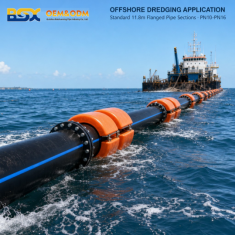
For channel deepening, harbor maintenance, and beach nourishment, pipe sections may be connected into floating or shore-based discharge lines. Flanged connections can help contractors assemble, dismantle, and reposition sections as the work area changes. The system must still be designed to accommodate the loads generated by current, waves, vessel movement, and the weight of the transported material.
HDPE flexibility can help accommodate limited movement and alignment changes, but it does not eliminate the need for proper support and stress analysis. Excessive bending, unsupported spans, external impacts, or poorly controlled movement can damage the pipeline or its connections. Project-specific design is therefore essential for maintaining stable operation in changing marine and freshwater environments.
Mining Slurry Transport and Land Reclamation
Mining, sand extraction, and land reclamation operations often require the transport of water mixed with sand, mineral particles, soil, or other solids. These mixtures can cause substantial internal wear, particularly at bends, reducers, and other locations where particle impacts and flow turbulence are concentrated.
HDPE provides good corrosion resistance in many water-based slurry applications and is not subject to the rusting and galvanic corrosion mechanisms that affect conventional steel pipe. This can reduce the need for protective coatings and corrosion-related maintenance. However, chemical compatibility should still be assessed where slurries contain acids, solvents, hydrocarbons, or other aggressive substances. Concentration, temperature, exposure time, and mixed-chemical conditions may influence material performance.
Abrasion remains a key design consideration. Higher particle concentrations, coarse or angular solids, and elevated flow velocities can accelerate internal wear. Engineers should evaluate the required wall thickness, anticipated wear allowance, flow conditions, and inspection strategy when specifying a slurry pipeline. Pipe sections in high-wear areas may require more frequent monitoring or replacement than sections carrying relatively clean water.
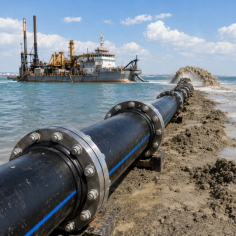
For land reclamation and coastal construction, HDPE pipe can be assembled into long discharge lines and deployed over water or across prepared ground. Its relatively low weight can simplify handling and installation, while properly designed fusion joints or mechanical connections support system assembly. Buoyancy, anchoring, support, and discharge-point stability must be considered together to ensure reliable slurry transport.
HDPE Dredge Pipe Configurations and Connection Options
Flanged and Double-Flanged Pipe Systems
Flanged HDPE dredge pipe is commonly used where pipelines need to be installed, dismantled, transported, or repositioned during project operations. A typical configuration uses a polyethylene stub end or flange adapter welded to the pipe, together with a backing ring and bolts. The backing ring provides the mechanical interface needed to connect the pipe to compatible flanged equipment or adjoining sections.
This arrangement is useful for connecting dredge pumps, manifolds, discharge outlets, floating hoses, and pipeline sections that may need to be separated for maintenance. Double-flanged spool pieces can also simplify the replacement of individual sections without requiring the entire line to be dismantled.
Flanged joints are not inherently leak-proof or suitable for unlimited reuse. Reliable performance depends on flange alignment, gasket selection, bolt tightening, backing-ring compatibility, pressure rating, and installation procedures. Connections exposed to vibration, bending, or repeated movement require particular attention because external loads can increase stress around the flange assembly.
The choice between flanged and fused connections should reflect the operating requirements. Fusion joining is often suitable for continuous pipeline runs, while flanges provide convenient access at equipment interfaces and locations where disassembly is expected. A combination of both methods can provide a practical balance between pipeline continuity and maintenance flexibility.
Floating HDPE Dredge Pipe Systems
Floating HDPE dredge pipe systems are designed to transport slurry across rivers, lakes, coastal waters, and other open-water environments. Depending on the pipe dimensions, wall thickness, contents, and operating conditions, the pipeline may require external flotation equipment to maintain the intended position at the water surface.
Common arrangements include external buoyancy floats or collars attached at calculated intervals. Some systems use foam-filled flotation components to provide buoyancy, while others use hollow or molded float structures. The appropriate configuration depends on the pipeline load, expected water conditions, connection arrangement, and required freeboard.
Buoyancy design must account for the weight of the pipe, slurry or water inside it, flanges, hoses, fittings, and other attached equipment. Wave action, current, wind, and possible water ingress into flotation components may also affect stability. Float spacing should therefore be established through engineering calculations rather than selected using a universal spacing rule.
The pipeline must also be protected against excessive bending, collision, and unwanted movement. Anchoring arrangements, flexible hose sections, connection loads, and the transition between floating and shore-based sections should be evaluated as part of the complete system. A well-designed floating line can improve deployment flexibility, but its performance depends on coordinated pipe, flotation, connection, and installation design.
Why HDPE Dredge Pipe Is Used in Demanding Environments
Corrosion Resistance and Lifecycle Considerations
One of the principal advantages of HDPE dredge pipe is its resistance to many forms of corrosion that affect metallic pipelines. It does not rust, and it is not subject to galvanic corrosion in the same way as steel. This makes it attractive for freshwater, seawater, and many water-based industrial applications where corrosion protection would otherwise require coatings, inspections, or other maintenance measures.
HDPE also offers resistance to a range of commonly encountered chemicals. However, chemical resistance should not be described as universal immunity. The suitability of a pipe depends on the specific medium, concentration, temperature, exposure duration, and mechanical stresses involved. Where unusual or aggressive chemicals are present, material compatibility should be confirmed before installation.
Lifecycle cost is another important consideration. Although purchase price is a factor, project evaluation should also consider transport, installation, connection methods, pumping requirements, abrasion-related replacement, inspection, downtime, and disposal. HDPE's relatively low weight and corrosion resistance can provide economic advantages in suitable applications, but the lowest lifecycle cost cannot be assumed without project-specific analysis.
Service life likewise depends on the conditions under which the pipeline operates. A pressure-rated water pipe's design basis should not automatically be applied to an abrasive dredging line. Slurry wear, pressure surges, external loading, sunlight exposure, and handling damage may all affect the replacement interval. Proper specification and routine inspection help project owners manage these risks.
Fusion Joining, Flexibility, and Pipeline Reliability
Butt fusion and electrofusion are established methods for joining compatible polyethylene pipe components. When performed using suitable materials, equipment, preparation, and controlled procedures, fusion joining can create a continuous connection with reliable mechanical performance.
Successful fusion depends on several factors, including pipe and fitting compatibility, surface preparation, alignment, heating conditions, joining pressure, cooling time, and operator competence. Contamination, incorrect settings, movement during cooling, or poor joint preparation can compromise the finished connection. Inspection and documentation requirements should follow the applicable project specifications and joining procedures.
HDPE's flexibility can help a pipeline accommodate limited settlement and movement, but flexibility should not be confused with unlimited movement tolerance. Bending radius, external support, anchoring, pressure cycling, and loads transferred from pumps or adjacent equipment must be considered during design. In marine environments, particular attention should be paid to transitions between floating, submerged, and shore-based sections.
Standards must also be selected according to the intended application. ISO 4427 covers polyethylene piping systems for water supply and specified drainage and sewerage applications under pressure. Its individual parts address different components, including pipes and fittings. Compliance with a particular part of ISO 4427 should not be presented as a universal certification for every dredge pipe or as proof that a complete floating slurry pipeline meets all project requirements.
For dredging applications, buyers should request the relevant material and dimensional specifications, pressure or operating limits where applicable, connection details, inspection records, and any project-specific test documentation. These records provide a clearer basis for evaluating suitability than broad claims about leak prevention or service life.
Frequently Asked Questions
What is the difference between PE80 and PE100 HDPE?
PE80 and PE100 are polyethylene material classifications with minimum required strengths of 8.0 MPa and 10.0 MPa, respectively. PE100 may allow higher pressure ratings or thinner walls in appropriately designed pressure piping systems. However, material grade alone does not determine abrasion resistance or the suitability of a pipe for every dredging application.
How does HDPE dredge pipe resist corrosion and abrasion?
HDPE is resistant to rust and many common corrosion mechanisms affecting metal pipe. Its abrasion performance depends on the resin formulation, particle characteristics, slurry concentration, flow velocity, and pipeline geometry. The pipe specification should be matched to the actual slurry and operating conditions.
Why is UV stabilization important for HDPE dredge pipe?
Floating and exposed pipe sections may receive prolonged sunlight exposure. Suitable UV stabilization helps reduce material degradation caused by ultraviolet radiation. The effectiveness of protection depends on the pipe formulation, material quality, and exposure conditions.
Which connection method is suitable for HDPE dredge pipe?
Butt fusion and electrofusion can provide reliable permanent connections when compatible components and approved procedures are used. Flanged connections are useful where equipment interfaces, maintenance access, or frequent pipeline reconfiguration are required. The best arrangement depends on pressure, movement, installation, and maintenance needs.
How should a floating HDPE dredge pipeline be designed?
Floating pipeline design should consider pipe dimensions, wall thickness, the weight and density of the transported slurry, flotation capacity, wave and current conditions, anchoring, and loads at connections. Float type and spacing should be determined from project-specific engineering calculations rather than a universal rule.
What information should buyers provide when sourcing HDPE dredge pipe?
Buyers should provide the required pipe diameter and length, slurry composition, solids concentration, operating flow rate, pump discharge pressure, expected pressure surges, installation environment, and preferred connection method. Details about floating or submerged sections, temperature, and chemical exposure are also useful. This information helps the manufacturer recommend an appropriate pipe configuration and identify the technical requirements that need verification before production.
Conclusion
HDPE dredge pipe can be a practical solution for transporting sand, silt, water-based slurry, and other materials in dredging, mining, and reclamation projects. Its low weight, corrosion resistance, flexibility, and potential for reliable fusion joining offer meaningful advantages in suitable applications.
However, dependable performance requires more than selecting PE80 or PE100 resin. Wall thickness, operating pressure, abrasion allowance, connection design, flotation, anchoring, and environmental conditions all influence pipeline integrity. By matching the pipe specification to the project requirements and verifying relevant technical documentation, contractors and procurement teams can make better-informed decisions and improve the reliability of their dredging systems.
Table of Contents
- HDPE Dredge Pipe: Material Properties, Structural Integrity, and Key Applications
- Understanding HDPE Resin Grades and Their Impact on Dredging Performance
- UV Stabilization and Long-Term Material Protection
- Primary Applications of HDPE Dredge Pipe
- HDPE Dredge Pipe Configurations and Connection Options
- Why HDPE Dredge Pipe Is Used in Demanding Environments
-
Frequently Asked Questions
- What is the difference between PE80 and PE100 HDPE?
- How does HDPE dredge pipe resist corrosion and abrasion?
- Why is UV stabilization important for HDPE dredge pipe?
- Which connection method is suitable for HDPE dredge pipe?
- How should a floating HDPE dredge pipeline be designed?
- What information should buyers provide when sourcing HDPE dredge pipe?
- Conclusion