 EN
EN

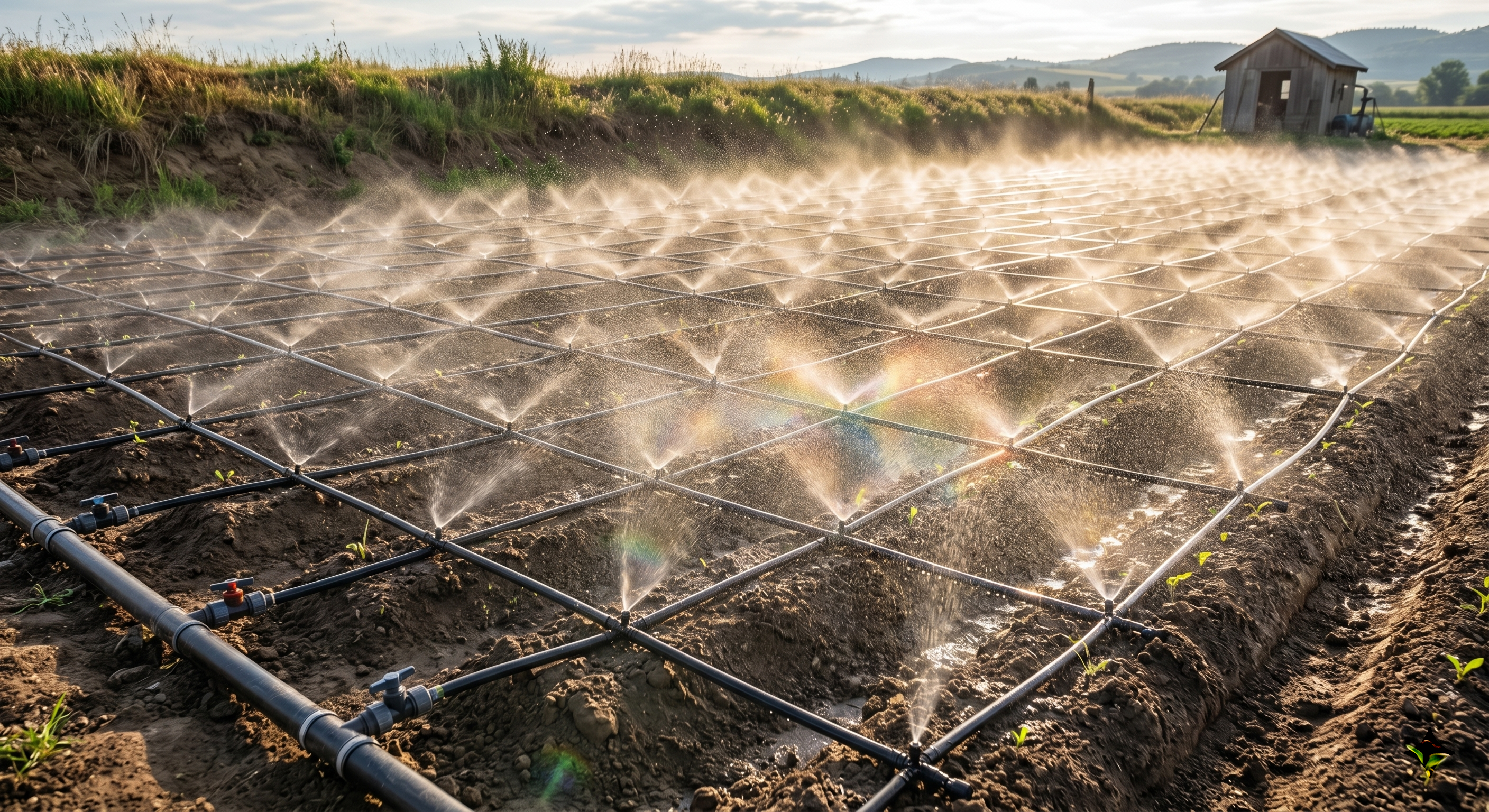
HDPE Irrigation Pipe Installation Guide: Trenching, Fusion, and Testing
Proper HDPE irrigation pipe installation is essential for maintaining reliable water flow, preventing leaks, and extending the service life of an irrigation system. Unlike rigid piping materials, HDPE can accommodate ground movement and is typically joined by heat fusion, creating continuous, leak-resistant pipelines.
However, good installation depends on more than simply placing the pipe underground. Trench conditions, bedding, backfilling, fusion procedures, pressure testing, flushing, and commissioning all influence long-term system performance.
This guide explains the key steps for installing HDPE irrigation pipe, from site preparation and trenching to heat fusion, testing, and final commissioning.
Site Preparation and Trenching for HDPE Irrigation Pipe
Trench design should provide adequate protection for the pipe while maintaining stable support and suitable installation conditions. The required burial depth depends on factors such as local frost conditions, surface loads, soil characteristics, pipe specifications, and project requirements. There is no single trench depth that applies to every irrigation project.
The trench should provide enough working space for pipe placement, jointing, inspection, and backfilling. The bottom should be reasonably smooth and free from sharp rocks, construction debris, roots, or other objects that could damage the pipe.
Where soil conditions are unstable or groundwater is present, additional measures may be required to maintain trench stability and protect workers. Proper site preparation also helps prevent uneven settlement after installation.
For agricultural and large-scale irrigation systems, trench design should therefore be based on the actual site conditions rather than relying on a standard depth or width alone.
Bedding and Backfilling Requirements
Proper bedding provides uniform support between the HDPE pipe and surrounding soil. A clean, suitable granular material is commonly used where the native soil does not provide adequate support.
The bedding should create a relatively smooth surface without sharp particles that could damage the pipe wall. After the pipe is positioned, selected material should be placed around the pipe and compacted appropriately to provide stable support.
Backfilling is particularly important around the pipe haunches and springline because these areas help maintain the pipe's shape under external loading. Poorly placed backfill can create voids, uneven support, or localized stress.
HDPE has some flexibility and can tolerate controlled deformation, but excessive deformation can affect hydraulic performance and indicate inadequate installation support. Bedding and backfill materials should therefore be selected according to the pipe specification, soil conditions, installation depth, and applicable standards.
Heat Fusion for HDPE Irrigation Pipe Installation
One of the major advantages of HDPE irrigation pipe is its ability to be joined using heat fusion. Instead of relying on threaded or mechanical connections throughout the pipeline, properly fused HDPE joints can form a continuous piping system with strong resistance to leakage and ground movement.
Butt Fusion vs. Electrofusion
Butt fusion is widely used for joining HDPE pressure pipe, particularly on larger-diameter pipelines and open installation sites. The pipe ends are aligned, heated using a controlled heating plate, and then pressed together under specified fusion conditions. When performed correctly, the joint becomes an integral part of the pipeline.
Electrofusion uses fittings with embedded heating elements. Electrical current heats the fitting and pipe interface, creating a fused connection. This method is particularly useful where space is limited, for certain branch connections, or when repair and retrofit work makes conventional butt-fusion equipment difficult to use.
The appropriate joining method depends on pipe diameter, material, SDR, site conditions, available equipment, and project specifications. Neither method should be selected based only on pipe diameter.
Fusion Procedures and Quality Control
The quality of an HDPE irrigation pipeline depends heavily on proper fusion procedures. Fusion equipment should be correctly calibrated, and operators should be trained to follow the manufacturer's recommended parameters and applicable industry standards.
Important variables include heating temperature, interface pressure, fusion pressure, heating time, cooling time, pipe alignment, and the characteristics of the specific HDPE material.
Visual inspection provides an important first-level quality check. For butt-fused joints, the fusion bead should be continuous and reasonably uniform around the pipe circumference. Misalignment, contamination, inadequate heating, or abnormal bead formation may indicate that a joint requires further evaluation.
For larger or critical irrigation projects, fusion machines with data-recording capabilities can provide additional documentation of the fusion process. Keeping records of fusion parameters and joint locations can also make future inspection and maintenance easier.
Hydrostatic Testing of HDPE Irrigation Pipe
After installation, pressure testing is normally performed before the irrigation system is placed into service. The purpose is to verify the integrity of the pipeline, joints, valves, and other pressure components.
The test pressure and test duration should be established according to the applicable project specifications, pipe standard, and manufacturer's recommendations. A universal rule such as testing every HDPE irrigation system at a fixed multiple of operating pressure should be avoided because allowable test conditions can vary between systems.
Before testing, the pipeline should be filled carefully and air should be removed from high points where possible. The system is then brought to the specified test pressure and monitored for pressure changes and potential leakage.
HDPE's viscoelastic behavior means that pressure can change during testing even when the pipeline does not have a leak. For this reason, HDPE pressure testing procedures should account for pipe material behavior and follow an appropriate standard or engineering procedure rather than interpreting every pressure change as a failure.
Flushing and Commissioning
Once pressure testing has been successfully completed, the irrigation pipeline should be flushed to remove soil, construction debris, sediment, and other contaminants introduced during installation.
Flushing is particularly important for systems containing filters, valves, drip lines, emitters, or other components that may be sensitive to debris. Water should be discharged through suitable outlets until the system is sufficiently clean for normal operation.
Commissioning then verifies that the complete irrigation system performs as designed. Valves, pressure regulators, air-release devices, filters, controllers, and other components should be checked under operating conditions.
Flow and pressure should also be measured at representative points within the system. This helps identify excessive pressure loss, uneven distribution, or other problems before the irrigation network enters regular operation.
How HDPE Irrigation Pipe Performs in Long-Term Applications
HDPE irrigation pipe is widely used in agricultural, landscape, municipal, and other water-distribution applications because of its combination of flexibility, corrosion resistance, and fused-joint technology.
Its flexibility allows the pipe to accommodate certain ground movements more effectively than rigid materials. Heat-fused joints can also reduce the number of potential leakage points compared with systems that depend heavily on mechanical connections.
The smooth internal surface of HDPE can provide favorable hydraulic characteristics, while its resistance to corrosion makes it suitable for many soil and water conditions.
These characteristics can contribute to lower maintenance requirements and reliable long-term water distribution when the pipe is correctly designed and installed.
However, actual service life and performance depend on pipe specification, operating pressure, temperature, installation quality, environmental conditions, and maintenance. Material selection should therefore be based on the complete project rather than durability claims alone.
HDPE vs. PVC for Irrigation Applications
HDPE and PVC can both be effective materials for irrigation systems, but their characteristics differ.
HDPE offers flexibility and heat-fused joints, making it attractive for installations where ground movement, long continuous runs, or leak resistance are important considerations. PVC is rigid and is widely used in irrigation networks where its pressure rating, cost, availability, and installation characteristics meet project requirements.
The choice between HDPE and PVC should consider pipe diameter, pressure requirements, soil conditions, installation method, jointing requirements, temperature, project cost, and expected operating conditions.
Rather than assuming that one material is always superior, designers should select the pipe material that best matches the specific irrigation application.
Common HDPE Irrigation Pipe Installation Mistakes
Poor trench preparation is one of the most common installation problems. Sharp rocks, unstable soil, inadequate bedding, or poorly compacted backfill can create unnecessary stress on the pipe.
Improper fusion is another major risk. Contaminated pipe surfaces, incorrect alignment, unsuitable heating conditions, or insufficient cooling can compromise joint quality.
Skipping pressure testing or flushing can also allow installation problems to remain hidden until the system is operating. A pipeline may appear visually complete while still containing a defective joint, trapped debris, or a pressure problem.
Finally, installation should not be separated from hydraulic design. Pipe diameter, operating pressure, flow rate, elevation, and system layout should be established before construction begins so that the installed pipeline can meet the intended operating requirements.
Conclusion
Successful HDPE irrigation pipe installation requires careful attention to trench preparation, bedding, backfilling, heat fusion, pressure testing, flushing, and commissioning.
The most important principle is to treat installation as part of the overall system design. Pipe size, pressure, flow, soil conditions, elevation, jointing method, and operating environment should all be considered before construction begins.
When the pipe is properly selected, correctly fused, adequately supported, and thoroughly tested, HDPE can provide a flexible and reliable solution for long-term irrigation water distribution.
FAQ About HDPE Irrigation Pipe Installation
How deep should HDPE irrigation pipe be buried?
There is no universal burial depth. The appropriate depth depends on frost conditions, surface loading, soil properties, pipe specifications, and local installation requirements. Agricultural irrigation projects should determine burial depth based on actual site conditions and engineering requirements.
What material should be used for HDPE pipe bedding?
Suitable clean granular material can provide uniform support where native soil is unsuitable. The material should be compatible with the pipe specification and free from sharp objects that could damage the pipe. Bedding requirements should follow the applicable installation standard and project specifications.
Is butt fusion better than electrofusion for HDPE irrigation pipe?
Neither method is universally better. Butt fusion is widely used for larger pipelines and open work areas, while electrofusion can be useful for certain fittings, repairs, branches, and confined installation areas. The correct method depends on the pipe, fitting, site conditions, and project requirements.
Does HDPE irrigation pipe need pressure testing?
Pressure testing is generally an important part of commissioning a pressurized HDPE irrigation system. It helps identify leakage and installation problems before the system enters normal operation. The test pressure and procedure should follow the applicable standard, manufacturer guidance, and project specifications.
How long can HDPE irrigation pipe last?
HDPE can provide long service in properly designed and installed irrigation systems. Actual service life depends on factors such as pipe specification, pressure, temperature, installation quality, soil conditions, and operating environment. A specific service-life claim should therefore be supported by the pipe manufacturer's technical data.
Table of Contents
- HDPE Irrigation Pipe Installation Guide: Trenching, Fusion, and Testing
- Site Preparation and Trenching for HDPE Irrigation Pipe
- Bedding and Backfilling Requirements
- Heat Fusion for HDPE Irrigation Pipe Installation
- Fusion Procedures and Quality Control
- Hydrostatic Testing of HDPE Irrigation Pipe
- Flushing and Commissioning
- How HDPE Irrigation Pipe Performs in Long-Term Applications
- HDPE vs. PVC for Irrigation Applications
- Common HDPE Irrigation Pipe Installation Mistakes
- Conclusion
- FAQ About HDPE Irrigation Pipe Installation